
Coffee Machine Care
Fix Your Brew: A Guide to Coffee Temperature Control
Jul
You wake up, press brew, and expect a reliable cup. Instead, the coffee tastes thin, oddly sour, or dull enough that you start blaming the beans, the machine, or your own routine.
That frustration is common with Keurig brewers, Ninja systems, and even more expensive machines. You can buy better coffee, rinse the reservoir, and still end up with a cup that feels slightly off. Frequently, the advice given is to “check the temperature,” and that advice is partly right. It's just incomplete.
Bad coffee often starts with temperature control, but it doesn't always end there. If your machine runs too cool, flavor stays trapped in the grounds. If it runs too hot, the cup can turn harsh. But if temperature is already close enough, the problem is often your grind, your coffee-to-water ratio, or buildup inside the brewer that gradually changes performance over time.
That Disappointing Morning Cup
You buy decent beans. You clean the mug. You run the machine the same way you did last week. Yet today's coffee tastes weaker, flatter, or sharper than it should.
That's the part that drives people crazy. The routine looks identical, but the cup doesn't. A Keurig owner might notice one pod tastes acceptable and the next tastes hollow. A Ninja user might brew a full carafe that smells promising but lands in the mug with very little sweetness. The result is the same. Your morning starts with a small letdown that's hard to diagnose.
Why the problem feels random
Coffee doesn't fail in obvious ways. If toast burns, you see it. If milk spoils, you smell it. Coffee is trickier because several small variables stack on top of each other.
A machine can be heating inconsistently. Water can be moving through the grounds too quickly. Old scale can be coating internal parts. A reusable pod can be packed too tightly one day and too loosely the next. Any one of those can shift taste enough to make you think the whole machine is unreliable.
Coffee that tastes “off” usually isn't a mystery. It's a process problem hiding inside a familiar routine.
What people usually blame first
Most home brewers start with the obvious suspects:
- The coffee itself: You assume the beans are stale or the pod brand changed.
- Your machine model: You start wondering if your brewer just can't make a good cup.
- Your own taste: You second-guess whether you've become too picky.
Sometimes those guesses are right. Often they're not. Plenty of disappointing cups come from a machine that's mostly fine but not brewing under ideal conditions that day.
The invisible variable
Temperature control is the hidden part of the brew because you rarely see it happen. Water heats internally, moves fast, and reaches the coffee before you can judge whether it was hot enough or too hot. Yet that brief contact decides whether the cup tastes balanced or disappointing.
That's why bad coffee feels so unfair. The machine did its job mechanically. Water came out. Coffee filled the mug. But the flavor says something went wrong in the short window where heat, flow, and extraction had to line up.
Once you understand that, the problem gets less personal and more fixable. You're not failing at coffee. Your brewer is giving you clues.
Why Temperature Is Your Coffee's Secret Ingredient
You can use great beans and still end up with a cup that tastes sour, hollow, or oddly harsh. A lot of the time, the problem starts with brew temperature. Hot water is what dissolves the acids, sugars, oils, and aroma compounds that make coffee taste like coffee instead of hot brown water.
The target range most coffee pros work from is about 195 to 205°F. The SCA standard is tighter in practice. Brew water needs to get hot enough early in the brew and stay in that zone long enough to extract evenly, as noted earlier. Hitting that window usually brings out sweetness and body. Missing it pushes flavor off balance fast.

A practical way to read the cup
Taste gives you useful clues.
- Too cool: sharp, sour, thin, underdeveloped
- Close to ideal: sweeter, rounder, more balanced
- Too hot: bitter, harsh, sometimes dry or ashy
That said, temperature is only one part of extraction.
I see home brewers get stuck here all the time. They hear "195 to 205°F" and assume fixing temperature will fix everything. Sometimes it does. Sometimes the machine is already brewing close enough, and the issue is a grind that is too fine, a ratio that is too strong or too weak, or a brewer that needs descaling.
That matters because bad coffee often has more than one cause. Researchers at UC Davis have pointed out that extraction depends on several variables working together, including grind and contact conditions, not heat alone. So if your coffee still tastes off after you address temperature, stop chasing the number and check the rest of the brew.
What proper brewing temperature actually means at home
For a home barista, "proper temperature" does not mean chasing a perfect number with lab equipment. It means your brewer heats consistently, stays reasonably stable during the brew, and gives the coffee enough heat to extract without scorching it.
The same principle shows up in other kitchen work. Bakers pay attention to baking faster with ideal fermentation temperatures because heat changes the speed and outcome of the process. Coffee works the same way. A few degrees can shift flavor more than people expect.
Practical rule: If the cup tastes sharp and empty, check for low brew temperature, too coarse a grind, or too little coffee. If it tastes rough and bitter, check for overheating, too fine a grind, or a ratio that runs too strong.
Why temperature alone often gets too much credit
A coffee maker can brew in the right range and still produce a disappointing cup. I would check these three things next:
- Grind size: Too fine slows the flow and over-extracts. Too coarse lets water pass through before enough flavor is pulled out.
- Brew ratio: Too much coffee can taste muddy and bitter. Too little can taste weak, sour, or empty.
- Machine condition: Scale, old oils, and clogged shower screens interfere with both heat transfer and water flow.
That is the part many temperature guides miss. They give you the rule, but not the troubleshooting path when the rule does not solve the problem. If you want a broader fix, this guide on how to make coffee taste better at home is a useful companion.
How Different Brewers Handle Temperature
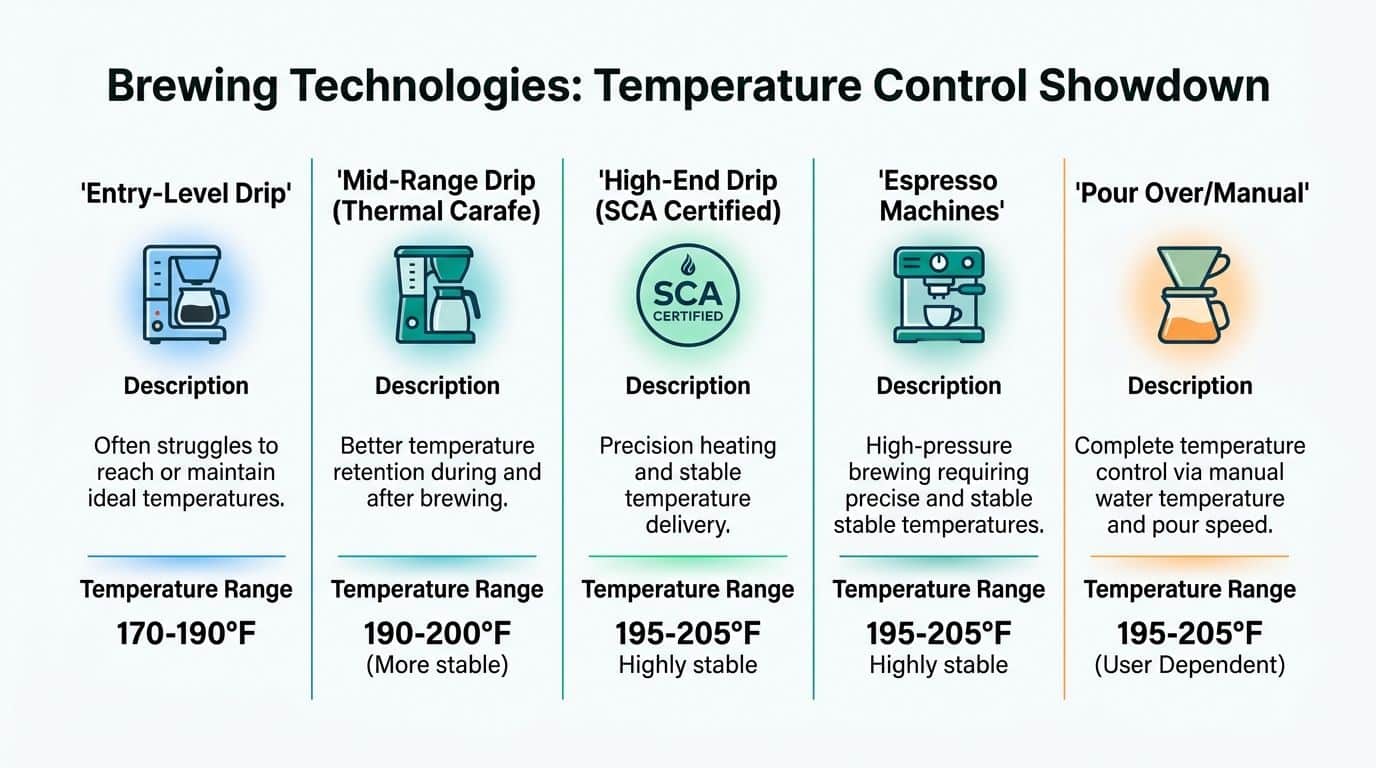
Not every brewer gives you the same control. Some machines choose the temperature for you and never explain it. Others let you adjust it directly. Espresso machines aimed at enthusiasts often manage heat far more actively than pod brewers.
That difference matters because it tells you what kind of troubleshooting will work. If your machine has fixed brew behavior, you'll solve more problems with maintenance, grind, and dose than by hunting for temperature settings that don't exist.
Pod machines and what they can actually do
Many Keurig owners assume every model has some hidden temperature menu. That's not the case. Keurig model guidance notes that only the Keurig K-Elite and K-Supreme Plus models include programmable temperature control, while models such as the K-Slim, K-Duo, and K-Classic do not.
That's a useful dividing line:
| Brewer type | What temperature control usually looks like | What this means for you |
|---|---|---|
| Basic pod brewer | Fixed brew behavior | Focus on maintenance, water quality, pod fill, and cup size |
| Advanced pod brewer | Some user adjustment | You can fine-tune taste within the machine's allowed range |
| Espresso machine with PID | Active, tight control | Heat stability becomes a real feature, not a marketing phrase |
If you're brewing on a fixed-temperature machine, don't waste time trying to force it into an espresso-style workflow. Work within its strengths. Use an appropriate grind, avoid overfilling reusable pods, and keep internal parts clean.
Why espresso machines feel more consistent
PID-equipped espresso machines manage heat much more tightly. According to Pro Coffee Gear's explanation of PID control, a PID system can reduce brew water fluctuations to within ±0.5°C of the target temperature by constantly reading the boiler and adjusting heater power in real time.
That tighter band changes the experience. Mechanical thermostats wait for temperature drift, then react. A PID controller keeps nudging the system before the swing gets too large. In the cup, that usually shows up as repeatability. One shot tastes more like the next shot.
If your pod brewer feels inconsistent, that doesn't mean it's broken. It means it was built for convenience first, not the kind of thermal precision an enthusiast espresso machine delivers.
A useful comparison for home brewers
Some people move from pod coffee into French press or manual brewing because they want more control over variables. That can make sense. It also means you become the heating system, timing system, and extraction manager all at once. If you're weighing that jump, this overview of what a French press coffee maker is helps clarify what changes when you leave automated brewing behind.
The key takeaway is simple. Know your machine category first. Once you know whether your brewer has fixed, adjustable, or actively managed temperature control, your next steps become much clearer.
The Hidden Temperature Killers Inside Your Machine
A coffee maker can leave the factory working properly and still produce lousy coffee later because its internal pathways get dirty. That decline sneaks up slowly. The machine still turns on, still pushes water, and still looks normal from the outside.
Inside, the story can be different. Hard water leaves mineral residue. Old filters restrict flow. Narrow passages collect buildup. The result is weaker heat transfer and less stable brewing.

Why buildup changes brew performance
Scale acts like a barrier between the heating element and the water you want heated. The machine may still be working hard, but the heat doesn't move as efficiently. That leaves you with coffee that tastes underdeveloped, especially if the brewer already operates with limited thermal headroom.
Flow problems make things worse. If water moves irregularly through a clogged path, extraction gets less predictable. Some grounds get enough contact. Others don't. The cup can taste both weak and harsh, which confuses people because those flaws seem contradictory.
A similar principle shows up in other equipment. This expert guide on motor overheating explains how stress, insulation, and blocked performance pathways can push machines away from normal operation. Coffee makers aren't industrial motors, of course, but the maintenance lesson is familiar. When internal components can't transfer energy properly, performance drifts.
What to inspect before blaming the machine
A few checks tell you a lot:
- Reservoir and water quality: If you're using hard tap water, scale is more likely to form and keep returning.
- Filter condition: A spent or clogged filter can reduce clean flow and contribute to stale taste.
- Needles, pod holders, and brew paths: Coffee residue can interfere with normal water movement.
- Descaling history: If you can't remember the last cleaning cycle, that's already a clue.
Here's a useful visual walkthrough before you start cleaning more thoroughly:
What works and what doesn't
Wiping the exterior helps appearance, not brewing. Rinsing the reservoir helps a little, but it won't remove internal mineral deposits once they've formed. Running repeated plain-water cycles can flush loose residue, but it won't reliably clear stubborn scale.
What does work is a proper descaling routine and consistent filter replacement. If your Keurig has started producing coffee that tastes weaker or cooler than usual, this step-by-step guide to descaling a Keurig machine for a better coffee taste is worth following.
Maintenance problems often masquerade as “bad beans” or “a cheap machine.” The brewer may just need clean internal surfaces and unrestricted water flow again.
If you use reusable pods, maintenance matters even more. Finer grinds and coffee oils can leave more residue behind than sealed commercial pods, so small lapses in cleaning show up faster in the cup.
Practical Troubleshooting for a Perfect Brew
If your coffee tastes wrong, don't change five things at once. Test the machine first, then test your brew setup.
A lot of people treat temperature like the only variable because it sounds scientific and easy to blame. Sometimes that's right. Sometimes it sends you in circles while the actual issue is grind size, dose, or a neglected machine.
Start with the brewer
First, brew plain hot water into a preheated mug or measuring vessel and check it quickly with an instant-read thermometer. You're not trying to run a lab. You're looking for a practical answer to a practical question. Is the machine delivering obviously low heat, or is it in the expected neighborhood?
If the water seems clearly lukewarm, maintenance is the first move. Descale the machine, check the filter, and clean any brew-path parts your model allows you to access.
If you own a Keurig model with hidden settings, check those too. A Keurig high-altitude walkthrough shows that enabling the High Altitude setting on machines such as the K-Select and K-Elite lowers brew temperature by about 5°F, and the setting is accessed by holding the Strong button and a cup-size button like 8 oz or 10 oz for 3 seconds from the off position.
Then check the coffee itself
If temperature looks reasonable and the cup still tastes bad, shift your attention. Many guides, however, stop too early here.
The coffee science community has highlighted an important nuance. The Coffee Science Foundation's discussion of UC Davis findings notes that coffee brewed at 87°C (189°F) could be indistinguishable from coffee brewed at 93°C (199°F) when grind, ratio, and flow rate were adjusted to keep extraction and strength constant. That doesn't mean temperature doesn't matter. It means temperature alone may not fix the cup once the rest of the brew variables are working against you.
If your machine is hot enough, your next suspects are usually grind size, coffee amount, and flow restriction.
A better troubleshooting sequence
Try this order instead of guessing:
Confirm the machine isn't brewing unusually cool
Check hot water output quickly after brew starts. If it seems low, clean and descale before changing coffee variables.Review your cup size choice
A larger cup size on a pod brewer can stretch the same coffee too far and make the result seem weak.Adjust the grind for reusable pods
If the coffee tastes sour or thin, your grind may be too coarse. If it tastes muddy or bitter, it may be too fine or packed too tightly.Check the fill level
Reusable pods often fail because people overpack them. Water needs room to move through the bed evenly.Look at water-to-coffee ratio
If you're using a Ninja or another ground-coffee brewer, a small ratio change can matter more than another degree or two of water heat.
What I'd change first on common machines
For a Keurig with reusable pods, I'd check pod fill and grind before chasing obscure temperature theories. For a Ninja drip or DualBrew setup, I'd look closely at ratio and basket behavior. For an espresso machine, I'd trust the machine's thermal system first if it has stable control, then evaluate puck prep and shot time.
That's the practical lesson most home brewers need. Temperature control matters. It just isn't the only lever that shapes taste.
Your Action Plan for Consistently Great Coffee
A good cup doesn't come from obsessing over one variable. It comes from getting the whole process under control, starting with the parts that create the biggest swings in taste.
For most home brewers, the action plan is straightforward. Know what your machine can and can't control. Keep the internal water path clean. If the coffee still tastes wrong after that, fix the brew recipe instead of endlessly blaming temperature.
The smart checklist
Use this as your baseline routine:
- Match expectations to your brewer: A basic pod machine won't behave like a PID espresso setup, so troubleshoot accordingly.
- Protect heat transfer: Descale regularly and don't ignore signs of slower brewing or flatter taste.
- Replace filters on time: Fresh filtration helps flavor and helps reduce the conditions that make maintenance harder.
- Tune the brew variables: For reusable pods and ground-coffee systems, grind and ratio often decide whether a cup tastes lively or lifeless.
A replacement filter and a descaling product are the two accessories that make the most practical difference for everyday brewers. They don't make coffee “premium” by themselves, but they help your machine perform the way it was meant to.
Premium accessories versus generic alternatives
A lot of people think all compatible filters and maintenance products are interchangeable. They aren't. Fit, material quality, and consistency matter, especially with Keurig and Ninja accessories.
| What you're buying | Premium option | Generic alternative |
|---|---|---|
| Water filter | Designed for cleaner fit and predictable water flow | Can fit loosely or inconsistently |
| Reusable pod | Easier cleaning and more consistent basket shape | Can vary in mesh quality or fit |
| Descaler | Built for brewing equipment maintenance | Can feel like a one-size-fits-all compromise |
The most common objection is simple. “A filter is a filter.” In practice, poor-fit accessories can leak, sit unevenly, or create small annoyances that keep showing up in the cup. Cheap reusable pods can also make troubleshooting harder because you can't tell whether the bad taste comes from your coffee or from the accessory itself.
Here's a quick look at a retailer focused on this category:

The bigger point is consistency. Better accessories remove variables. That makes it easier to diagnose your brew and keep it tasting the way you want.
Better coffee comes from fewer weak links. Clean machine, proper fit, sensible recipe.
If your coffee has been disappointing lately, don't start over from scratch. Start with the machine, then the water path, then the brew recipe. That sequence solves more problems than chasing a perfect number on a thermometer.
If you're ready to stop fighting inconsistent brews, shop PureHQ Inc. for compatible water filters, reusable pods, and descaling supplies that help Keurig, Ninja, and other home coffee machines brew more cleanly and consistently.

