
Coffee Machine Care
How to Clean a Keurig Filter for a Flawless Brew Every Time
Jan
Did you know that your coffee maker is likely one of the top five germiest spots in your entire kitchen? If your daily brew has started tasting bitter, weak, or just plain off, the problem isn't your coffee beans—it's a dirty filter silently breeding germs and ruining the flavor.
That funky, chalky taste is a warning sign. Your Keurig’s water filter is clogged and failing, allowing chlorine, mineral scale, and even mold to flow directly into your mug. You bought a Keurig for a perfect, convenient cup of coffee, but now you’re left wondering why it tastes worse than day-old gas station sludge. Neglecting this simple cleaning task doesn't just lead to a disappointing morning; it slowly damages your machine from the inside out.
The good news is that restoring that rich, smooth coffee flavor is incredibly simple. By following a quick cleaning and replacement routine with the right high-quality filters, you can eliminate contaminants, protect your machine’s longevity, and guarantee a perfect brew every single time. Combine this with our powerful descaling solution, and you'll have a complete maintenance system that keeps your brewer in peak condition.
Is Your Keurig Filter Ruining Your Coffee?
That weird, chalky taste isn't just in your head. When your Keurig's water filter gets clogged, it stops doing its one job: filtering out the junk. Instead, it lets chlorine and mineral deposits from your tap water flow right into your cup, creating that bitter flavor.
But it’s not just about taste. This neglect creates a surprisingly gross breeding ground for germs.
Did you know coffee makers consistently rank among the top five germiest appliances in the kitchen when they aren't cleaned regularly? It gets worse. Mold can contaminate up to 80% of uncleaned water reservoirs in just a few weeks, which is why a good cleaning routine is non-negotiable for your health.
The good news? This is a completely preventable problem. A simple cleaning and replacement schedule will keep contaminants out and bring back your coffee’s rich, smooth flavor. This little bit of maintenance also protects your machine’s internal parts from damaging scale buildup, helping it run smoothly for years. For the best results, pair your clean filter with a regular descaling cycle to knock out any lingering mineral deposits.
It’s simple, really: your coffee is over 98% water. If that water is bad because of a dirty filter, even the most expensive gourmet beans can’t save your brew from tasting flat or sour.
A clean machine is the foundation of a great cup of coffee. To get the most out of your brewer, it's worth knowing the common pitfalls that can mess with its performance. Check out our guide on the 7 mistakes you might be making with Keurig water filters to make sure every single cup is perfect.
Cleaning Your Keurig's Charcoal Water Filter
Ever notice your daily brew tasting a little… off? If it's flat, or has a faint chalky aftertaste, the culprit is often hiding in plain sight: the small, unassuming charcoal water filter inside the reservoir.
This little guy is your machine's first line of defense against impurities. But when it gets old and clogged, it stops being the solution and starts being the problem. A neglected filter doesn’t just make for a weak, slow brew; it lets mineral-laced water flow straight into your cup and, worse, into the guts of your machine.
It's not just a taste issue—it's about the health of your brewer. Over time, that old filter allows hard water minerals to build up internally, which can lead to damage. The same principle applies in professional settings, where high-performance commercial water filtration systems are non-negotiable for both flavor and equipment longevity.
The fix is simple: a consistent replacement routine. First, you have to find it. In most Keurig models like the K-Classic or K-Supreme, the filter assembly is attached to a handle inside the water reservoir. Just lift the handle, and the whole unit comes right out.
Replacing Your Filter for a Perfect Brew
Once you have the filter holder out, pop open the bottom clip to release the old charcoal pod. Toss it.
Before you pop in a new one, here's a crucial step most people miss: soak the new PureHQ filter in a cup of fresh water for about five minutes. This "activates" the charcoal and gets rid of any harmless loose dust from shipping. While it's soaking, give the plastic holder a good wash with warm, soapy water to get rid of any grime or potential mold.
Forgetting this simple task is the root cause of so many common coffee complaints.
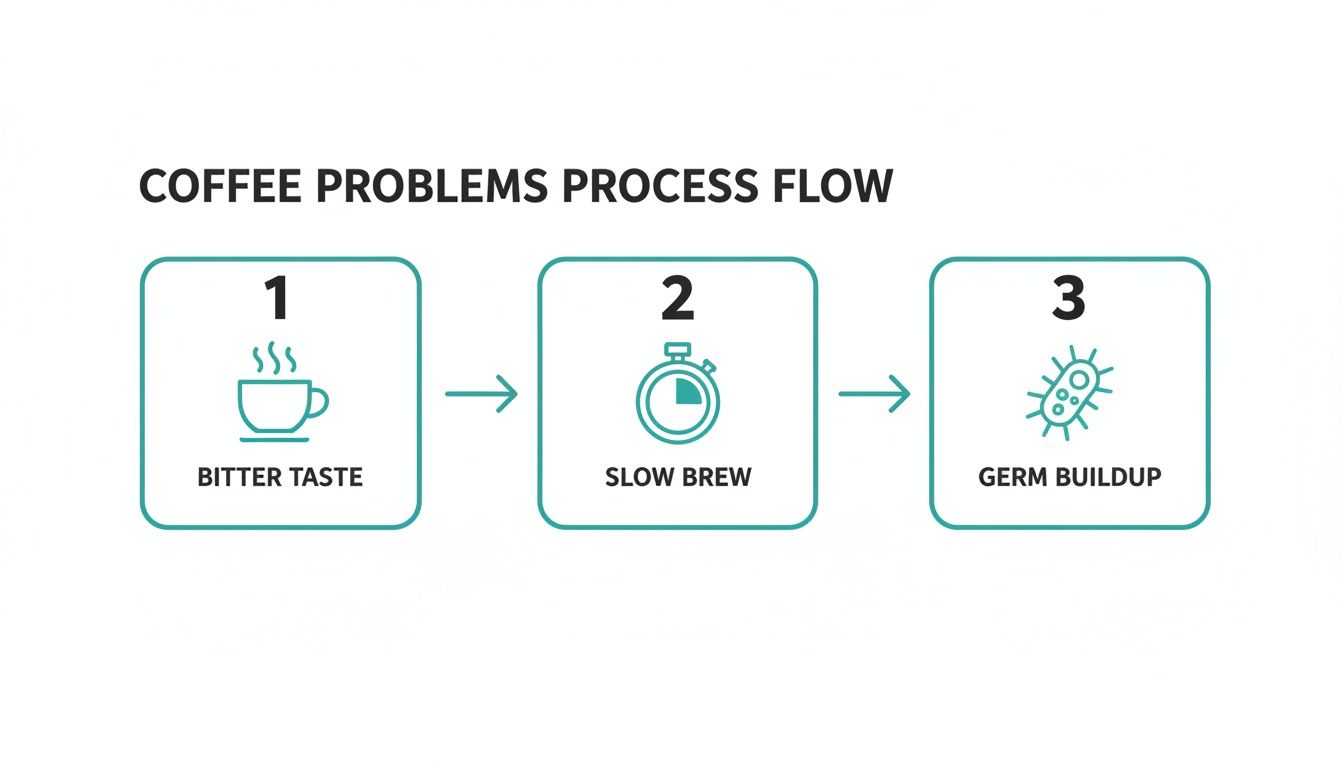
As you can see, a dirty filter is a direct path to bitter coffee, slow brewing, and germ buildup. Proper filter care isn't just a suggestion; it’s essential. We've heard people complain that some third-party filters don't fit well, allowing unfiltered water to sneak past. That's why PureHQ filters are engineered for a perfect, tight seal, ensuring every drop gets purified.
Pro Tip: Don't guess when to replace your filter. To maintain peak performance, swap it out every 60 days. After 90 days, an old filter can cause brew temperature to drop by 10-15°F and slow the flow in 65% of machines.
This one habit makes a massive difference. Data actually shows that people who use filtered water consistently end up descaling their machines 40% less often. That’s a huge time-saver.
A clean filter is the foundation of great coffee. If you're ready to taste the difference, shop our premium PureHQ charcoal water filters today and get that rich, full flavor back in your cup.
Properly Cleaning Your Reusable K-Cup Filter
Switching to a reusable K-Cup is a smart move for your wallet and the planet. But if your coffee suddenly tastes weak, muddy, or just plain off, your filter is the likely culprit. Over time, microscopic coffee grounds and oils bake onto the fine metal mesh, creating a stubborn, flavor-killing residue.
Let’s be honest, a quick rinse under the tap isn't going to cut it. That buildup forces water to channel through the path of least resistance, which means you get under-extracted, watery coffee. You might even find a silty sludge at the bottom of your mug. Even worse, a perpetually damp, dirty filter can become a breeding ground for germs, tainting every single cup you brew.
You didn't switch to a reusable filter just to end up with a worse-tasting, less hygienic cup of coffee. The good news is, a proper deep clean is simple.
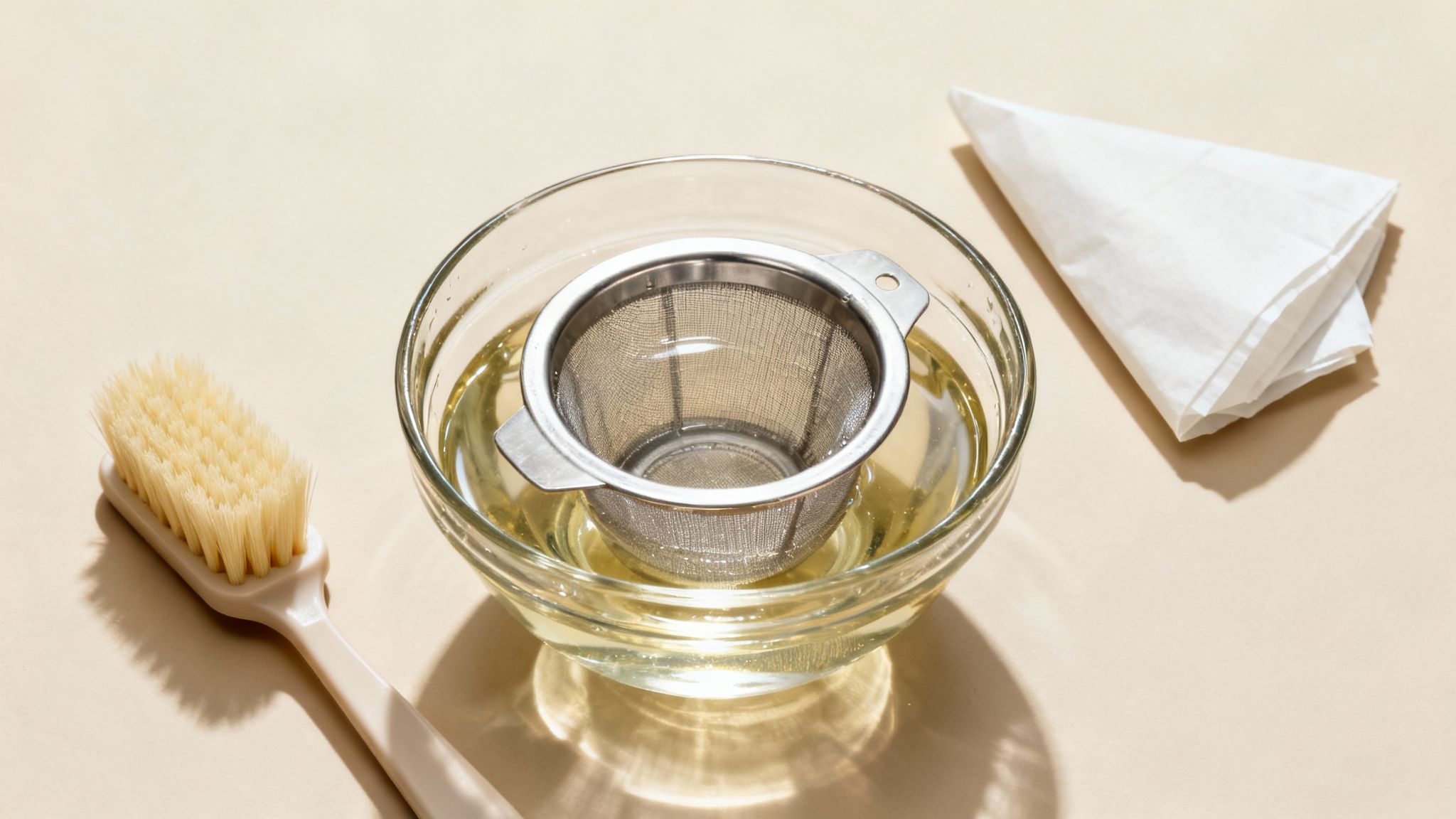
The solution is to soak the filter in a solution of equal parts white vinegar and warm water. Let it sit for about 30 minutes. The acidity in the vinegar works like magic, breaking down those caked-on oils and mineral deposits without any harsh chemicals.
A Deeper Clean for Better Taste
After its bath, grab a soft brush (an old toothbrush is perfect for this) and gently scrub the inside and outside of the mesh. This is what dislodges any particles the soak loosened up. Give it a thorough rinse with fresh water and—this part is important—let it air dry completely before you use it again.
Pro Tip: For an even easier daily cleanup, pop one of our disposable paper filters inside your reusable K-Cup. It catches the grounds, making your day-to-day rinse-out a breeze while still letting all the rich coffee flavors pass through.
A common worry is that reusable filters, especially off-brand ones, might break down or warp over time. While that can happen with cheaply made options, PureHQ’s reusable filters are made with durable, surgical-grade steel mesh. This material is designed to resist clogging and stand up to daily use and regular deep cleaning.
When you’re weighing your options, it helps to understand the larger coffee pod versus ground coffee debate to really appreciate the balance between convenience and quality. For more pointers on getting the absolute best performance from your filter, check out our guide on using reusable K-cups effectively.
Ready to upgrade to a reusable filter that’s built to last and a cinch to clean? Shop our durable PureHQ Reusable K-Cup Filters today.
How Filter Cleaning and Descaling Work Together
Think of your Keurig’s filter and its descaling cycle as a one-two punch against bad coffee. A clean charcoal filter is your first line of defense, catching chlorine and other impurities right out of the tap. But what about the microscopic minerals that sneak through, especially if you have hard water?
That’s where the real trouble begins. Over time, these minerals form a stubborn, chalky buildup called scale inside your machine's heating element and internal tubes. This is why, even with a fresh filter, your coffee might start tasting bitter or brewing lukewarm.
The scale forces your machine to work harder, slowing it down and eventually leading to clogs or total failure. This is where descaling becomes your secret weapon. The process uses a gentle acidic solution to dissolve that hidden mineral buildup, flushing it out and restoring your brewer to peak performance.
The Teamwork of Clean Filters and Descalers
It's a common mistake to think these two tasks are interchangeable, but they have distinct jobs that support each other. A clean filter reduces the amount of minerals entering the system in the first place, which means you can go longer between descaling sessions. Descaling, in turn, cleans the parts the filter can't reach, ensuring the water flowing to your coffee pod is pure and hot.
One critical step to remember: always remove the charcoal water filter from the reservoir before you start a descaling cycle. The acidic descaling solution can damage the charcoal, making it totally ineffective.
Descaling your Keurig is a game-changer for its health and your coffee's taste. Experts suggest that in areas with hard water, descaling should happen every 6-8 weeks. A proper solution, like PureHQ’s universal descaling formula, rinses away up to 95% of the calcium deposits that cause performance issues. For a deeper dive, read more insights on how often you should descale your machine.
This teamwork between filter changes and regular descaling is the key to a long-lasting, reliable machine. Neglecting either one will eventually lead to frustrating performance problems. By pairing our PureHQ filters with our descaling solution, you create a complete maintenance routine that keeps your Keurig running like new.
Comparing PureHQ Filters to Standard Alternatives
When you're trying to figure out how to clean a Keurig filter, the quality of the filter itself makes all the difference. We've all been there: you grab a cheaper reusable K-Cup from a big-box store, only to have it warp or crack after a few weeks. Suddenly, you're left with a weak, gritty brew and the hassle of buying another one.
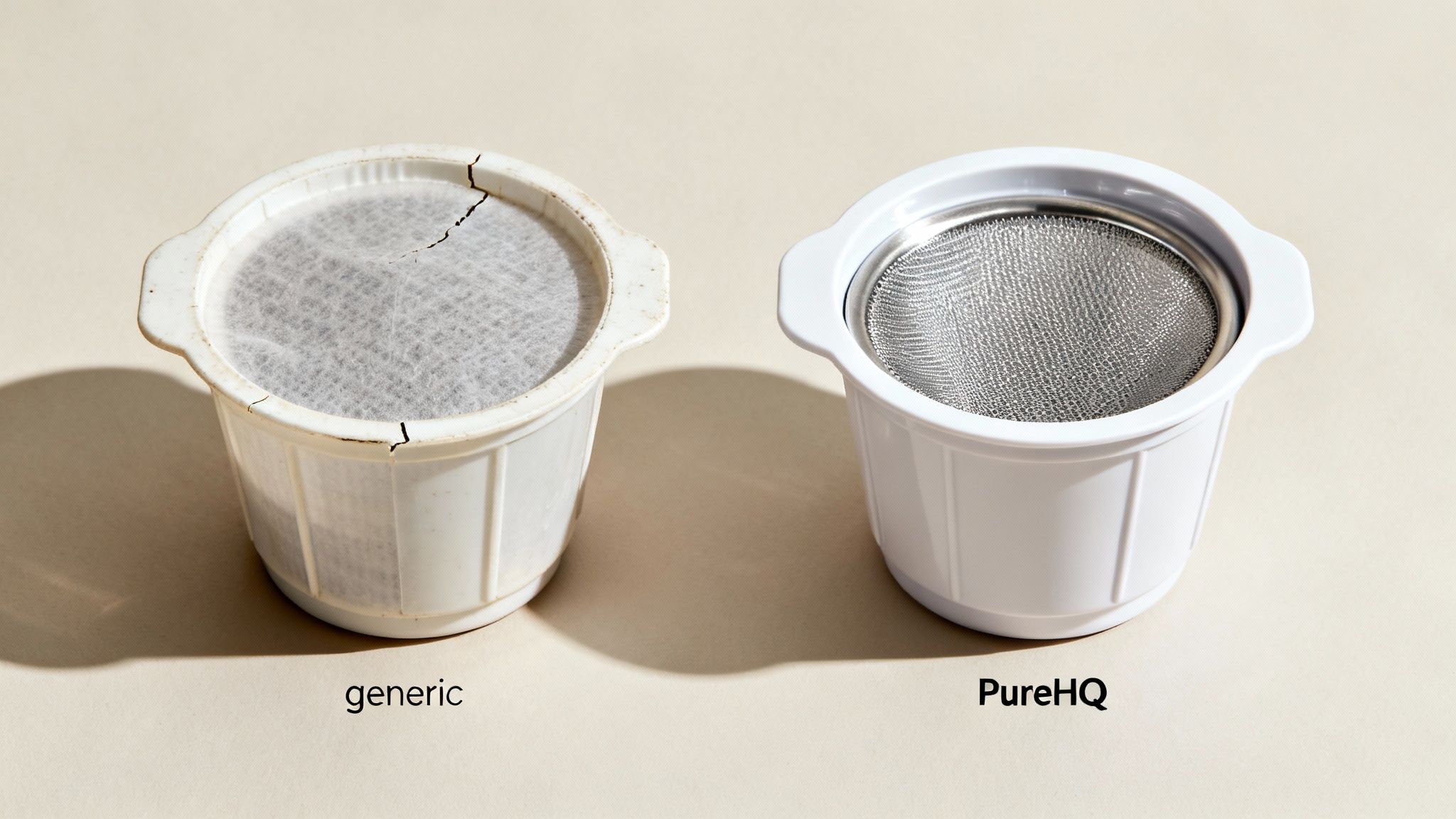
This experience is incredibly common. The few dollars you save on a generic alternative quickly disappear when you’re forced to replace it multiple times a year. It's a frustrating cycle that's not just a waste of money—it's a daily compromise on the quality of your coffee.
The real solution is investing in accessories designed for longevity and performance from the start. We engineered PureHQ filters with premium, durable materials to solve these exact problems.
Durability Meets Performance
We hear one concern all the time: durability. People worry that third-party filters just won't last. That’s precisely why our reusable K-Cups are made with tough, BPA-free plastics and a surgical-grade steel mesh that resists clogging and stands up to daily cleaning without warping. Our charcoal water filters aren't flimsy, either; they use a high-grade, micro-mesh material for seriously superior filtration.
Choosing a premium filter means your coffee is cleaner and tastes better. It also means you’re not throwing away a flimsy, broken accessory every few months.
When you're ready for a complete maintenance overhaul, you can pair your new filters with our powerful universal descaling solution to keep your entire machine running like new.
The table below breaks down exactly what sets our filters apart from the standard options you find everywhere else.
PureHQ Premium Filters vs Standard Alternatives
| Feature | PureHQ Premium Filters | Standard/OEM Filters |
|---|---|---|
| Material Quality | Surgical-grade steel mesh & BPA-free plastics | Thinner, lower-grade plastics; prone to warping |
| Filtration | Fine micro-mesh for superior sediment and chlorine removal | Standard mesh that may allow finer grounds to pass through |
| Durability | Engineered to withstand daily use and cleaning for years | Often crack, stain, or clog after a few months of use |
| Compatibility | Precision-molded for a leak-free, perfect fit in specified Keurig models | "Universal" fit that can be loose, leading to leaks and brew errors |
| Long-Term Value | Higher initial cost but lower lifetime cost due to longevity | Low upfront cost but requires frequent replacement |
As you can see, the difference isn't just about how long the filter lasts—it's about the quality of every single cup of coffee you brew.
Ready to stop the cycle of replacing cheap, ineffective filters?
Shop PureHQ's premium Keurig filters today and taste the difference quality makes.
It All Comes Down to a Better Cup of Coffee
You've got the roadmap. No more bitter coffee, no more slow brews, and no more wondering what kind of gunk is hiding inside your Keurig. Following these cleaning routines isn't just about machine maintenance—it’s about reclaiming that perfect, consistent cup you deserve every single morning.
Let's be honest, nobody wants to start their day with subpar coffee. That unpleasant chalky taste is your brewer practically screaming for a little TLC. A clean filter is where it all starts, but pairing that with a powerful descaling solution is what truly gets the job done, flushing out every bit of mineral buildup that can kill your machine and your mood.
It's time to elevate your daily ritual and protect the coffee maker that gets you through the day. Ready to taste the difference a truly clean machine makes?
Explore our full range of PureHQ filters and cleaning solutions now.
Your Keurig Filter Questions, Answered
Ever notice your coffee tasting a little… off? That stale, almost chalky flavor can sneak up on you. More often than not, the culprit is a forgotten charcoal water filter. When that little filter gets clogged with impurities like chlorine and minerals, it stops doing its job.
This doesn't just ruin the taste of your expensive coffee beans. It makes your Keurig work harder, leading to slower brews and the dreaded scale buildup that can damage your machine over time.
You bought your Keurig for convenience and a great cup of coffee, not for frustrating performance issues. Let's tackle the most common questions so you can get back to a perfect morning ritual.
How Often Should I Clean My Reusable Filter?
For the best flavor, a quick rinse of your reusable K-Cup after every single use is non-negotiable. It only takes a second to get those fresh grounds and oils out before they have a chance to stick around.
Once a week, give it a deeper clean. Just soak the filter in a 50/50 solution of white vinegar and water for about 30 minutes. Then, gently scrub the mesh with a soft brush and let it air dry completely before popping it back in.
Can I Use My Keurig Without a Water Filter?
Technically, yes, but it's a really bad idea—especially if you have hard water. That little filter is your first line of defense against minerals that cause scale and impurities that mess with the taste.
Brewing without one just means you'll have to descale your machine much more frequently to prevent clogs and protect the internal heating elements. It's an easy step to avoid a much bigger headache later.
What Happens If I Forget to Change My Filter?
Look, we've all done it. Forgetting for a couple of weeks won't kill your machine, but making it a habit has consequences. The charcoal will stop filtering effectively, and you'll notice a real drop in coffee quality.
More importantly, it fast-tracks mineral buildup. That's what leads to slower brewing, lukewarm coffee, and eventually, clogs that can require a frustrating repair. Sticking to a two-month replacement schedule is the simplest insurance policy for your brewer and your brew.
At PureHQ Inc., we believe great coffee starts with clean water. Stop compromising on taste and protect your machine with filters designed for peak performance.
Shop PureHQ’s premium Keurig filters today and taste the difference.

