
Coffee Machine Care
How Often Should You Clean Your Coffee Maker? A Guide to a Better, Safer Brew

Jan
Did you know that 50% of household coffee makers are hiding a dirty secret? A study by NSF International found that half of the machines they tested had yeast and mold growing in their water reservoirs. That first sacred sip of morning coffee might be delivering more than just caffeine—it could be teeming with bacteria that thrive in the warm, damp environment of an uncleaned machine.
This isn't just about a "yuck" factor; it's a genuine health concern. Every time you brew, sticky coffee oils and hard water minerals get left behind, creating a grimy film that becomes a perfect breeding ground for germs. This buildup not only ruins the taste of your expensive coffee beans, making them bitter and sour, but it also forces your machine to work harder. The result? A sputtering, lukewarm brew, and a brewer that's slowly choking to death from the inside out. You invested in a great machine for a perfect cup, not a daily dose of disappointment and potential illness.
But there’s a simple, powerful solution that doesn’t involve complicated, time-consuming chores. A consistent cleaning and descaling routine is the key to unlocking a safer, better-tasting brew and ensuring your coffee maker lasts for years. By setting up a simple schedule, you take back control, turning that daily ritual back into the pure, enjoyable experience it's supposed to be.
What's Really Brewing in Your Coffee Maker
That first sip of coffee in the morning is sacred. It's the ritual that kicks off the day. But what if that comforting brew is hiding an unpleasant secret? The truth is, the warm, damp guts of your coffee maker are a perfect playground for stuff you'd never want in your cup.
This isn't just a hunch; it's a documented problem. A shocking study by NSF International found that a whopping 50% of household coffee makers they tested were teeming with yeast and mold inside their water reservoirs. That statistic alone shows just how fast things can get gross in your Keurig or Ninja DualBrew if you let cleaning slide. You can read more about their coffee machine findings on their website.
The Problem Beyond Bad Taste
Every time you brew, two things get left behind: natural coffee oils and mineral scale from your water. These residues don't just vanish. They build up, creating a sticky film and a hard, crusty layer inside your machine's hidden tubes and chambers.
This buildup causes a few nasty problems:
- It's a breeding ground: Moisture, warmth, and old coffee gunk are an open invitation for bacteria, yeast, and mold.
- It ruins your coffee's flavor: Old, rancid coffee oils make your expensive beans taste bitter and sour, completely overpowering their actual flavor notes.
- It wrecks your machine: Limescale—that chalky stuff from hard water—clogs up the internal parts. This forces your Keurig or Ninja to work harder, leading to slow brewing, lukewarm coffee, and eventually, a total breakdown.
The question of how often to clean your coffee maker isn't just about a perfect cup. It's about your health, flavor, and protecting the machine you paid good money for. An unclean coffee maker delivers a bad experience and can easily become a hidden health hazard in your kitchen.
The Simple Solution to a Purer Brew
Thinking about all this—from potential health risks to the daily disappointment of a bad cup of coffee—can feel a little overwhelming. You might worry that keeping your machine pristine requires some complicated, time-sucking chore.
But the solution is way simpler than you think.
A consistent cleaning and descaling routine is the key to unlocking a safer, better-tasting brew and making sure your coffee maker lasts for years. By setting up a simple schedule, you take back control over your machine’s health and your coffee’s quality, turning that daily ritual back into the pure, enjoyable experience it's supposed to be.
Your Custom Coffee Maker Cleaning Schedule
Figuring out how often to clean your coffee maker isn't a one-size-fits-all deal. The perfect schedule really boils down to your daily habits and, believe it or not, the water coming out of your tap. The two big players here are how often you brew and the mineral content (or "hardness") of your local water.
Think of mineral scale inside your machine like plaque slowly building up in arteries. At first, you don't notice a thing. But over time, this limescale silently chokes the internal pathways, messes with water flow, insulates the heating element, and puts a serious strain on your brewer.
Factors That Define Your Cleaning Frequency
That simple morning ritual is a bit more complex inside the machine. Nailing down the right cleaning schedule for your Keurig, Ninja, or classic drip machine means finding the right balance between these two key factors:
- Daily Usage: A single morning cup creates way less residue than a machine cranking out coffee all day in a busy home or a small office. The more you use it, the faster coffee oils and fine grounds build up.
- Water Hardness: This is the invisible enemy. Hard water is loaded with dissolved minerals like calcium and magnesium. When heated, these minerals crystallize and form that tough, chalky limescale that clogs everything up.
Water hardness dictates your descaling frequency more than you might realize. If you live in a city with soft water like Seattle (around 15 parts per million), you might only need to descale every three or four months. But in hard-water hotspots like Phoenix (over 280 ppm), that schedule jumps to every few weeks just to prevent damage.
Why the huge difference? Scale from water with over 120 ppm of minerals can grow 0.18 mm per month inside your brewer's boiler. That insulates the heating elements and can spike its energy use by up to 20%. You can learn more about how water hardness affects your coffee pot on TastingTable.com.
Recommended Cleaning and Descaling Frequency
Not sure where to start? This table is a great quick reference. Just find your water type and daily usage to see a recommended cleaning and descaling schedule.
| Water Hardness | Daily Usage | Daily Cleaning | Weekly Cleaning | Descaling Frequency |
|---|---|---|---|---|
| Soft Water | 1–2 Cups | Rinse carafe & brew basket | Wash all removable parts with soap and water | Every 3–6 months |
| Soft Water | 3+ Cups | Rinse carafe & brew basket | Wash all removable parts with soap and water | Every 2–3 months |
| Hard Water | 1–2 Cups | Rinse carafe & brew basket | Wash all removable parts; wipe down exterior | Every 1–2 months |
| Hard Water | 3+ Cups | Rinse carafe & brew basket; wipe down exterior | Wash all removable parts; wipe down exterior & drip tray | Every 3–6 weeks |
Just remember, this is a starting point. If you notice any of the warning signs below, it's time to clean, no matter what the calendar says.
Signs It Is Time To Clean Your Machine
Sometimes your coffee maker will flat-out tell you it needs a good cleaning. Not sure what to look for? This quick decision tree will help you diagnose the problem and figure out what to do next.
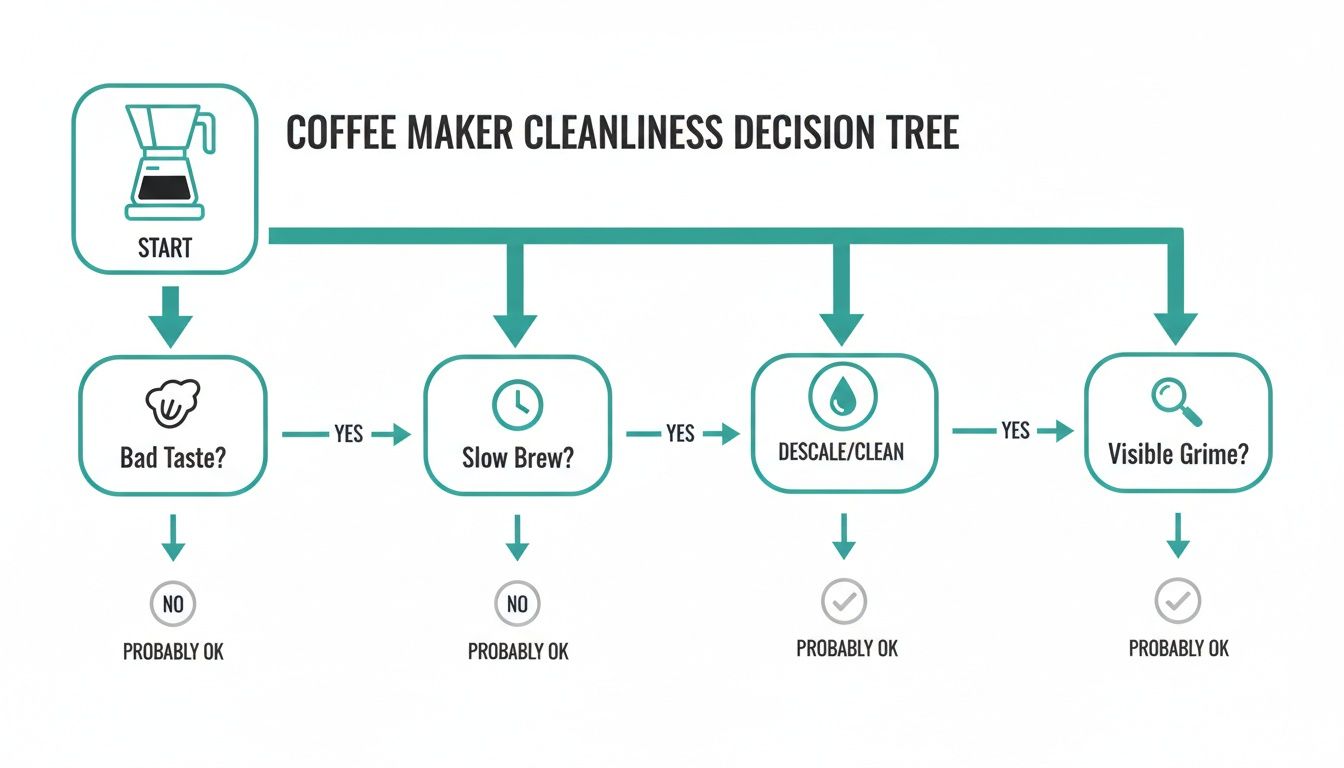
As you can see, things like a bad taste, slow brewing, or visible gunk are direct signals that your machine needs attention. The flowchart points you straight to the right fix, whether it's a simple clean or a full descale.
Key Takeaway: A personalized cleaning schedule isn't about being perfect; it's about being proactive. Staying ahead of the gunk based on your specific use and water type is the single best way to guarantee great coffee and protect your machine from dying an early death.
A consistent routine stops these problems before they even start. By pairing a quality descaler with good charcoal filters, you can seriously slow down mineral buildup and keep every single cup tasting fresh and clean.
A Practical Guide to Daily, Weekly, and Monthly Cleaning
We all know we should clean our coffee maker. But let’s be honest, figuring out how to fit it into a busy schedule without it becoming another dreaded chore is the real challenge. Most people put it off because it seems like too much work. Before you know it, that neglect allows bitter coffee oils and nasty bacteria to build up. Your coffee starts tasting "off," the machine groans and sputters, and suddenly you’re facing a much bigger, grimier problem that threatens both your morning ritual and your machine's lifespan.
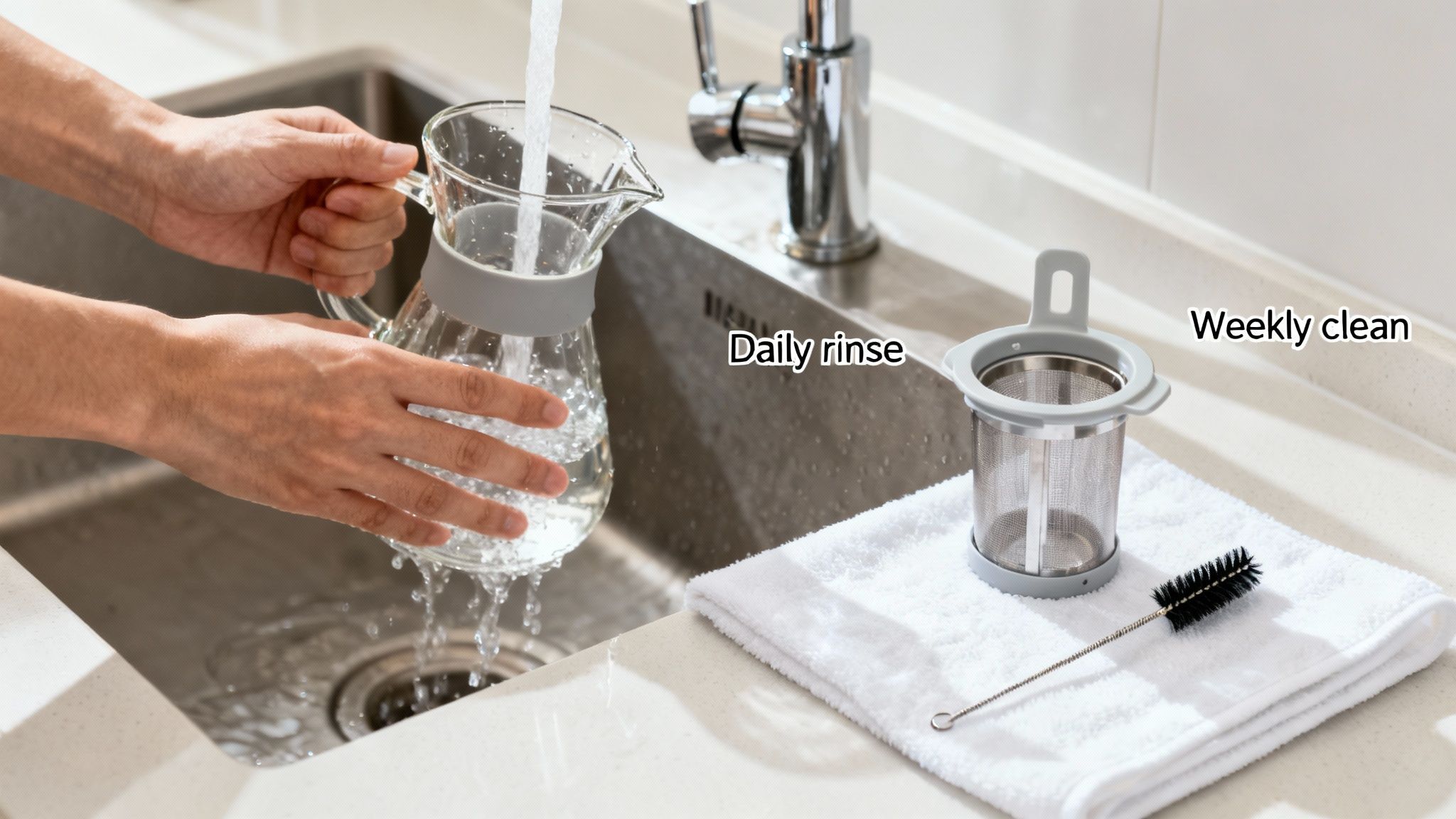
The secret isn’t a massive, hour-long scrub down. It’s breaking the job into tiny, manageable routines. By adopting a series of quick habits, you can keep your machine in peak condition, ensuring your Keurig or Ninja is always ready to brew a perfect cup without the hidden health risks.
Want to see the whole process? We've got you covered in our guide on the complete process of cleaning a coffee maker.
Your Daily 60-Second Reset
This takes less than a minute but makes a world of difference. It’s just basic kitchen hygiene, no different than rinsing your plate after dinner.
- Toss the Grounds: Immediately get rid of the used paper filter and grounds. If you use a reusable pod, empty it and give it a quick rinse.
- Rinse Removable Parts: Give the brew basket and carafe a quick rinse with hot water. This washes away fresh coffee oils before they have a chance to dry and turn rancid.
- Wipe It Down: Grab a damp cloth and wipe any coffee splashes from the exterior and the warming plate. Done.
The Weekly Deep Clean
Once a week, find five minutes. That’s all it takes to tackle the gunk your daily rinse can’t reach. This is your best defense against mold and bacteria.
For households with multiple coffee drinkers or busy office breakrooms, this weekly clean is absolutely non-negotiable. Even commercial cleaning experts agree that high-traffic machines need daily flushes and weekly deep cleans to stop bacteria from taking hold.
Pro Tip: If you're a Keurig user, this is the perfect time to clear out the exit needle. Just straighten a paperclip and gently poke it into the needle to dislodge any trapped coffee grounds that are waiting to cause a clog.
Your Monthly Descaling Ritual
This is the big one, the most important deep-cleaning task you'll do. Every 1 to 3 months—depending on how hard your water is—you need to run a descaling cycle. This is what dissolves the mineral scale that’s slowly choking your machine from the inside out. A quality descaler is your best friend here, as it's formulated to break down stubborn buildup without damaging internal parts. For an even easier cleanup, our reusable pods are designed for durability and a perfect fit, unlike flimsy alternatives that can fail and make a mess. They rinse clean in seconds, making that daily reset even faster.
Mastering the Art of Descaling Your Machine
Ever wonder what the real enemy of great coffee is? It’s not stale beans or a bad grind—it’s the invisible mineral buildup silently choking your machine from the inside. If you’ve ever waited impatiently for a lukewarm, sputtering cup of coffee, you’ve met this enemy firsthand. It’s called limescale. This chalky residue clings to your machine's internal heating elements, acting like a layer of insulation. Your brewer is forced to work harder and harder just to get the water hot. That sputtering, underperforming machine is a direct result of this mineral assault. Left alone, it leads to clogs, broken parts, and a flat, lifeless cup of coffee.
The basic principles of breaking down mineral scale are universal for any appliance that uses water. For a similar deep dive on another common kitchen machine, check out this guide on how to clean an ice maker, including descaling and sanitizing.
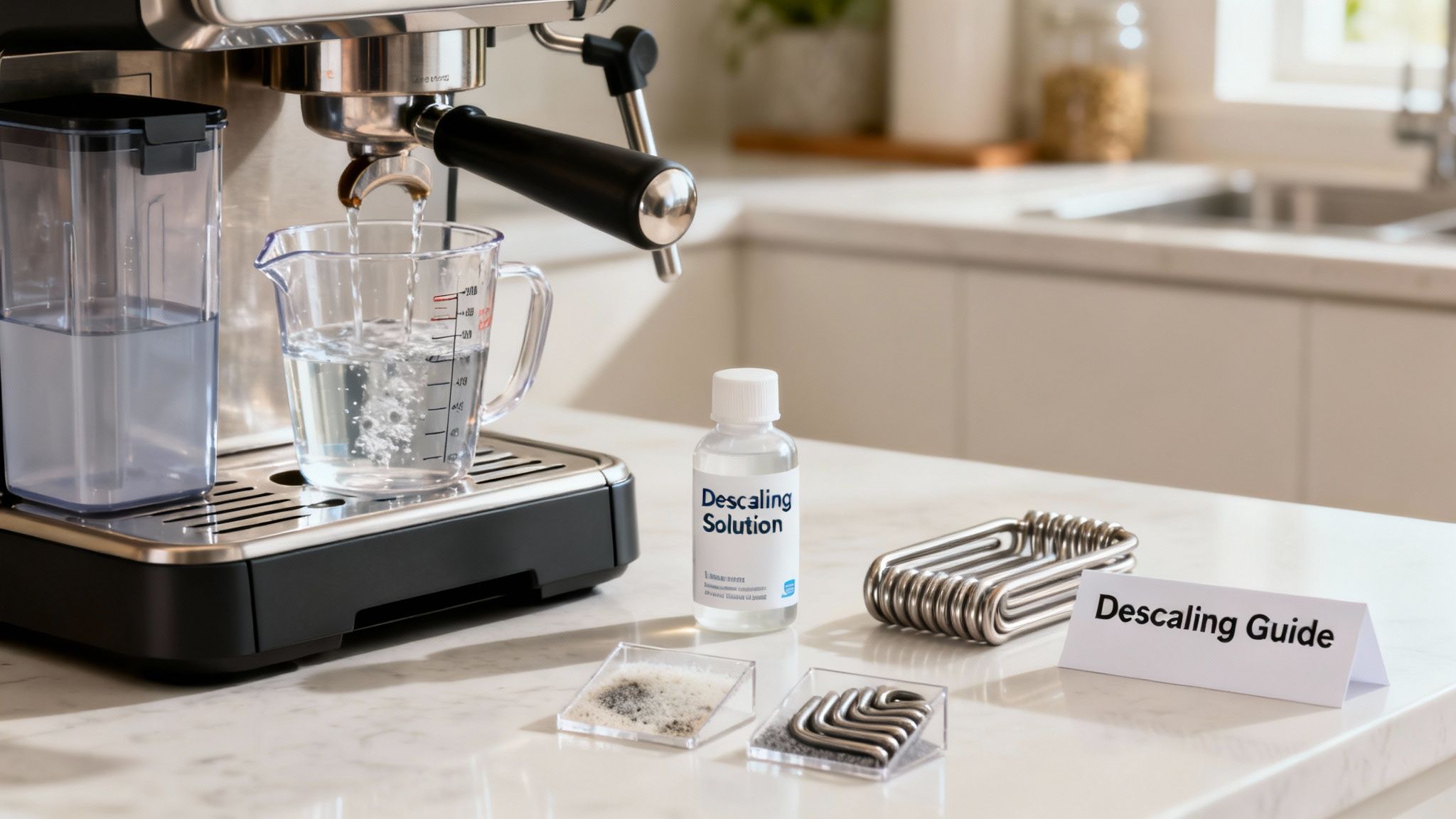
The fix is a powerful, yet gentle, deep clean that goes beyond a simple rinse. This is where a dedicated descaler comes in, chemically dissolving the scale that soap and water can't even touch. If you want to see this process in action for single-serve machines, take a look at our detailed guide on descaling a Keurig for better coffee taste.
Why a Universal Solution is a Smarter Choice
Let's be honest, nobody wants to buy overpriced, brand-specific cleaning products. Many people worry that a generic solution might not work, or worse, could even damage their brewer. It's a valid concern—some cheap descalers use harsh acids that can eat away at the delicate internal seals over time.
PureHQ’s Universal Descaling Solution hits that perfect balance. It’s specially formulated to be tough on stubborn mineral deposits while remaining gentle on your machine’s important components. The citric acid-based formula is non-toxic and rinses away completely, meaning no weird chemical aftertaste will ever ruin your next brew. For the ultimate defense, pair your descaling routine with high-quality PureHQ charcoal water filters to reduce mineral buildup from the start.
| Feature Comparison | PureHQ Universal Descaling Solution | Standard Vinegar Solution |
|---|---|---|
| Effectiveness | Formulated to rapidly dissolve heavy mineral scale. | Mildly acidic; often ineffective on severe buildup. |
| Component Safety | Non-corrosive and safe for rubber seals and O-rings. | Can degrade rubber and plastic components over time. |
| Flavor Impact | Odorless and rinses cleanly, leaving no aftertaste. | Leaves a strong odor that can require multiple rinses. |
It's time to restore your machine’s power and bring back your coffee’s true flavor. Shop PureHQ’s Universal Descaling Solution and get your brewer back to peak performance.
Why Premium Water Filters Matter
You can follow every cleaning step to the letter, use the best descaler on the market, and still pull a bitter, chalky cup of coffee. The reason is surprisingly simple: over 98% of your coffee is just water. If the water you start with is bad, your coffee doesn't stand a chance. The real problem is lurking in your tap water. Chlorine leaves behind a chemical aftertaste, while dissolved minerals are the very things that build up into the limescale we’re constantly trying to fight. The fix isn't cleaning more often—it's stopping these impurities before they ever hit your coffee grounds. This is why a high-quality charcoal water filter isn’t just an accessory; it’s your first and best line of defense.
PureHQ Filters vs Standard Options
Let's be clear: not all water filters are created equal. The standard filter that comes with your machine does a basic job, but premium filters are engineered from the ground up for far better performance. PureHQ filters use an ultra-fine grain charcoal, which creates a massive surface area to grab onto contaminants. This design is far more effective at capturing impurities and significantly reducing water hardness right at the source, which in turn slows down that dreaded scale buildup. Take a look at how a premium filter really stacks up.
PureHQ Premium Water Filters vs Standard Options
This head-to-head comparison shows how PureHQ's advanced filtration provides superior taste, machine protection, and value over standard filters or using none at all.
| Feature | PureHQ Premium Filters | Standard Manufacturer Filters | No Filter |
|---|---|---|---|
| Taste & Odor Improvement | Removes up to 97% of chlorine, dramatically improving taste and aroma. | Basic chlorine reduction, moderate taste improvement. | All chlorine and off-tastes remain, resulting in bitter coffee. |
| Limescale Prevention | Actively softens water, significantly slowing mineral buildup. | Minimal impact on water hardness and scale. | Accelerates limescale buildup, leading to frequent descaling. |
| Material Quality | BPA-free, food-grade materials with ultra-fine grain charcoal. | Standard materials with basic charcoal. | N/A |
| Value & Long-Term Savings | Protects machine internals, reducing the need for descaling and costly repairs. | Offers limited protection, leading to higher long-term costs. | Leads to premature machine failure and expensive replacements. |
As you can see, the choice makes a big difference in every cup. For an even deeper dive, you can learn more about the health benefits of using purified water in your Keurig in our dedicated article. And if you're thinking about water quality for your whole home, exploring the benefits of a whole house water filter is a great next step.
We hear this concern all the time: "I'm worried a third-party filter won't fit right and will leak." It’s a valid point, and we’ve invested heavily in precision engineering to solve it. PureHQ filters are meticulously designed to create a perfect, leak-proof seal in a huge range of popular models, from the Keurig K-Classic to the Ninja DualBrew.
To get your machine truly pristine, pair our filters with our Universal Descaling Solution during your deep cleans. This powerful but gentle formula is the perfect partner for our filters, ensuring your machine stays spotless inside and out.
Stop letting bad water ruin good coffee. Shop PureHQ’s premium charcoal water filters today and taste the difference for yourself.
Your Top Coffee Maker Cleaning Questions Answered
That little "descale" light starts blinking, and suddenly your brain is flooded with questions. You dropped good money on a great coffee machine, and now you’re terrified you’ll break it with one wrong move. This kind of uncertainty is frustrating. You jump online and find a dozen different opinions. Some people swear by vinegar; others act like it’ll dissolve your machine from the inside out. All you want are clear, straight answers to keep your coffee tasting amazing and your brewer humming along. No guesswork. That’s where we come in. We’ve pulled together the most common questions our customers ask about cleaning their coffee makers.
Can I Really Use Vinegar to Descale My Coffee Maker?
Look, while vinegar is the go-to DIY cleaner for a lot of things, we strongly recommend keeping it away from modern machines like a Keurig or a Ninja. It's just not strong enough to tackle serious limescale, and over time, that mild acidity can slowly eat away at the rubber seals and gaskets inside. But here's the bigger problem: the smell. Vinegar leaves behind a powerful odor that is incredibly tough to rinse out completely. That lingering aftertaste can ruin your coffee for days. A proper descaler like PureHQ's Universal Descaling Solution is made to dissolve tough mineral buildup without harming your machine's parts or leaving any flavor behind.
My Descale Light Is Still On After I Cleaned It. What Now?
This is easily one of the most common frustrations we hear about, especially with Keurig brewers. You went through the whole descaling cycle, and that stubborn light is still blinking. Don't panic. First, try running one or two more full tanks of fresh water through the machine. This is often enough to clear the sensor and shut the light off. If that doesn’t do it, go for a hard reset: unplug the machine from the wall, wait a full 60 seconds (seriously, count it out!), and plug it back in. That simple step often reboots the internal computer and clears the notification. For some models, there’s also a specific button combo to manually reset the light, so checking your user manual is always a good last resort.
How Do I Clean My Reusable K-Cup Filter?
For daily cleaning, it’s a piece of cake. Just dump the old grounds and give the pod a good rinse under warm, running water. Once a week or so, give it a deeper clean. Grab a soft brush and a drop of dish soap to gently scrub the mesh screen. This gets rid of any trapped coffee oils that can build up and make your coffee taste bitter. Most high-quality reusable pods, like the ones from PureHQ, are also top-rack dishwasher safe, making it super easy to sanitize. And for the fastest cleanup ever? Try our disposable paper liners inside your reusable pod—just toss the liner and give the pod a quick rinse.
What Are These Little Black Specks in My Coffee?
Finding mysterious black flecks in your cup is definitely alarming, but it usually comes down to one of two simple things.
- Coffee Grounds: If the specks look like grounds, your paper filter might have a small tear, or your reusable pod isn't sitting quite right in the holder.
- Charcoal Particles: Did you just install a new charcoal water filter? Those specks are likely harmless activated charcoal particles, which is totally normal. Just run 2-3 cycles of plain water through your machine (without a coffee pod) to flush the new filter before you brew your first cup.
At PureHQ Inc., we know that a truly great cup of coffee starts with a clean, happy machine. Stop letting maintenance worries stand between you and your daily ritual.
Explore our full range of premium water filters, reusable pods, and descaling solutions and get everything you need for a perfect brew, every single time.


Pingback: Keurig Descaling Solution Alternative: Your Guide to a Better Brew