
Coffee Machine Care
A Guide to Coffee Bean Quality and How to Taste the Difference
Apr
Does this sound familiar? You bought beautiful new coffee equipment and a bag of "premium" beans that promise notes of chocolate and citrus. You brew your first cup with excitement, but the result is just… meh. Flat, bitter, or just plain boring.
It’s an incredibly frustrating cycle. Over 74% of Americans drink coffee daily, yet so many are stuck in a loop of buying expensive beans only to be met with a disappointing, generic taste. You start to question your gear, your brewing method, and even your own taste buds, wondering if you'll ever get that coffee-shop quality at home. The problem isn't your machine or your technique; it's the hidden factors in coffee bean quality that no brewer, no matter how fancy, can fix on its own.
The solution isn't to buy a more expensive machine or follow a complicated brewing ritual. The real key to consistently fantastic coffee is learning to identify what makes a high-quality bean before you even buy the bag. This guide will pull back the curtain on coffee bean quality, turning it from an intimidating buzzword into your most powerful tool. By understanding what to look for, you can finally break the cycle of disappointing coffee and unlock the true potential of whatever machine you own.
The Hidden Factors That Define Bean Quality
You’ve probably heard coffee lovers debating Arabica versus Robusta, but that conversation barely scratches the surface of what makes a truly great coffee bean. The frustrating reality is that two different bags of 100% Arabica can give you wildly different results. One delivers a complex, aromatic cup that gets your day started right, while the other tastes flat and uninspired—leaving you wondering what you even paid for.
This happens because of the hidden factors that professional roasters and graders obsess over but are rarely printed on the bag. Without knowing what to look for, you’re essentially gambling with every purchase, hoping this next bag will finally be the one. It’s a frustrating cycle of spending good money on premium promises only to get mediocre coffee.
The solution is to look past the marketing and understand the physical traits that signal real flavor potential. Two of the most critical, yet overlooked, factors are bean density and moisture content. Grasping these concepts will change how you buy coffee forever.
Why Bean Density Is a Flavor Powerhouse
Imagine a coffee bean grown at a dizzying altitude, where the air is thin and the nights are cool. To survive, the coffee cherry is forced to mature slowly. This slow, deliberate process creates a dense, compact bean packed with complex sugars and vibrant organic acids. It's not just a bean; it's a tiny, concentrated flavor capsule waiting to explode.
Denser beans are the superstars of the coffee world. Their tightly packed cellular structure holds a higher concentration of the compounds that become sweet, intricate flavors and aromas during roasting.
In contrast, beans grown at lower altitudes mature quickly in the heat. This results in a lighter, more porous bean with less raw material for creating flavor. While still perfectly good for coffee, they just don't have the potential for the exceptional nuance you find in their high-altitude cousins.
Think of it like the difference between a sun-ripened garden tomato and a mass-produced winter one. Both are technically tomatoes, but their flavor intensity is worlds apart. The same exact principle applies to coffee bean quality.
The Role of Moisture Content
Moisture is the silent guardian of a coffee bean's potential. According to Roest Coffee, a leader in sample roasting technology, green, unroasted beans must maintain a very specific amount of water—ideally between 10% and 12%—to preserve their delicate chemical compounds. For specialty coffee, this narrow window is non-negotiable.
- Too Much Moisture (>12%): The beans become a perfect breeding ground for mold and fungus. This leads to musty, off-putting flavors that can ruin an entire batch.
- Too Little Moisture (<10%): The beans get brittle and lose their precious aromatic oils. During roasting, they can scorch easily and produce a thin, lifeless cup that tastes stale from the moment it’s brewed.
Hitting this perfect moisture balance is a testament to the skill of the farmer and processor. It ensures the bean arrives at the roastery in peak condition, ready for its full flavor to be unlocked.
This is also a crucial reminder of why the water you brew with matters so much. Even the world's best beans can be ruined by water full of chlorine or other minerals, which is why a quality filtration system is non-negotiable. You can check out our guide on coffee maker water filter replacement to see how to protect your coffee's flavor at home.
Unlocking Potential Through Roasting and Grading
Bean density is a game-changer for quality. In green coffee grading, these harder beans are prized because their higher sugar content leads to sweeter, more complex brews. Roasters have to completely change their approach for these beans, using higher starting temperatures and longer development times to evenly heat the dense structure and unlock its full potential.
The Specialty Coffee Association (SCA) has incredibly strict standards for this, allowing zero primary defects for its highest "specialty" grade—a benchmark where bean density is a key factor. As professional roasters at Perfect Daily Grind explain, analyses consistently show that high-density beans from high-altitude farms are the ones that score over 80 points on the 100-point scale, confirming their superior quality.
By understanding these hidden attributes, you're no longer just buying coffee. You're selecting it with purpose, ready to appreciate the incredible journey from farm to cup.
How Professionals Grade Coffee From Bean to Cup
Ever stare at a bag of coffee labeled "specialty grade," wonder what that actually means, and then see the premium price tag? It’s a term that gets thrown around so much it can feel like pure marketing fluff.
You end up feeling stuck. You want to buy better coffee for your home or office, but without a real way to judge quality, you're basically just guessing. It’s frustrating to think you might be overpaying for beans that are no different from the cheaper stuff on the shelf next to them.
The secret is to learn the language the pros use. Once you understand how experts systematically grade coffee, you can decode those labels with confidence and know you’re getting the quality you're paying for.
The 100-Point Scale Demystified
At the core of all professional coffee grading is the 100-point scoring system from the Specialty Coffee Association (SCA). This isn't just about how a coffee tastes; it's a super-strict evaluation that starts with the green, unroasted beans. A coffee's final score dictates its classification, which has a huge impact on everyone from the farmer to the roaster to you. It turns a simple agricultural product into a rated commodity with a clear value system.
The magic number is 80. Any coffee that scores 80 points or higher on the SCA's 100-point scale officially earns the title of "specialty grade." This is a signal to roasters that these beans have serious potential and are worth the effort to unlock incredible flavors.
Anything scoring below 80 is considered commercial or commodity grade. Those beans are typically destined for mass-market blends where the main goal is just consistency, not a complex or unique flavor profile.
Grading by Defects
The path to that 80+ score starts with a painstaking defect count. A certified expert, known as a Q Grader, meticulously inspects a 350-gram sample of green beans, hunting for any imperfection that could ruin the final cup.
Defects are sorted into two main groups as defined by the SCA:
- Primary Defects: These are the big deal-breakers. A single "full black" or "full sour" bean can completely taint an entire batch with foul, off-putting flavors. They're non-negotiable.
- Secondary Defects: These are less severe issues, like beans that are chipped, broken, immature, or slightly misshapen.
To hit that coveted specialty grade (scoring 80-100), a coffee sample can have zero primary defects and no more than five secondary defects. It’s an incredibly high bar to clear.
Size and Uniformity Matter
Beyond just looking for defects, graders also assess the physical size of the beans. Coffee is passed through a series of screens with different-sized holes, measured in 64ths of an inch.
This isn’t just about looks. Physical traits like size and density are the bedrock of quality.
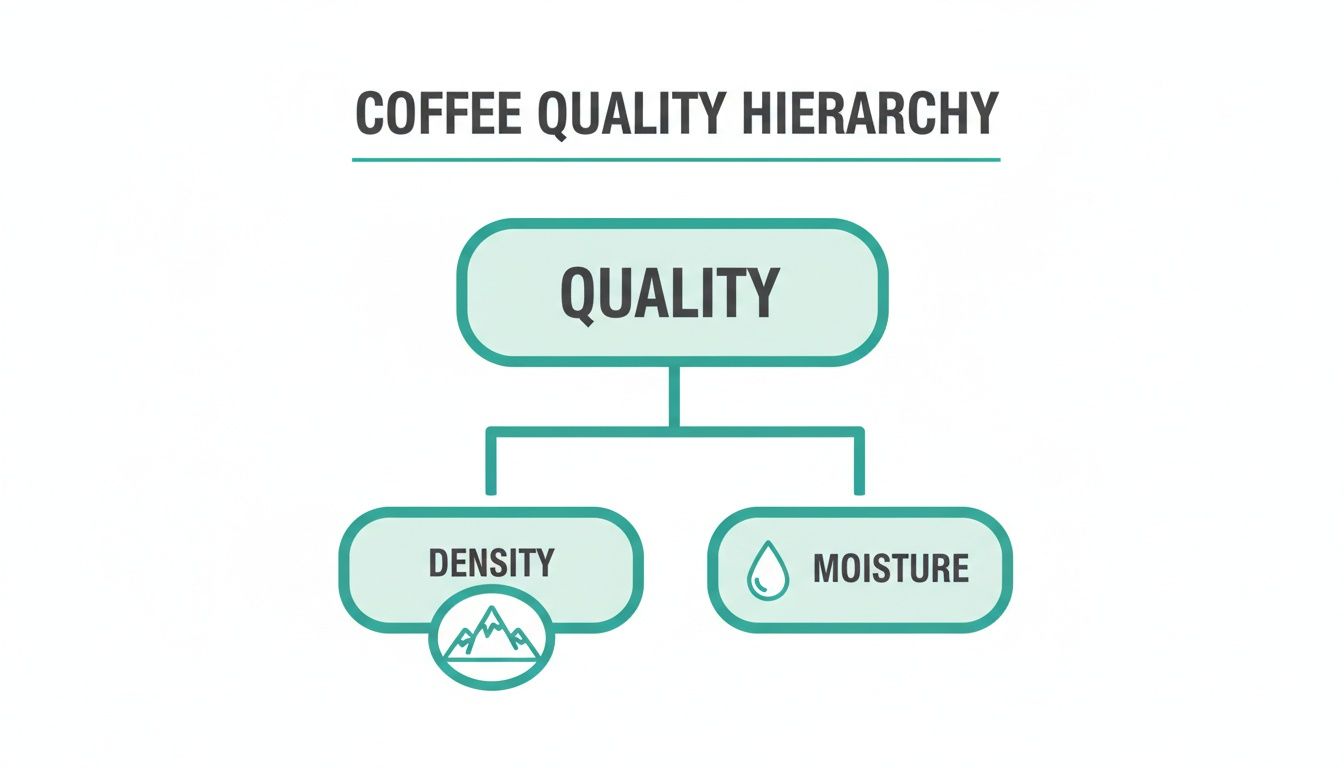
Why does this matter so much? Even roasting. A batch of uniformly sized beans will roast at the same rate.
Think about what happens when you roast a mix of big and small beans together. The little ones will start to burn before the bigger ones are even fully developed. That leads to a messy, inconsistent flavor in your cup—a mix of bitter, scorched notes and sour, underdeveloped ones. No thanks.
Learning about these hidden factors in coffee is a lot like understanding how experts go about assessing the grade and quality of other beverage ingredients, from matcha to wine. It all starts with the raw material.
Protecting Your Investment: Preserving Bean Freshness
You finally did it. You navigated the world of origins, roast levels, and tasting notes to track down that perfect bag of coffee beans. But a few weeks later, that once-amazing coffee tastes… flat. Lifeless.
It's a frustratingly common story. The vibrant, complex flavors you paid a premium for have simply vanished, leaving a dull, generic taste in their place. You're left wondering if you wasted your money, as the last half of the bag is just a shadow of its former self.
The answer isn’t to chug your coffee faster; it’s to store it smarter. By understanding and fighting back against the three main enemies of coffee—oxygen, light, and moisture—you can protect your investment and make sure the last cup is just as spectacular as the first. This is how you take back control of your coffee's quality the moment it enters your kitchen.
The Three Enemies of Coffee Freshness
Think of your freshly roasted coffee beans like delicate, aromatic flowers. Once they’ve been roasted, a natural clock starts ticking. Your job is to slow that clock way down by giving them the right environment.
Here are the culprits working against you:
- Oxygen: This is the big one, the primary driver of staling. When oxygen gets to the fragile oils and aromatic compounds in your coffee, it causes them to oxidize. That’s a fancy word for the process that turns those bright, beautiful flavors into something flat and cardboard-like.
- Light: Sunlight and even the lights in your kitchen act like a gas pedal for staleness. They speed up the chemical reactions that kill flavor. Those clear glass jars on the countertop might look nice, but they're actively wrecking your coffee with every minute of exposure.
- Moisture: Roasted coffee beans are hygroscopic, which means they’re like little sponges, sucking up moisture—and any smells—from the air around them. This is a fast track to losing aroma and developing nasty, musty flavors.
To protect your coffee, you need a storage solution that's basically a fortress against these three things.
Optimal Storage for Maximum Flavor
First things first: forget the freezer. While it might seem like a good way to preserve things, it can do more harm than good for coffee. Taking beans out creates condensation, introducing the very moisture you're trying to avoid. Plus, those porous beans can easily absorb the smell of last night's leftovers.
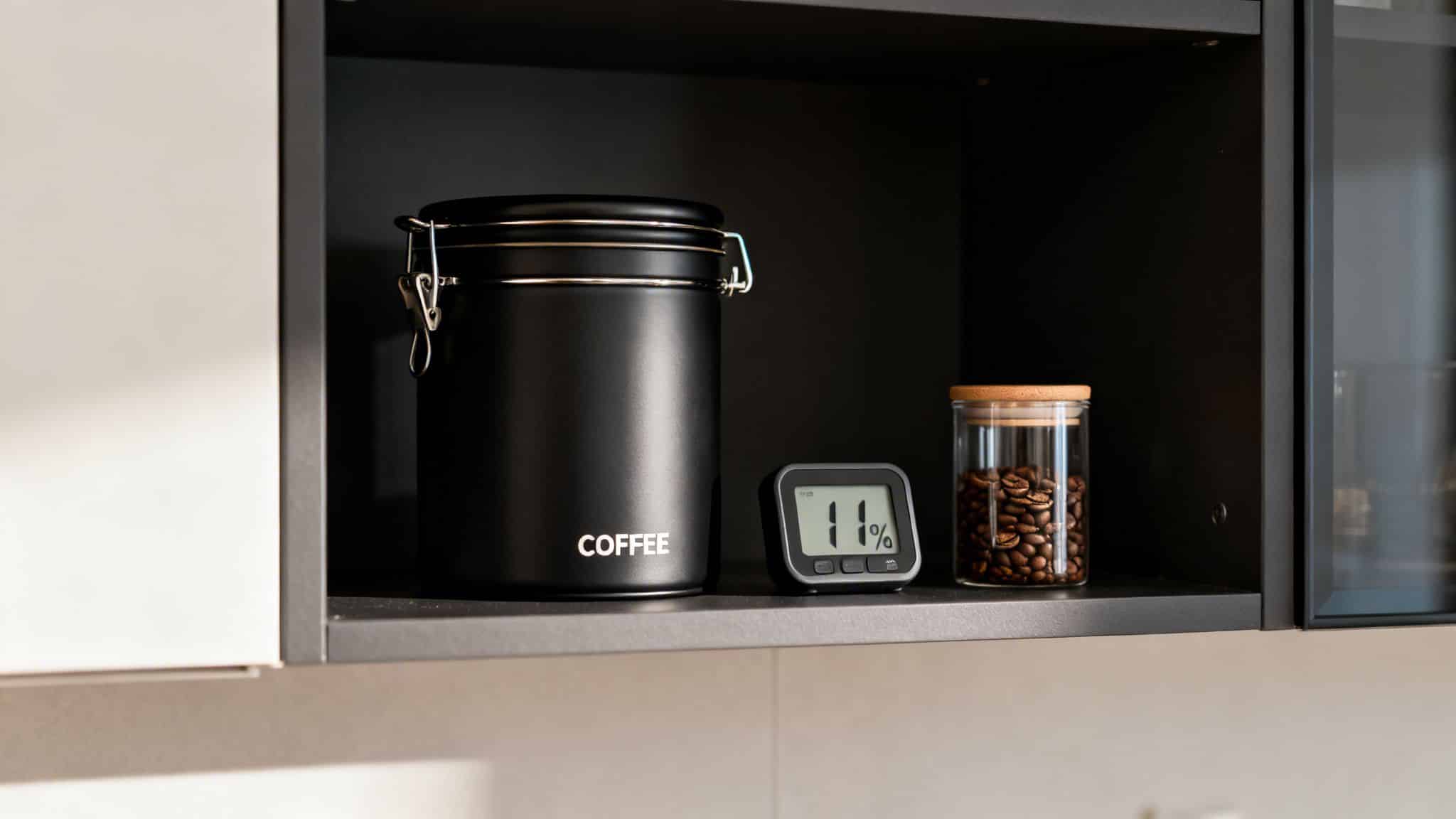
The gold standard for preserving coffee bean quality is surprisingly simple: store whole beans in an airtight, opaque container and put it in a cool, dark place. A pantry or cabinet is perfect.
An ideal storage canister has a one-way valve. This lets the CO2 that fresh beans naturally release escape, but it doesn't let any damaging oxygen in. It’s a game-changing feature that separates true coffee canisters from your average airtight container.
Moisture is actually a critical factor long before you even buy the beans. Green, unroasted coffee has to be dried to a very specific 10-12% moisture level. As experts at Roest Coffee detail, this exact range is what allows for a balanced cup with vibrant aromas. Get it wrong, and you either end up with mold from too much moisture or a dry, lifeless brew from too little.
Comparison: Premium vs. Standard Storage
| Storage Method | Premium (Airtight, Opaque, Valved Canister) | Standard (Original Bag, Clear Jar, or Freezer) |
|---|---|---|
| Oxygen Protection | Excellent. A one-way valve vents CO2 without letting oxygen in, preventing oxidation and preserving delicate aromatics. | Poor. Original bags aren't truly airtight once opened. Clear jars and freezer bags offer zero protection from gradual oxygen exposure. |
| Light Protection | Excellent. The opaque material completely blocks all light, preventing UV degradation that accelerates staling. | Poor to None. The bag offers some protection, but clear jars offer none. This directly destroys flavor. |
| Moisture & Odor Control | Excellent. The airtight seal prevents the beans from absorbing ambient moisture and unwanted pantry or freezer odors. | Poor. Beans in the freezer or in non-airtight containers are highly susceptible to moisture and odor contamination. |
| Common Objection | "Is a special canister really worth the price?" | "It's just easier to keep it in the bag." |
| Outcome | Your expensive beans taste fresh and vibrant for weeks. The canister pays for itself by preventing you from throwing out stale, flavorless coffee. | Your beans lose their flavor within days, tasting flat and generic. You end up wasting money and a potentially great coffee experience. |
When you get storage right, you ensure the true character of your beans stays intact. This means the pure water from your brewing system, like the water from a PureHQ filter for your Keurig, can pull out all those intended flavors without anything getting in the way. Using a high-quality reusable pod then guarantees that you’re brewing the exact coffee you so carefully protected.
Protecting your beans is the final, crucial step in honoring their journey from the farm all the way to your cup.
How Your Brewer Can Make or Break Bean Quality
You did everything right. You tracked down some truly exceptional beans, the kind with tasting notes that sound like a dessert menu. You even stored them perfectly. So why, when you brew a cup in your trusty Keurig or Ninja, does it taste… flat?
It’s one of the most frustrating feelings for a coffee lover. That vibrant pop of fruit or the deep, rich chocolate promised on the bag just isn’t there. Instead, you get a generic, disappointing brew that makes you question the whole "specialty coffee" thing. You start to blame the beans, your taste buds, maybe even the roaster.
But the machine isn't the problem, and neither are the beans. The real culprits are invisible enemies lurking in your tap water and building up inside your brewer. Things like chlorine and limescale are waging a silent war on your coffee's flavor, and it’s a war you can absolutely win.
How Water Quality Sabotages Your Coffee
Here’s a fact that changes how you think about coffee: your finished cup is over 98% water. If that water is off, your coffee doesn’t stand a chance. It’s like trying to paint a masterpiece on a dirty canvas—the final result will always be muddy.
Hard water, which is incredibly common, is packed with minerals like calcium and magnesium. These minerals actively bond with the delicate flavor compounds in your coffee, neutralizing them before they can ever hit your tongue. Those bright, acidic notes you paid a premium for? Chemically cancelled out.
Then there’s chlorine. It’s a necessary disinfectant in city water, but even a tiny amount can leave your coffee with a harsh, medicinal, or "swimming pool" aftertaste. It completely bulldozes the bean's natural character. You could have the best coffee bean quality in the world, but with bad water, it’s game over.
The Hidden Damage of Limescale Buildup
Those same hard water minerals don't just ruin the taste; they slowly cripple your coffee maker from the inside. When you heat hard water, those minerals precipitate and form a chalky, crusty deposit called limescale.
Limescale acts like an insulator, coating your machine's heating element. This forces the brewer to work harder and, more importantly, fail at its most critical job: maintaining a consistent water temperature.
Proper coffee extraction is a science, and it needs a precise temperature. Too cool, and you get sour, weak, under-extracted coffee. Too hot, and you scorch the grounds, leaving you with a bitter, acrid mess. Limescale makes that perfect temperature impossible, turning every single brew into a total gamble.
This is why regular cleaning and descaling are non-negotiable. For a full walkthrough on how to do it right, our guide on how to clean your coffee maker has you covered.
The PureHQ Solution for Peak Flavor Extraction
This is exactly where PureHQ accessories turn the tables. Instead of letting your brewer work against you, our products transform it into a high-performance tool that actually respects your beans.
Think of a PureHQ charcoal water filter for your Keurig or Ninja as your first line of defense. These little powerhouses are specifically designed to trap chlorine, excess minerals, and other impurities. By starting with a clean, neutral water, you’re giving your coffee’s true flavors the blank slate they need to shine. No interference, just pure taste.
And for those who love single-serve convenience but refuse to compromise on quality, our reusable stainless steel K-Cups are a game-changer. They free you to use your own freshly ground, top-tier beans, unlocking superior flavor while ditching the waste of disposable pods.
Brewing Premium Coffee PureHQ vs. Standard Methods
It’s easy to wonder if a few small accessories can really make that much of a difference. Let’s break down the head-to-head comparison.
| Factor | Brewing with PureHQ Accessories | Standard Brewing (No Filter/Maintenance) | Customer Objection Addressed |
|---|---|---|---|
| Flavor Clarity | Bright and clear. Delicate notes of citrus, floral, and fruit are easily detectable because chlorine and mineral interference are eliminated. | Muted and flat. Delicate flavors are masked by mineral reactions and a potential chlorine aftertaste. | "My expensive coffee doesn't taste any different from the cheap stuff." |
| Extraction Consistency | Optimal and reliable. A clean heating element maintains precise water temperature, ensuring balanced extraction cup after cup. | Unpredictable. Limescale buildup causes wild temperature swings, leading to sour or bitter results. | "My coffee tastes different every time, even with the same beans." |
| Machine Performance | Smooth and efficient. The machine operates as intended, with faster heat-up times and a significantly longer lifespan. | Strained and slow. The brewer struggles to heat water, leading to longer brew cycles and eventual component failure. | "My coffee maker seems to be getting slower and louder." |
| Sustainability & Cost | Minimal waste. Using a reusable pod with your own beans is eco-friendly and drastically reduces your cost per cup. | High waste and cost. Disposable pods create significant plastic waste and are far more expensive over time. | "Single-serve coffee is so wasteful and expensive." |
By folding these simple, effective tools into your coffee routine, you do more than just make coffee. You protect your investment in quality beans and ensure your brewer is finally performing at its absolute peak.
Shop PureHQ's Filters and Reusable Pods to Unlock Your Coffee's True Potential
Diving into the world of coffee can feel like learning a new language, right? Don't worry. We're here to cut through the noise and answer some of the most common questions we hear about getting that perfect, flavor-packed cup.
Let's clear up some persistent brewing myths, reinforce what truly matters, and get you making better coffee, every single time.
What Is the Single Most Important Factor for Coffee Bean Quality?
Everyone's looking for that one magic bullet, but the truth is, there isn't one. Think of amazing coffee like a three-legged stool. If one leg is weak, the whole thing topples over. No single factor can stand on its own.
Here are the three legs that are all equally crucial:
- Origin and Processing: This is the bean's DNA. High-altitude farms grow denser beans packed with complex sugars. The way those beans are processed (washed, natural, etc.) creates wildly different flavor profiles. This is the raw potential.
- Roasting: The roaster is the artist who unlocks that potential. A great roast can bring out a bean's incredible sweetness and bright acidity. A bad roast? It can make even the world's best beans taste like charcoal or grass.
- Freshness: Coffee is a perishable food. Once roasted, its greatest enemies—oxygen, light, and moisture—start breaking down all those delicious aromatic compounds. For peak flavor, you have to use beans within a few weeks of their roast date. It's non-negotiable.
You need all three to work together. A world-class bean can be destroyed by a terrible roast, and a perfect roast is worthless if the beans have been sitting on a shelf for six months.
Can a Good Machine Fix Bad Coffee Beans?
It’s a tempting thought, isn't it? If you just shell out for a high-end machine, it can work miracles on those cheap grocery store beans. Unfortunately, it’s the exact opposite.
A coffee maker, no matter how fancy, can only extract what’s already in the grounds.
Think of it this way: a world-class stereo system won't make a terribly recorded album sound good. In fact, it will just make all the flaws in the recording painfully obvious. Your amazing brewer will do the same thing—it will just give you a very clear, well-extracted cup of something flat, bitter, and stale.
The machine is an extraction tool, not a magic wand.
How Often Should I Descale My Coffee Maker for the Best Taste?
If you’re serious about how your coffee tastes, descaling isn't optional—it's a core part of your routine. Limescale from hard water builds up on your machine's heating element, acting like an insulator. This messes with water temperature, and inconsistent temperature is the fastest way to ruin your extraction.
A solid rule of thumb is to descale your machine every 1-3 months.
Your exact schedule really comes down to your water hardness. If you live in an area with very hard water, descaling every month is a smart move for flavor consistency. For those with softer water, every three months should be enough.
Using a quality descaling solution regularly is the only way to guarantee your machine can hit the right temperature every time, saving you from the sour or bitter coffee that a scaled-up brewer produces.
Are Reusable Pods as Good as Disposable Ones for Flavor?
This is a huge concern, especially for coffee lovers who want to be sustainable without sacrificing quality. The truth is, the flavor you get from a reusable pod depends entirely on its design and, of course, the coffee you fill it with.
Sure, many of the old, flimsy plastic reusable pods had problems. They created weak, watery coffee because of poor water flow. But a well-designed, modern stainless steel pod? That's a completely different game.
PureHQ Reusable Pods vs. Generic Alternatives
| Feature | PureHQ Stainless Steel Reusable Pods | Standard Plastic Reusable Pods |
|---|---|---|
| Water Flow | We engineered ours with a precision mesh filter. This ensures even water distribution for a full, balanced extraction every single time. | They often have a few poorly placed holes. This leads to "channeling," where water bypasses the grounds, resulting in a weak, under-extracted cup. |
| Flavor Integrity | Made from inert, food-grade stainless steel. It adds zero unwanted flavors, letting the pure taste of your expensive beans shine. | They can sometimes impart a subtle plastic taste, especially when new or if they're made from cheap, low-grade materials. |
| Durability | Built to last for years. Our pods resist clogs, won't warp from heat, and deliver a consistent brew for years to come. | Prone to warping from the heat of the brew cycle. The mesh clogs or breaks easily, leading to inconsistent coffee and a very short lifespan. |
| Customer Objection | "Won't it be messy and inconvenient?" | "It's cheap, so it's good enough." |
| The Reality | Our design is simple to fill and even easier to clean, especially with disposable paper liners. The long-term savings and incredible taste are well worth 10 extra seconds. | That initial "savings" disappears when you have to replace it every few months, all while drinking subpar coffee. |
Ultimately, a quality reusable pod gives you the freedom to use freshly ground, high-quality beans. That will always, always beat the stale, pre-ground coffee found in most disposable pods. And for those curious about coffee's wider health profile, you can even explore things like the green coffee bean extract benefits which are derived from unroasted beans. When you use a quality reusable filter, nothing stands between you and your perfect cup.
At PureHQ Inc., we believe great coffee starts with clean equipment and the freedom to choose your own beans. Elevate your daily brew by ensuring every cup is pure.
Shop PureHQ's Filters, Reusable Pods, and Descalers Today

