
Coffee Machine Care
Finding the Best Coffee Machine Descaler for Better Tasting Coffee

Feb
That bitter, chalky flavor in your morning coffee is more than just a bad brew—it’s a warning sign. Lurking inside your machine, mineral deposits known as limescale are silently choking its heating elements, a problem affecting the vast majority of U.S. households supplied with hard water, as noted by the U.S. Geological Survey. This buildup not only ruins the taste of your coffee but also puts immense strain on your machine's internal components, forcing it to work harder and leading to slower brew times and eventual failure.
The longer you ignore it, the worse it gets. The scale thickens, creating a porous, warm, and damp environment that becomes a perfect breeding ground for bacteria and mold deep inside the parts you can't see. This hidden contamination, combined with the machine's inability to reach the correct brewing temperature, leaves you with a weak, sour, and potentially unsafe cup of coffee every single day. You're left wondering why the expensive beans you bought suddenly taste so bad, unaware that your machine is slowly destroying itself from the inside out.
The solution is a professionally formulated descaler designed to dissolve this harmful buildup safely and effectively. The PureHQ Universal Descaling Solution uses food-safe acids that target and eliminate limescale without damaging the delicate gaskets and seals inside your Keurig, Breville, or Nespresso. By flushing out the mineral deposits, you restore your machine's heating efficiency, eliminate the source of bitter flavors, and ensure every cup is as fresh and delicious as the first.
That Bitter Taste Is Your Coffee Machine Crying for Help

If your morning cup has taken on a bitter, almost chalky aftertaste, that’s not a bad batch of beans. It's a distress signal from your coffee maker.
That nasty flavor is almost always a direct result of limescale, a silent mineral buildup that’s slowly choking your machine’s internal pipes and heating elements. Think of it like cholesterol for your coffee maker. This scale acts as an insulator, forcing the machine to fight much harder just to heat the water.
This extra strain causes two big problems. First, your machine can't get the water to the perfect brewing temperature, which means you're not getting a proper flavor extraction from your grounds. We dive deeper into how this works in our guide on why your coffee tastes bitter.
The True Cost of Limescale
Beyond just ruining your morning ritual, that mineral buildup is putting serious stress on everything inside your machine. This leads to slower brew times, weaker coffee, and eventually, expensive and premature failure.
Regular descaling isn’t just another chore; it's the single most important piece of maintenance you can do to protect your investment.
By removing this mineral buildup, you restore the rich, full-bodied flavor you love, improve your machine's performance, and extend its lifespan for years to come.
This isn't just a coffee-nerd secret anymore. The global market for coffee machine cleaning liquids hit an estimated $394.6 million in 2025 and is projected to keep growing. Why? Because people are finally connecting the dots between a clean machine and a perfect cup.
Properly caring for your coffee maker not only saves you from the headache of costly repairs but also guarantees that every single cup is as delicious as the very first one.
What Is Limescale and Why Is It Wrecking Your Coffee?
Ever notice your coffee just doesn't taste as good as it used to? That invisible enemy ruining your morning brew is called limescale. It’s the hard, chalky deposit left behind by minerals like calcium and magnesium, which are naturally present in your tap water.
Think of the inside of your coffee machine like a vital artery. Just like cholesterol slowly builds up and restricts blood flow, limescale silently coats the tiny pipes and critical heating elements inside your brewer.
This mineral layer acts as an insulator, forcing your machine to work overtime just to reach the optimal brewing temperature. When water isn't hot enough, it can't properly extract all those rich, complex flavors from your coffee grounds. The result? A cup that tastes weak, sour, or disappointingly bitter.
The Unseen Damage of Mineral Buildup
It's a problem that only gets worse over time. As the scale thickens, it doesn't just suffocate your coffee's flavor—it puts immense strain on your machine’s internal components. The pump has to work harder to push water through clogged passages, and the heating element can overheat, leading to premature failure and costly repairs.
That restricted, lukewarm water flow is exactly why your coffee starts tasting "off." Instead of the delightful aroma you expect, your machine produces a beverage tainted with a distinct mineral or metallic taste. This is the direct result of hot water passing over layers of old, baked-on limescale.
Worse yet, that warm, damp, and porous limescale surface is a perfect breeding ground for bacteria and mold. It creates a hidden environment deep inside your machine where microorganisms can thrive, completely out of sight.
Limescale isn’t just a harmless nuisance; it's a direct threat to both the quality of your coffee and the health of your coffee machine. Ignoring it means accepting subpar coffee and risking permanent damage to your appliance.
To fight back, you need a powerful descaling solution. The best coffee machine descaler uses a formula that specifically targets and dissolves these stubborn calcium and magnesium deposits, breaking them down completely so they can be flushed out of the system.
How a Descaler Restores Your Brew
A high-quality descaler works by introducing a food-safe acid—often citric or lactic acid—that creates a chemical reaction with the alkaline mineral deposits. This process safely dissolves the scale into a solution that can be rinsed away without harming your machine’s delicate internal parts like seals, gaskets, and metal components. Regular descaling is the secret to ensuring every single cup tastes fresh and clean.
For those truly committed to peak performance, pairing regular descaling with high-quality water filters is a game-changing strategy. By actively removing minerals before they even have a chance to build up, you extend the time between descaling cycles and keep your machine running like new. You can learn more about how the right filter complements this process in our guide to choosing a coffee maker water filter replacement.
Comparing Your Descaling Options
When it’s time to descale your machine, you’ll find a few options out there. But let’s be clear: they are absolutely not created equal, especially when it comes to the safety and longevity of your coffee maker. Picking the right one is critical for protecting the delicate parts humming away inside that machine you rely on every morning.
Professional Descalers vs. DIY Methods
A lot of folks reach for a bottle of white vinegar from the pantry, thinking it's a cheap and easy fix. Honestly, this is one of the most common DIY shortcuts, and it can be a costly mistake. The acetic acid in vinegar is just too aggressive. Over time, it can eat away at the soft rubber gaskets, o-rings, and seals inside your machine, leading to leaks and permanent damage.
And that's not all. The pungent smell can linger for days, tainting brew after brew with a sour, unpleasant aftertaste. Nobody wants that.
This little flowchart nails it—when you’re trying to figure out why your coffee is suddenly terrible, one of the first roads leads straight to limescale.
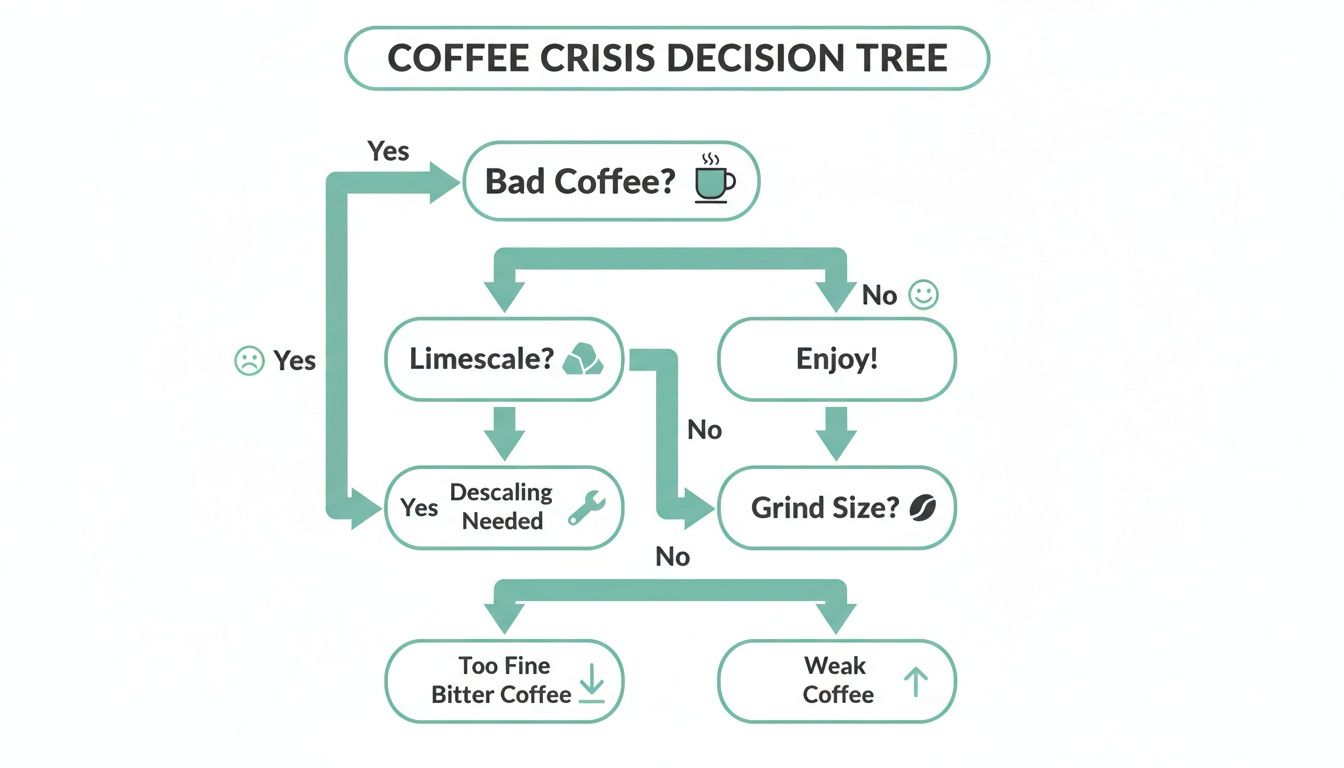
As you can see, figuring out if you have a scale problem is the first step. It just goes to show how fundamental proper descaling is to a good cup of coffee.
So, what’s the alternative? A professionally formulated descaler is easily the safest and most reliable way to go. These solutions are engineered with specific acids, like citric or lactic acid, that are tough on stubborn mineral deposits but gentle on your machine’s internal parts. They’re designed to do their job and then rinse away completely, leaving zero residue or weird flavors behind.
The core difference really comes down to science. A dedicated descaler is like a smart bomb—it targets calcium and magnesium without attacking the sensitive materials that keep your brewer running. Vinegar, on the other hand, is a blunt instrument that can cause more harm than good.
The coffee machine market is booming and expected to hit USD 10.19 billion by 2033, which just tells you how many brewers are sitting on countertops worldwide that need proper care. A quality descaler is just part of keeping them all working as they should.
Want to go deeper into why some DIY methods just don't make the cut? Check out our guide on finding a great Keurig descaling solution alternative.
A Closer Look at the Options
To really make the right call, it helps to see a head-to-head comparison. While some DIY fans suggest citric acid powder as a better option than vinegar, it’s not foolproof. If you mix the powder incorrectly or use it at the wrong water temperature, it can actually react with the calcium to form calcium citrate—a solid gunk that’s even harder to remove than the original limescale.
Here’s a quick breakdown to put it all in perspective.
Descaling Solution Comparison
| Method | Effectiveness on Scale | Machine Safety | Odor and Aftertaste | Recommendation |
|---|---|---|---|---|
| PureHQ Descaler | High | Excellent (Formulated to be non-corrosive) | None (Rinses clean) | Highly Recommended |
| Citric Acid Powder | Moderate | Good (Risk of residue if not used correctly) | None | Use with Caution |
| White Vinegar | Low to Moderate | Poor (Can damage seals and gaskets) | Strong (Lingering odor) | Not Recommended |
The verdict is pretty clear. A professional descaler like ours gives you the best performance without putting your machine’s health at risk. For ongoing protection, you could even look into advanced prevention tech like the Scalenet system, but for your routine clean, a dedicated solution is the way to go.
When you weigh the options, a professional formula just makes sense. It offers superior cleaning without gambling with the longevity of your machine. And a pro tip: pairing it with a high-quality water filter after you've cleaned everything out can seriously slow down future mineral buildup.
A Simple Guide to Descaling Any Coffee Machine
Ready to get your machine running like new again? The idea of a full cleaning cycle can sound like a hassle, but it's surprisingly simple. Putting it off just lets that nasty mineral scale keep building up, which leads to slow brewing, lukewarm coffee, and eventually, a dead machine.
The good news is that bringing your coffee maker back to life is straightforward. We've broken down the process into easy, actionable steps that work for just about any popular brand out there, including Keurig, Breville, Ninja, and Cuisinart. Follow along, and you’ll flush out that harmful limescale and be on your way to a noticeably better cup of coffee.
Step 1: Prepare Your Machine
First things first, let's get your brewer prepped for the cleaning process. This initial step is all about making sure the descaling solution can get everywhere it needs to go without anything getting in the way.
- Empty Everything: Toss out any used pods or coffee grounds and remove the carafe.
- Remove the Filter: Pop out the water filter from the reservoir. Trying to descale with a filter still in place can wreck it and block the solution from circulating properly.
- Empty the Reservoir: Pour out any leftover water from the tank.
This is also the perfect time to give the removable parts a quick wash. The drip tray and pod holder could probably use a little scrub with warm, soapy water.
Step 2: Run the Descaling Cycle
With your machine prepped and ready, it's time for the main event. This is where the descaling solution gets to work its magic, dissolving months—or even years—of mineral gunk.
- Mix the Solution: Pour the entire bottle of PureHQ Universal Descaling Solution into the empty water reservoir. Top it off with fresh water according to the instructions on the bottle.
- Start the Brew: Place a large mug or a ceramic bowl under the spout to catch the dirty water. Run a full brew cycle. If your machine has a hot water-only setting, use that. For single-serve brewers like a Keurig, just keep running large-cup brew cycles until the “Add Water” light kicks on.
- Let It Sit: Once that first pass is complete, let the machine sit for 30 minutes. This pause is crucial. It gives the descaler time to soak in and really break down the stubborn limescale deposits hiding inside the heating element and tubing.
- Finish the Cycle: After the wait, start running brew cycles again until the reservoir is completely empty. Carefully pour the collected solution down the sink.
Step 3: Perform the Final Rinses
Don't skip this part—rinsing is probably the most important step of all. If you don't flush the system properly, you can leave behind descaler residue and loosened mineral crud, which will definitely ruin the taste of your next brew.
The whole point of the rinse is to completely purge the machine of both the cleaning solution and all the scale it dissolved. A good flush ensures your coffee tastes pure and your machine’s internal parts are left sparkling clean.
Give the water reservoir a thorough rinse with clean water. Fill it to the max line with fresh water and run at least three full brew cycles. This final flush guarantees that any lingering solution is gone, leaving you with a clean machine that's ready to brew a perfect cup.
Want to keep that just-cleaned performance going longer? Pop in a new water filter after you're done descaling. A quality filter catches a ton of minerals before they ever enter your machine, slowing down future scale buildup and stretching the time between cleanings.
Ready to bring your coffee machine back to life? A proper descaling is the fastest way to better-tasting coffee and a brewer that lasts.
Shop the PureHQ Universal Descaling Solution now and restore your machine’s performance.
Why a Professional Descaler Is the Smartest Choice
It’s a totally valid question: you spent good money on a great coffee machine, so why would you pour some unfamiliar chemical into it? A lot of coffee lovers hesitate right here, worried a descaler might be too aggressive, damage the internal seals, and cause leaks or even corrode the heating element.
This fear often leads people down one of two paths. Either they reach for a risky DIY fix like vinegar, or worse, they just skip descaling altogether. Both roads lead to the same ugly destination: a machine that struggles, makes bitter coffee, and is heading for an early grave.
But you don't have to choose between protecting your machine and cleaning it. The real solution is a product engineered specifically for this job. A professional descaling solution is formulated to be tough on mineral scale but gentle on your machine's guts—the rubber gaskets, o-rings, and metal parts that keep everything running perfectly.
Universal Compatibility and Safety
One of the best things about a professional formula is its universal design. Whether you own a Keurig, a fancy Breville espresso machine, a do-it-all Ninja brewer, or a classic Cuisinart, a top-tier descaler works safely and effectively across the board.
This isn’t an accident. These formulas are designed for versatility, giving you a reliable clean no matter what’s on your counter. And it's clear what coffee drinkers prefer: liquid descalers are on track to grab a massive 54.3% share of the market by 2025. You can learn more about descaler market trends and see why households are driving this shift.
A professional descaler isn't just a cleaner; it's preventative maintenance. By using a formula made for the task, you're giving your machine the care it needs to perform at its peak for years.
Comparing Professional vs. Generic Formulas
| Feature | PureHQ Professional Descaler | Generic or DIY Alternatives |
|---|---|---|
| Formula | Engineered with specific, food-safe acids that are non-corrosive to internal parts. | Often use harsh acids (like acetic acid in vinegar) that can degrade rubber seals and gaskets. |
| Effectiveness | Rapidly dissolves stubborn limescale for a thorough clean in one cycle. | May only partially remove scale or require multiple cycles to be effective. |
| Compatibility | Tested and proven safe for Keurig, Breville, Ninja, Nespresso, and more. | Can be unpredictable; may damage certain materials or leave harmful residue. |
| Residue | Rinses away completely, leaving no aftertaste or odor. | Vinegar often leaves a lingering smell that taints coffee for several brews. |
A common worry we hear is about leaks starting after using a third-party descaler. Here's the truth: leaks are far more likely to be caused by the corrosive acid in vinegar or the intense pressure buildup from untreated limescale. A professional solution safely removes that scale, actually preventing the very conditions that cause damage in the first place.
For best results, try replacing the water filter right after you descale. It's a simple step that helps slow down the next round of mineral buildup.
Buying multi-packs is also a smart move. It saves you money in the long run and ensures you always have a bottle ready to go when your machine needs it most. Protect your investment and get back to the coffee you love.
Shop the PureHQ Universal Descaling Solution today and see the difference a professional clean makes.
Got Questions About Descaling? We've Got Answers.
Even when the process is simple, you probably still have a few questions floating around. Let's tackle some of the most common ones so you can feel totally confident every time you give your machine a little TLC.
How Often Should I Descale My Machine?
This really boils down to two things: how much coffee you brew and how hard your water is. If you're using hard water (which is loaded with minerals like calcium and magnesium), that limescale is going to build up much, much faster.
A good rule of thumb for most people is to descale every 2-3 months. But honestly, the best advice is to listen to your machine. Many modern brewers from brands like Keurig and Breville have a handy indicator light that flashes when it's time for a clean. When you see that light, don't put it off—your machine is telling you exactly what it needs to keep brewing its best.
Is Vinegar a Safe Alternative to a Descaler?
We hear this one all the time, and while tons of DIY blogs recommend vinegar, we strongly advise against it. Vinegar is just plain too harsh for the delicate parts inside your coffee maker.
The acetic acid in vinegar can eat away at soft rubber seals, gaskets, and o-rings over time. This can lead to leaks and even permanent damage. A professionally formulated descaler uses gentler acids, like citric or lactic acid, that are tough on scale but easy on your brewer's internal components.
Besides the risk of damage, vinegar leaves behind a powerful smell and taste that’s a nightmare to rinse out. You could be stuck with sour-tasting coffee for days, which completely defeats the purpose of cleaning your machine in the first place.
Can I Use a Descaler in My High-End Espresso Machine?
Absolutely. Professional-grade descaling solutions are designed to be universal, making them a safe and effective choice for a huge range of coffee and espresso machines, including the pricey ones with sensitive internal systems.
These formulas are engineered to be tough on stubborn limescale while remaining gentle and non-corrosive to the machine itself. Whether you have a top-of-the-line espresso machine or a simple single-serve pod brewer, a quality universal descaler is the right tool for the job.
Will Descaling Really Make My Coffee Taste Better?
Yes, and the difference is often immediate and surprisingly noticeable. Think of it this way: when limescale coats the heating element, it acts like an insulator, preventing the water from getting hot enough to properly extract flavor from your beans. That’s a one-way ticket to weak, bitter, or even chalky-tasting coffee.
By stripping away that mineral buildup, you let the machine heat water to the exact temperature it was designed for. This unlocks the full spectrum of flavor and aroma from your coffee grounds, giving you a richer, smoother, and more balanced cup. It restores the taste you fell in love with.
Ready to give your coffee machine the care it deserves? The PureHQ Universal Descaling Solution is made in the USA and engineered to restore your brewer's performance, ensuring every cup is as delicious as the first.
Shop the PureHQ Universal Descaling Solution now and taste the difference a clean machine makes.

