
Coffee Machine Care
Best Reusable K Cup for Keurig 2.0: Models Compared
Nov
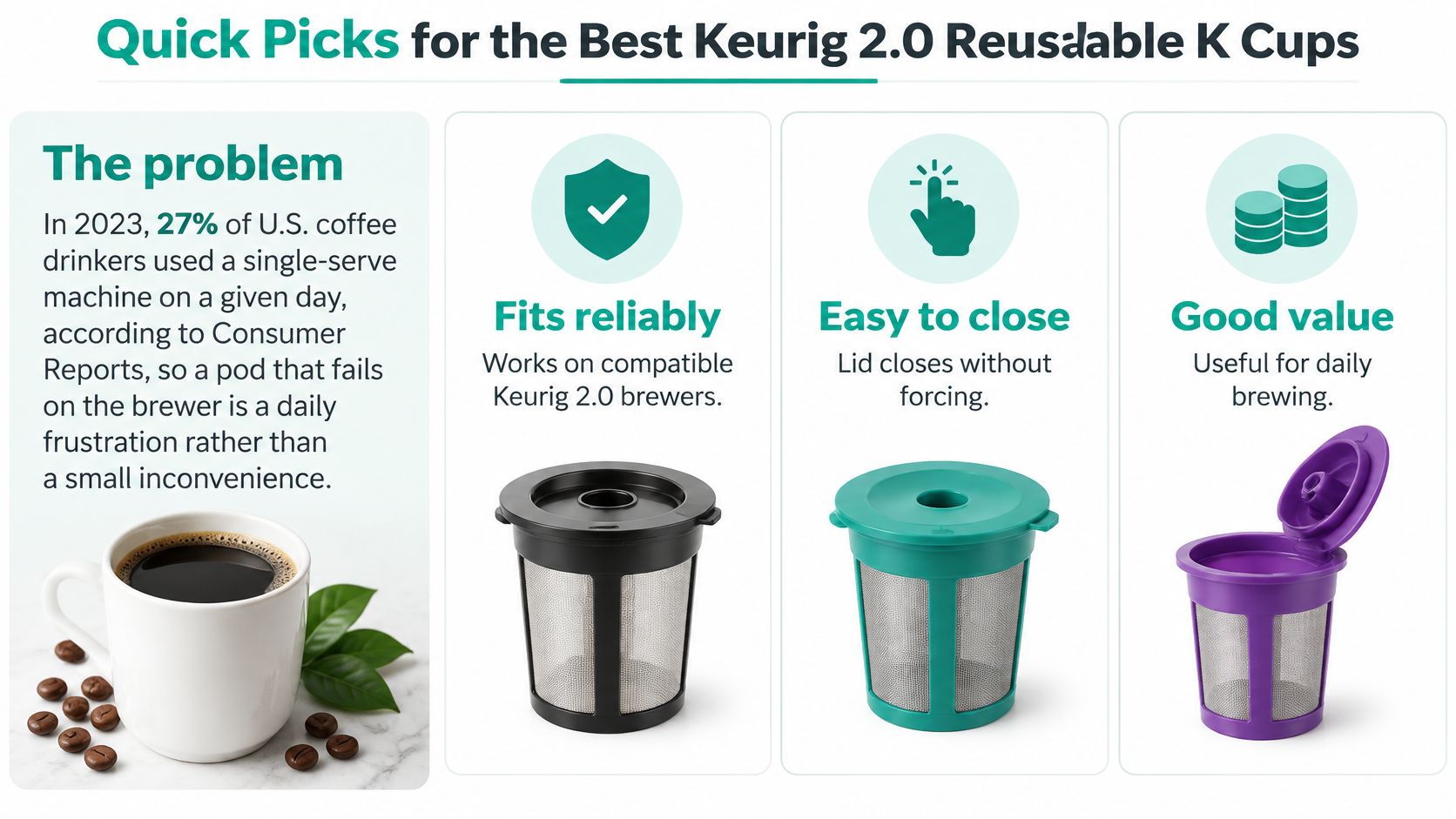
A pod that doesn't work can turn a routine cup of coffee into a daily hassle. In 2023, 27% of U.S. coffee drinkers used a single-serve coffee machine to prepare coffee on a given day, according to Consumer Reports, citing National Coffee Association and Statista data. For Keurig 2.0 owners, the first buying question isn't whether a reusable K-Cup looks sturdy. It's whether the brewer recognizes it, closes around it, and lets water flow through it properly.
A useful shortlist starts with the exact model number on your brewer, then narrows the choice by pod type and brewing routine. These options give you a starting point, but a product listing is not a substitute for checking your machine's compatibility.
Quick Picks for the Best Keurig 2.0 Reusable K Cups
| Product | Listed models | Price | Best use |
|---|---|---|---|
| Stainless steel refillable K-Cups, 2-pack | Single-needle models per listing; confirm 2.0 fit | $19.95 | Daily single-cup brewing after a model check |
| Stainless steel refillable K-Cups, 4-pack | K-Supreme, K-Slim, K-Duo Gen 2 | $19.95 | Households on K-Supreme or K-Slim |
| Mesh filter value pack with gold-tone carafe and 2 refillable K-Cups | K-Duo Gen 2 and Essentials | $18.95 | Carafe brewing on K-Duo |
| Mesh filter carafe with 100 paper filters and 1 refillable K-Cup | K-Duo Essentials and K-Duo | $16.95 | Budget K-Duo setup |
The first option is a stainless steel 2-pack for single-needle brewers, including Classic, 2.0, K-Elite, and K-Mini series models according to the product listing. Because older Keurig 2.0 guidance requires pods bearing the Keurig Brewed seal, treat the 2.0 fit as a specific listing check, not an assumption based on physical size.
The 4-pack is listed for K-Supreme, K-Slim, and K-Duo Gen 2. For K-Duo owners who also brew full carafes, the mesh value pack includes a gold-tone carafe and two refillable K-Cups. The lower-priced carafe option includes a mesh filter, 100 paper filters, and one refillable K-Cup for K-Duo Essentials and K-Duo.
Buying rule: The model number on the brewer decides the choice, not the pod's appearance.
Check the 2-pack listing first if you have a single-needle brewer, the 4-pack if you own a listed K-Supreme or K-Slim, and a carafe bundle if you regularly brew a full pot on a K-Duo.
Match Your Keurig 2.0 Model Before You Buy
Keurig's current guidance and older documentation don't line up neatly: current support says its 2025 My K-Cup filter isn't compatible with the K-200, K-300, K-400, or K-500 series, while an older instruction sheet describes a My K-Cup 2.0 filter for some of those machines. That conflict is why “Keurig 2.0 compatible” by itself isn't enough. Check the exact model number on the brewer's label, then look for that same model in the product listing.
| Brewer family | Current Keurig guidance | Older guidance | What to verify |
|---|---|---|---|
| K-200 | Not compatible with the 2025 My K-Cup filter | No K-200-specific older guidance stated | Seller lists K-200 compatibility |
| K-300, K-400, K-500 | Not compatible with the 2025 My K-Cup filter | My K-Cup 2.0 filter described for these models | Listing names the exact model number |
| Standard 2.0 brewers | Check the exact brewer and accessory guidance | My K-Cup accessory not compatible; Keurig Brewed seal pods required | Pod or filter is designed for the 2.0 holder |
| K-Supreme Gen 2 | Use only a My K-Cup Universal Reusable Filter or Keurig-approved pods | No older guidance stated here | Filter is labeled for this model |
| K-Duo Gen 2 and Essentials | Confirm the exact model in the product listing | No older guidance stated here | Mesh basket variant matches your model |
Keurig's current My K-Cup support guidance distinguishes compatibility by model and documents the change in the company's recommendations. The K200 user guide says the brewer reads a lid-based identifier, won't operate with packs lacking the required Keurig logo, and identifies the original My K-Cup filter as incompatible with Keurig 2.0.
For K-200, don't treat an older generic “2.0 compatible” claim as proof. For K-300 through K-500, check both the exact model and which generation of filter the seller means. For a standard 2.0 brewer, check whether the reusable assembly is specifically designed for its holder and recognition system. For K-Supreme Gen 2, follow the current manufacturer guidance rather than applying older 2.0 advice to a newer brewer. For K-Duo Gen 2 and Essentials, verify the carafe and pod components separately if the bundle includes both.
A marketplace listing that conflicts with current Keurig support is a reason to pause. Follow the manufacturer's current guidance and choose a product that names your exact model. For more model-by-model selection context, see this guide to choosing a reusable K-Cup for different Keurig models.
If you can't identify the brewer family, find the model number on its label before ordering. Don't rely on a seller's use of “universal” when the listing doesn't name your machine.
Fit, Leaks and Closing Problems to Test First
A reusable pod that fits in the holder can still fail during closing, recognition, or brewing. Keurig's K-Supreme Gen 2 guide says to use only a My K-Cup Universal Reusable Filter or Keurig-approved K-Cup pods, and warns users not to force a pod that doesn't fit. A filter that's too tall or wide can stop the handle from closing correctly or interfere with the brewer's puncture mechanism.
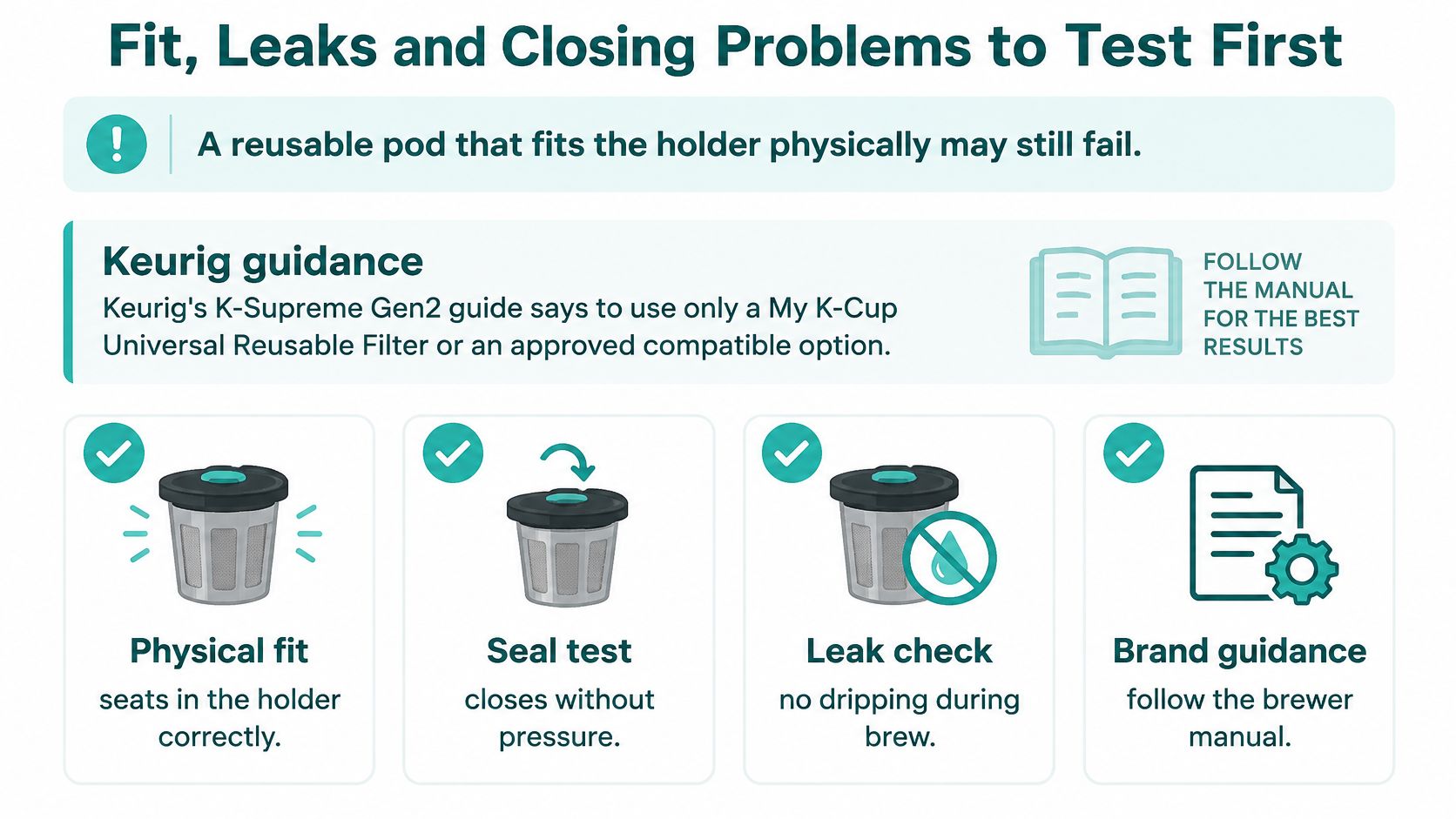
Before brewing a full cup, run this simple test:
- Check the model. Match the number on the brewer's label to the product's compatibility list.
- Dry-fit the empty pod. Place it in the holder and close the handle. It should close smoothly, without pressure.
- Run a water-only cycle. Watch for drips around the lid and any pod-recognition message before adding coffee.
| Symptom | Likely cause | Check or fix |
|---|---|---|
| Handle will not close | Pod is too tall or wide, or isn't designed for this model | Stop, remove it, and confirm model compatibility |
| Unrecognized pod message | Pod lacks the design the brewer reads | Return it and use one listed for your model |
| Coffee leaks at the lid | Basket is overfilled or lid isn't seated | Reduce the dose and reseat the lid |
| Grounds in the cup | Needle holes are clogged or the fit is loose | Clean all three needle holes with a straightened paper clip |
| Weak or slow flow | Grounds are too fine or packed too tightly | Try a medium grind and a lighter dose |
A water-only cycle can reveal leaks before coffee grounds make cleanup harder. If the handle won't close normally, don't press harder or modify the brewer to accommodate the pod.
For grounds in the cup, Keurig's K-Duo cleaning directions call for clearing the needle holes with a straightened paper clip. That addresses a common restriction point, but it won't fix a reusable pod that doesn't fit. This guide to reusable K-Cup issues can help you distinguish a cleaning problem from a fit problem.
If the handle doesn't close smoothly or the brewer rejects the pod, stop and return it rather than adjusting the machine.
Stainless Steel, Mesh and Plastic Compared Side by Side
A stainless steel refillable pod is a practical choice when you want a reusable basket and your brewer is named on the product listing. Generic plastic pods may cost less per unit, but their price and durability aren't established here. A paper liner can make cleanup simpler, but it's a consumable you discard after brewing.
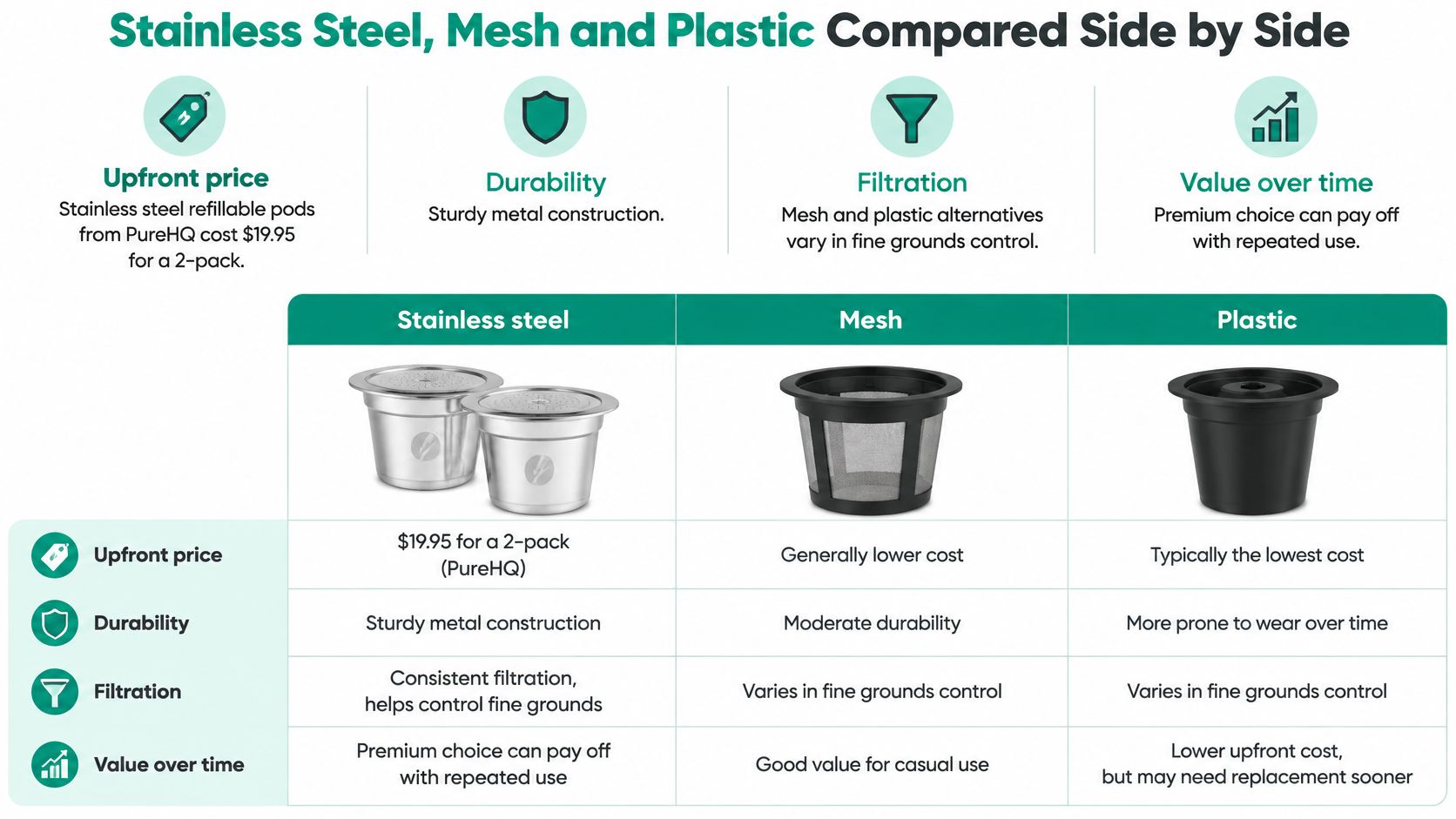
| Feature | Stainless steel refillable | Paper liner |
|---|---|---|
| Upfront price | $19.95 per 2-pack | $12.95 per 100 filters |
| Cleanup | Dump grounds, then rinse and reuse | Discard the liner after each brew |
| Consumable waste | Coffee grounds only | Paper liners add ongoing waste |
| Fit risk | Must match the model listing | Liner adds bulk and may affect closing |
| Durability | Reusable; product lifespan not specified | Disposable each use |
For comparison, a generic plastic reusable pod has unknown price and durability in this comparison. Don't assume it's a better bargain just because the upfront price looks lower. A low-cost pod that doesn't seat properly or wears out quickly can be poor value, and compatibility still comes first.
Paper can help keep cleanup straightforward and catch some fines, but the liner adds material to each brew and can change how the pod closes if it bunches or sits too high. If you're considering liners, choose ones designed for reusable pods rather than cutting paper to fit. The 100-pack disposable filters listed for Keurig and Ninja DualBrew makers costs $12.95. A separate K-Duo carafe bundle costs $16.95 and includes a mesh carafe filter, 100 paper filters, and one refillable K-Cup.
For extraction, a consistent water path matters more than a material label. A coffee-brewing flow study found that flow rate affected extracted coffee components, with the effect becoming more pronounced at finer grinds and higher temperatures. In practical terms, avoid packing the basket tightly or using a powder-fine grind; either can restrict the flow and make a brew inconsistent.
The premium steel option is worth considering only if the listing confirms your brewer model. Weigh reusable construction and rinse-and-repeat cleanup against the lower initial cost of paper liners and their ongoing waste.
Cost per Cup and When Reuse Pays Off
A reusable pod doesn't make ground coffee free. To judge whether it pays off for your routine, compare the upfront pod cost and your coffee cost with what you'd spend on the same number of single-use pods. The 2-pack for single-needle brewers and the 4-pack listed for K-Supreme, K-Slim, and K-Duo Gen 2 each cost $19.95.
Use your own local prices for the calculation:
- Count brews per week. Use the number of cups you make, not the number you hope to brew.
- Add the pod cost to the coffee cost per cup. Divide the reusable set's upfront cost across the brews you expect to make, then add your ground coffee cost per cup.
- Subtract the single-use pod cost per cup. A positive difference is your estimated saving per brew.
- Divide the upfront pod cost by the weekly saving. The result estimates how many weeks it takes to break even.
A household brewing one cup daily reaches break-even faster than one brewing occasionally, assuming the same prices and no wasted coffee. Include two often-missed costs: grounds lost through overfilling or weak extraction, and the water and time you spend washing the pod after each brew. If you discard a cup because the flow is poor, count the wasted grounds in your comparison.
Reusable doesn't automatically mean lower environmental impact. A synthesis of coffee life-cycle research reports that coffee production and brewing energy can contribute more to total impact than packaging. It also reports that packaging contributes a median 9–18% of coffee's footprint, with a higher share for single-serve pods. Refillable pods remove disposable pod packaging from your routine, but they don't remove the coffee's own footprint or the energy used to brew it.
Write this down before buying: your estimated weekly saving multiplied by the number of weeks you expect to use the pod.
That total helps you compare the projected savings with the upfront cost, while keeping maintenance and brewing waste in view.
Descale Your Brewer Around Reusable Pods
A reusable filter reduces disposable-pod use, but it doesn't prevent mineral buildup inside the brewer. Keurig describes descaling as routine preventative maintenance and recommends it every three to six months in its general descaling guidance; schedules differ by machine, with a K-Duo guide calling for descaling every three months or when brewing slows, one K-Express Essentials Plus guide showing an alert after 250 brews, and a K-1500 guide adding a 500-cycle threshold.
For the K-Duo procedure, remove the reusable pod and all loose grounds before starting. Keurig's K-Duo Use & Care Guide says the descaling process takes about 75 minutes and specifies the following steps:
- Remove any water filter. Make sure the brewer contains no pod or ground coffee.
- Pour the full bottle of descaling solution into an empty reservoir, then add an equivalent bottle of water.
- Run the prescribed brew cycle.
- Let the brewer stand for at least 30 minutes.
- Rinse the reservoir and complete the fresh-water rinses.
- Clean all three needle holes with a straightened paper clip to loosen coffee grounds.
The rinse cycles help clear the cleaning solution from the machine. Clean the reusable filter separately after descaling, and use the schedule or alert system for your exact brewer rather than assuming every Keurig follows the same interval.
For a fuller maintenance walkthrough, use this guide to descaling a Keurig machine. A reusable pod still needs regular cleaning, and descaling still matters even if you brew with your own grounds.
Choose Your Pod and Order With Confidence
A daily home brewer with a single-needle machine should start with the stainless steel 2-pack listing. Confirm that the listing names your exact model, especially if you own a 2.0 brewer. The important check is documented compatibility, not a seller's general claim that a pod fits Keurig machines.
A household with a K-Supreme, K-Slim, or K-Duo Gen 2 should compare the stainless steel 4-pack after checking the model number. For a K-Duo household that regularly brews full carafes, the mesh value pack includes a gold-tone carafe and two refillable K-Cups. The key check is that the bundle's carafe and pod components match your brewer family.
A small office with several users and frequent brewing should calculate the break-even point using its actual weekly cup count. More use gives the reusable set more opportunities to offset its upfront cost, but staff still need a simple routine for dumping grounds, rinsing the pod, and keeping the brewer clean. The check is whether the expected savings justify the upkeep.
Once you've matched the pod to the brewer, keep the machine's maintenance on schedule. The Coffee Machine Descaler gives 10 uses, works with Keurig, Nespresso, Breville, and espresso machines, and costs $23.95. Keurig and Breville descaling and cleaning tablets are another option, with a 24-count pack that includes six compatible water filters for $19.95.
Use these three actions to finish your selection:
- Find the model number. Check the brewer's label and match the number to the compatibility table.
- Check the listing. Confirm that it names your model, and reject a “universal” claim that doesn't identify compatible models.
- Choose for your routine. Pick a refillable pod for single-cup brewing or a carafe bundle if you make full pots, then order the matching option.
Shop the PureHQ reusable K-Cup that matches your model number at purehqfilters.com, and keep the listing and receipt until your first brew confirms that the pod closes and brews cleanly.
PureHQ Inc. offers reusable K-Cups, carafe filters, paper liners, and brewer-care products for home and small-workplace coffee setups. Visit PureHQ Inc. to shop for the reusable K-Cup that matches your Keurig model.

