
Coffee Machine Care
Are Charcoal Water Filters Safe for Drinking
Oct
Charcoal water filters are generally safe on already disinfected tap water when they're installed correctly and replaced on schedule, and carbon can remove up to 99.9% of some volatile organic compounds. They are not germ killers, and a cartridge that makes coffee taste cleaner does not make microbiologically unsafe water safe to drink.
That gap between taste and safety is where most home brewers get tripped up. A small black puck in a Keurig or Breville reservoir can pull chlorine taste out of municipal water and still leave bacteria, nitrate, fluoride, and hardness minerals largely untouched. If you're asking are charcoal water filters safe, you're really asking three separate questions. Is the carbon itself a problem, does it remove the contaminant you care about, and have you maintained it well enough that it still works. The carbon is rarely the problem. The other two answers decide everything.
The Short Answer on Charcoal Filter Safety
Charcoal water filters, more precisely activated-carbon filters, are generally safe for water that's already disinfected when the cartridge is properly manufactured, installed, and replaced on schedule. They aren't universal disinfection systems, and you shouldn't treat them as a safety net for untreated well water, surface water, or emergency water.
What Carbon Removes Well
The EPA overview of drinking water treatment technologies identifies granular activated carbon as a proven treatment for taste and odor compounds, natural organic matter, volatile organic compounds, synthetic organic chemicals, and disinfection-byproduct precursors. For some VOCs, including trichloroethylene and tetrachloroethylene, EPA reports removal efficiencies of up to 99.9%, with treated concentrations often reduced below 1 microgram per liter.
| Issue | What carbon does | Safety takeaway |
|---|---|---|
| Chlorine taste and odor | Adsorbs chlorine and related taste and odor compounds | Useful polish for treated municipal water |
| VOCs such as TCE and PCE | EPA reports up to 99.9% removal, often below 1 µg/L | Strong only with enough contact time and bed depth |
| Longer-chain PFAS such as PFOA and PFOS | Can be highly reduced for a period; shorter-chain PFBS and PFBA break through sooner | Needs a contaminant-specific certified cartridge |
| Some pesticides | A 2024 Water Research study removed 100% of 13 pesticides from spiked tap water | Lab result, not proof every home pesticide is removed |
| Bacteria and viruses | Not designed to remove germs | Don't rely on charcoal for unsafe or untreated water |
| Lead, nitrate, fluoride, sodium, hardness | Generally ineffective, or only a small share of some inorganics | Match a certification to the named contaminant |
That table is the whole safety story in one scan. Carbon has real strengths, and it has hard boundaries. A cartridge earns trust only when your concern falls on the right side of that line.
Why Results Vary Between Homes
Activated carbon works through adsorption. Contaminants attach to the carbon's extensive pore surfaces rather than being destroyed, so the filter has a finite number of places where molecules can stick.
Because of that, performance depends on conditions you control and conditions you don't. Carbon type, bed depth, water flow, temperature, contaminant concentration, and contact time all change how much gets captured before water exits the cartridge. A deep bed with slow flow gives molecules more chances to stick. A thin puck with fast flow gives them fewer.
A better taste is not proof the water was made safe. It's proof that something you can taste or smell changed, and many contaminants have no taste at all.
The clearest boundary is microbial. Most household filters, including pitcher and refrigerator filters, aren't designed to remove germs, and their primary purpose is often improving taste and smell. Carbon also becomes saturated over time, and once that happens, incoming contaminants pass through instead of sticking.
So use charcoal as a polishing step for treated tap water, and respect what it can't do. If you suspect pathogens in your water, you need boiling, disinfection, or a purifier specifically certified for microbial reduction. Don't ask a taste cartridge to do a purifier's job, because it will fail while your coffee tastes fine.
How Activated Carbon Traps What You Taste
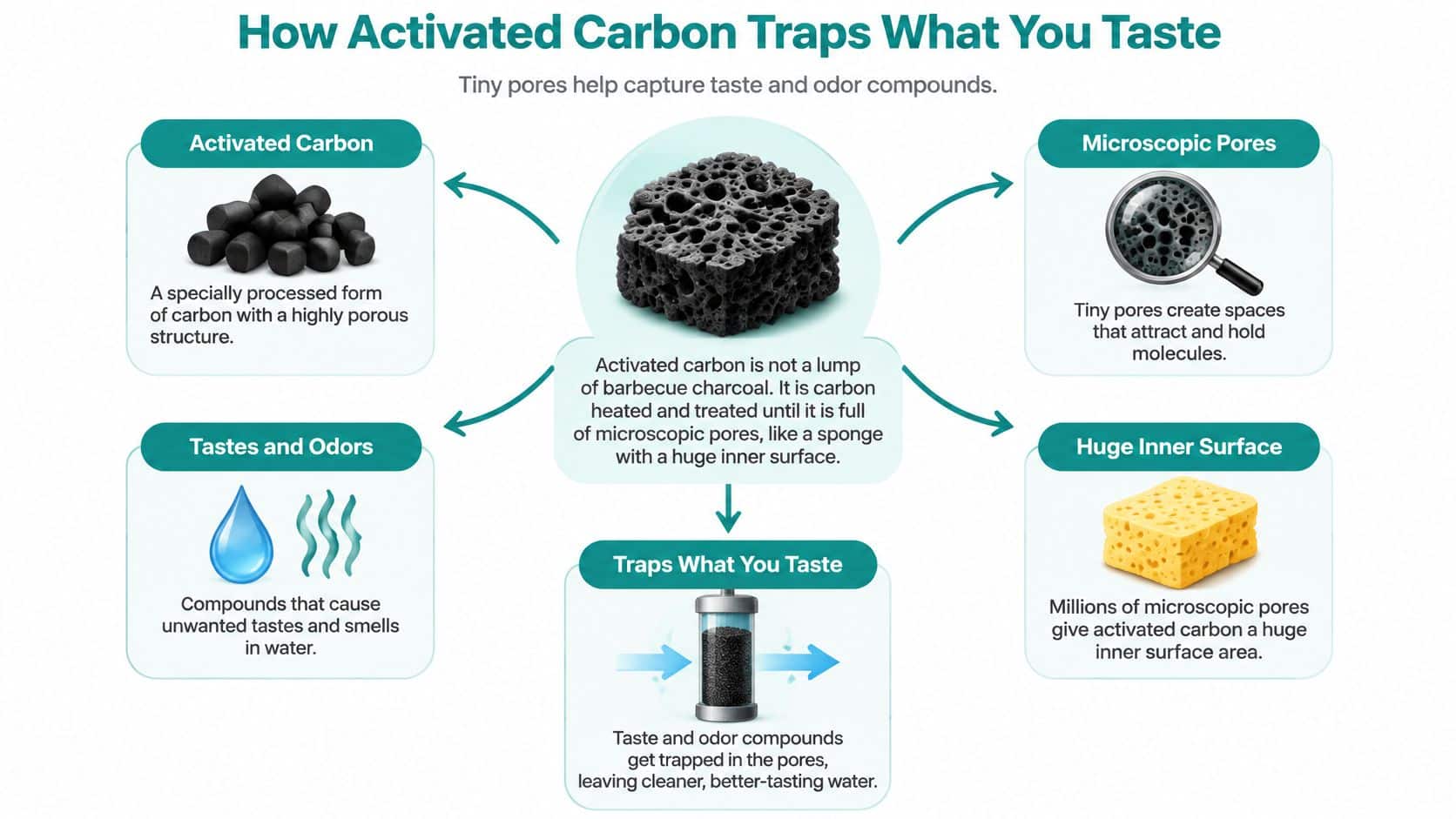
Activated carbon isn't a lump of barbecue charcoal dropped into a plastic holder. Manufacturers heat and treat carbon until it's full of microscopic pores, which turns each granule into something closer to a sponge with a huge inner surface. Water doesn't get strained through a screen so much as it passes countless sticky walls.
This diagram shows why pore surface matters more than the black color you see from outside.
Adsorption Is Sticking Not Sterilizing
As water moves through, dissolved substances contact that porous surface and become trapped in the pores, a process called adsorption. The EPA guidance on identifying drinking water filters certified to reduce PFAS describes granular activated carbon as an extremely porous material that traps contaminants, and EPA treats activated carbon as a common medium for improving taste and odor and trapping selected contaminants.
Say you fill a coffee reservoir with chlorinated tap water in the morning. Chlorine and many less water-soluble organic chemicals cling to the carbon if the flow is slow enough and there's enough carbon in the path. Your coffee loses that pool-water edge because those molecules stayed behind in the puck.
That same pass tells you the limit. Nitrate, fluoride, hardness minerals, and most metals largely stay dissolved and move on with the water. Germs aren't burned up or sterilized either, because adsorption is a sticking process, not a kill step.
This short video walks through that contact process so you can picture what happens inside a cartridge.
When the Parking Spots Fill Up
Think of each pore surface as offering a limited set of parking spots. Early in a cartridge's life, plenty of spots sit open, and capture looks effortless. As spots fill, new molecules find fewer places to stick, and removal drops even though water still flows normally.
That's why flow rate and contact time matter so much in a small brewer filter. Performance depends on the contaminant, how much carbon is in the cartridge, water chemistry, flow rate, and how long water touches the media. Push water through too fast and you shorten every molecule's chance to stick.
Once the carbon's adsorptive capacity is exhausted, disposable cartridges must be discarded, while larger carbon columns must be regenerated. The captured material is still sitting in that spent media, because the filter didn't destroy it.
Don't judge any of this by appearance. A black cartridge can make coffee taste cleaner without sterilizing the reservoir, the needle, or anything downstream, so look for an independent certification and a named reduction claim instead of trusting carbon color or the word charcoal on a box.
What NSF Labels Actually Promise
No single federal rule sets performance for every residential filter you'll find online. Voluntary standards set minimum safety and performance criteria instead, and each certification has to name the specific contaminant that was tested. That naming requirement is the part most buyers skip.
| Standard or claim | What it covers | What it does not mean |
|---|---|---|
| NSF/ANSI 42 | Aesthetic effects such as chlorine taste and odor | Not a health-contaminant reduction claim |
| NSF/ANSI 53 | Named contaminants with health effects | Does not remove every hazardous substance |
| Certified PFAS reduction | The specific PFAS chemicals tested on that model | Not automatic compliance with every newer limit; shorter-chain PFAS break through sooner |
| Generic activated carbon wording | Marketing description of the media | No verified reduction for lead, nitrate, microbes, or PFAS |
Read the Contaminant List Not the Headline
The EPA filtration fact sheet states that an activated-carbon filter alone is not designed to remove all disease-causing organisms, and carbon filters should be used only with a source known to be free of bacteria. That same EPA guidance names specific limits, because carbon filters don't remove bacteria, hardness minerals such as calcium and magnesium, fluoride, nitrates, or chlorides, and they remove only a small percentage of some inorganic chemicals.
So a filter can carry a legitimate certification and still leave your actual concern untouched. If lead in a pitcher is your worry, our guide to water filter pitcher lead removal shows why you need lead named on that exact model, not a generic health claim. A taste certification doesn't automatically upgrade itself into lead protection.
Reading rule: Find your contaminant printed on the model's own reduction list. If it isn't named there, assume the cartridge doesn't reduce it.
PFAS Shows Why Specific Beats General
PFAS is the clearest test of that rule. The EPA PFAS treatment fact sheet identifies granular activated carbon among the treatment technologies for meeting federal PFAS drinking-water limits, but it generally performs better against longer-chain PFAS such as PFOA and PFOS than against shorter-chain compounds such as PFBS and PFBA, which break through sooner.
EPA also describes activated carbon as potentially capable of complete removal for a period of time. That period depends on carbon type, filter-bed depth, flow rate, temperature, organic matter, and competing contaminants, so a strong first month doesn't guarantee a strong sixth month.
Real-world use adds one more qualifier. The Minnesota health guidance on granular activated carbon reports a Michigan review of point-of-use GAC systems that detected PFAS in 7 of 269 post-filtration samples, or about 3%, while the same assessment described PFOA and PFOS reductions potentially exceeding 99%.
Those two facts fit together. Certified GAC can work very well on the PFAS it was tested for, and existing certification standards may not demonstrate reduction to every newer regulatory level. Certified for PFAS is not the same sentence as safe against every chemical, so read the model's reduction list, not the box headline.
Premium Cartridges Versus Generic Charcoal
Start with the objection that ruins an otherwise good cartridge, the leak you don't notice. If a seal sits loose or a holder leaves a gap, water slips around the carbon instead of through it, and that bypassed stream gets no treatment at all. Great media can't help water it never touches.
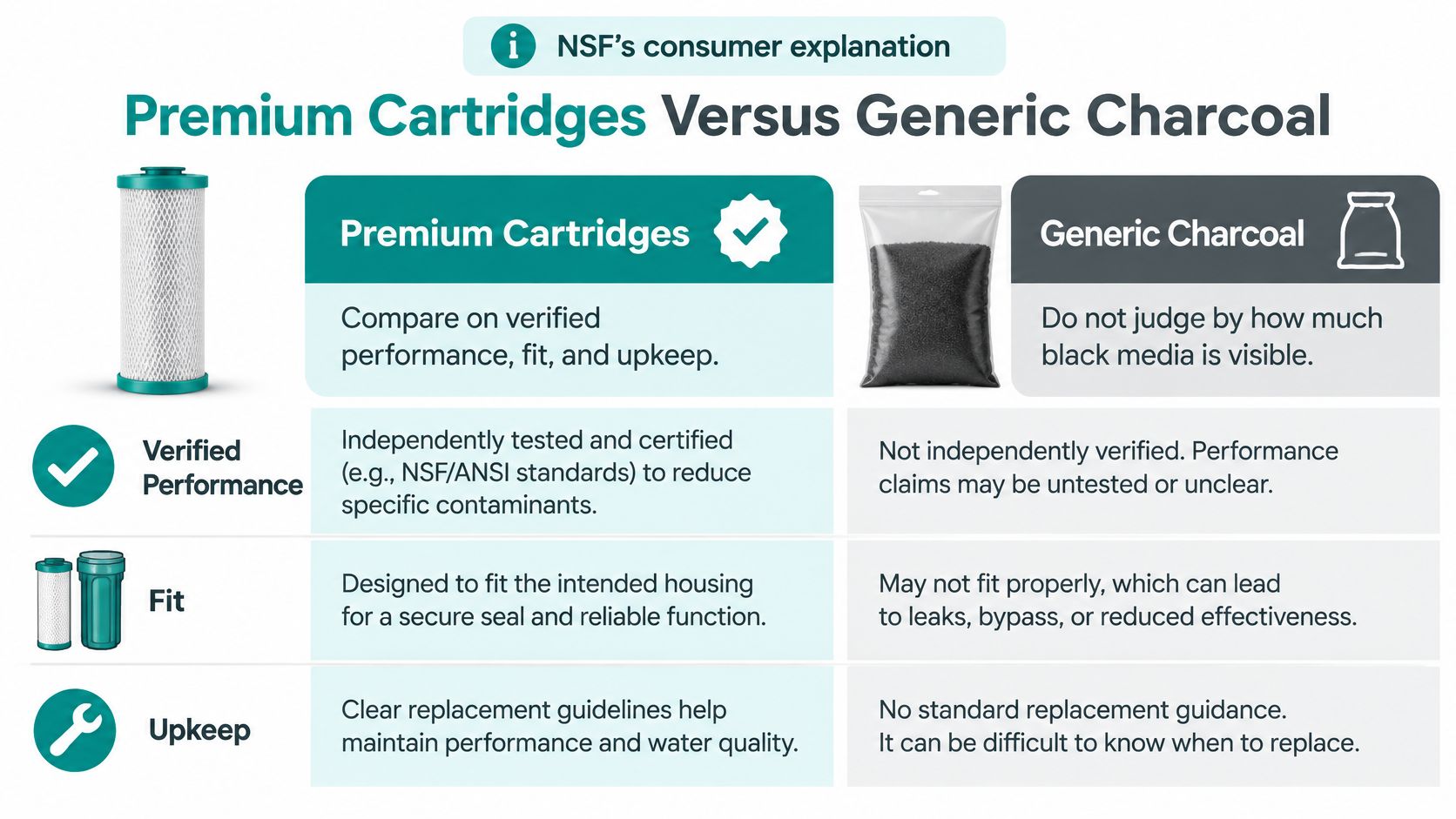
This comparison puts fit and verified claims ahead of how much black media you can see through the plastic.
| Check | Premium compatible cartridge | Generic charcoal cartridge |
|---|---|---|
| Fit | Made for a named machine so water is forced through the media | Loose fit can leave a bypass gap |
| Claims | Documented contaminant list under NSF/ANSI 42 or 53 | Often only the words activated carbon |
| Leaks | Seated seal you can inspect after the first fill | Poor seating drips or short-circuits treatment |
| Life | Replacement tied to gallons or months on the label | Often kept until coffee tastes off |
| Scale | Does not descale; mineral film still needs a cleaner | Same limit, easy to miss on a cheap puck |
What a Premium Label Should Actually Give You
Compare cartridges on verified performance, compatibility, and upkeep, not on carbon volume alone. The NSF guide to standards for water treatment systems separates NSF/ANSI 42 aesthetic claims such as chlorine taste and odor from NSF/ANSI 53 health-effect contaminants, and both apply only to the individual contaminants tested.
A premium compatible cartridge that names its claim and fits your machine gives you a more defensible result than a generic puck that only says activated carbon. Neither product removes everything, and price alone doesn't change that chemistry. What you're paying for is documented performance and a fit that forces contact.
Check that fit the moment you install it. Run a short fill, watch the holder for drips, and confirm the cartridge sits fully seated with no wobble. If water beads around the edge or the puck tilts, reseat it before you brew, because a cracked or loose seal turns your filter into decoration.
Four Checks Before You Buy
- Exact model fit: Match the cartridge to your named Keurig, Breville, or other brewer so water can't slip past the media.
- No bypass gap: Press the cartridge fully into its holder and inspect the seal after the first fill.
- Named certification: Require a printed contaminant claim if a health contaminant, not just taste, is your worry.
- Spare on hand: Keep a replacement ready so you don't stretch the old cartridge past its rated gallons or months.
Don't confuse this purchase with descaling, either. Swapping the charcoal filter on a Keurig, Breville, or similar brewer doesn't remove mineral scale, because carbon targets selected dissolved substances and taste or odor while scale needs its own cleaning cycle. If you're using ordinary tap water, follow the labeled interval even when the coffee still tastes acceptable, because taste is a late and unreliable gauge of remaining capacity.
When a Wet Cartridge Grows Bacteria and How to Stop It
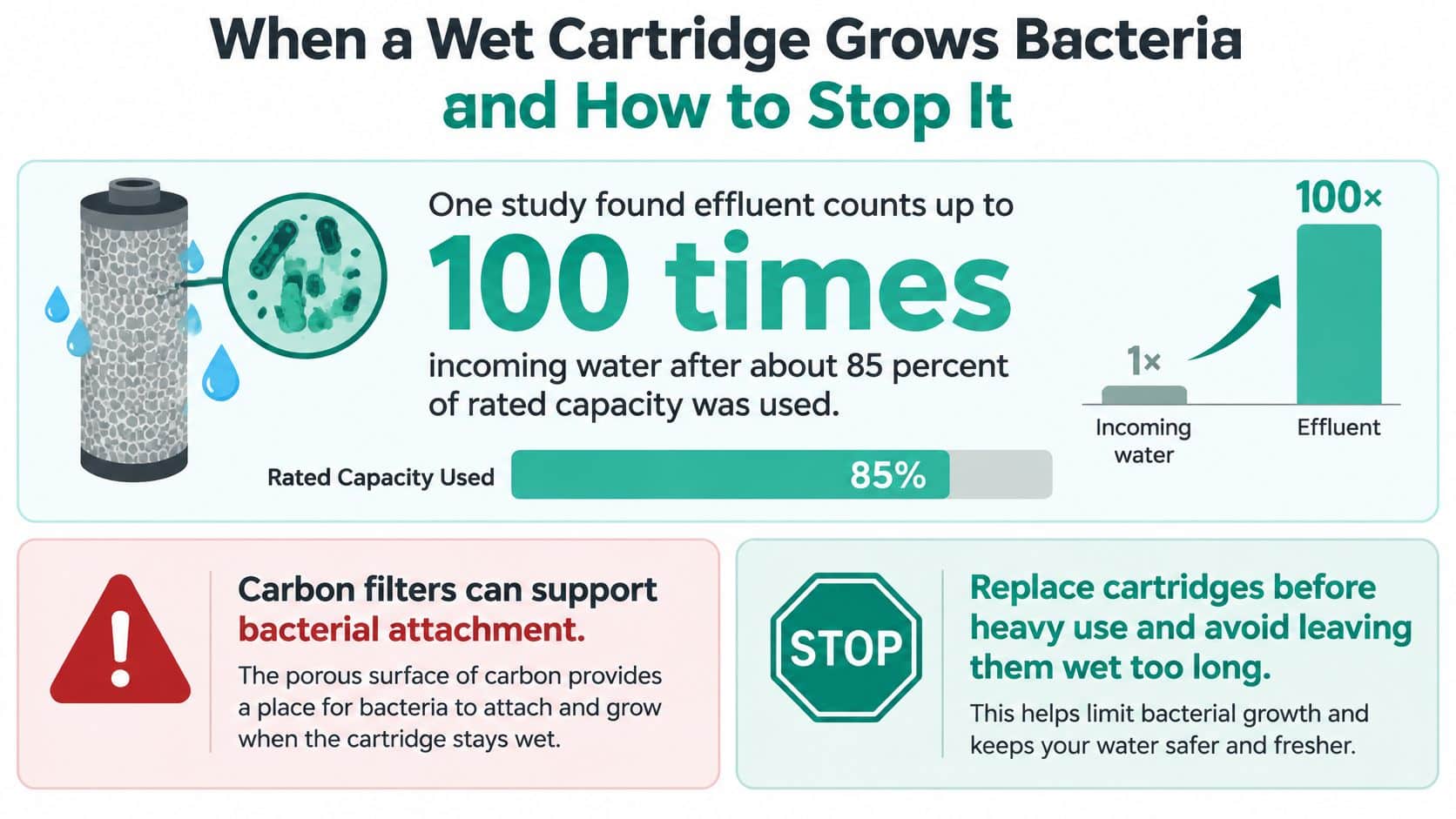
Here's the number that should change how you treat an old cartridge. The Connecticut guidance on granular activated carbon treatment reports research finding that activated-carbon filters can support bacterial attachment and growth, and in one study, effluent bacterial counts eventually reached levels up to 100 times those of incoming water after about 85% of the recommended filter capacity had been used.
Earlier field work in that same guidance found bacterial counts in filter effluent increasing over several weeks, with coliforms persisting after temporary contamination. That sounds alarming, and it should push you toward better upkeep. It doesn't mean charcoal itself is poisonous.
This infographic puts that capacity threshold in view, because the risk climbs as the cartridge ages.
Hold Two Facts at Once
Balance matters here, because the same guidance describes another study where filtered and unfiltered water had similar microbial levels after overnight standing, and flushing reduced both. Risk depends on source-water quality, storage, temperature, flow, and maintenance rather than charcoal alone. Clean, disinfected water moving through a fresh cartridge is a different situation from warm water sitting in a neglected reservoir for a week.
The mechanism is plain once you picture it. Carbon accumulates organic compounds as it works, and those trapped organics can serve as nutrients. Add a wet cartridge, stagnant water, and warmth, and you've built comfortable conditions for microbial growth on a surface that was only meant to adsorb chemicals.
The University of Georgia extension guidance on activated carbon filtration devices reports that significant bacterial growth can occur on carbon, particularly when a filter has been unused for several days or has become saturated, and it recommends thorough flushing for at least five minutes after extended nonuse. That guidance also ties the principal household risk to poor hygiene and delayed replacement, not to the carbon material itself.
Charcoal doesn't create the bacteria problem on its own. Wet, nutrient-loaded carbon left sitting in warm, stagnant water gives bacteria a place to settle and multiply.
For coffee brewers, the reservoir is the weak point people forget. A puck sitting in a warm tank doesn't disinfect the tank walls, the filter holder, the needle, or the downstream path to your cup. If you're unsure about the cleaning side, our guide on how often to clean a coffee maker covers the reservoir routine that a filter swap can't replace.
Seven Habits That Keep a Cartridge Safe
- Use carbon only on water already free of bacteria. Never make it the only step for untreated well, surface, or emergency water, because carbon isn't a reliable barrier for bacteria and viruses. If your source isn't known to be microbiologically safe, disinfect it first or use a system certified for that job.
- Seat the cartridge so flow can't bypass it. Follow the maker's flow and capacity specifications and press the puck fully into its holder. Water that sneaks around the edge skips treatment and can carry reservoir grime straight through.
- Flush new media until it runs clear. Run water through a new cartridge until carbon fines and gray discoloration disappear before you brew with it. Those early fines are loose particles from manufacturing and shipping, and you don't want them in your first cup.
- Flush again after days of nonuse. If the machine sat unused for several days, flush thoroughly for at least five minutes before drinking from it. Coming back from a trip to a half-full tank is exactly the scenario this step exists for.
- Empty a tank that will sit warm. Don't leave water standing in a coffee reservoir over a long weekend or a slow office week. Dump it, let the tank dry if you can, and refill with fresh treated water when you return.
- Replace by rating, not by taste. Swap the cartridge at its rated gallons or months instead of waiting for odor or flavor changes, because adsorption sites can fill before your tongue notices anything. Wash the tank and filter holder at each swap while everything is already apart.
- Dispose of spent media with care. Bag the used cartridge with household trash unless your local rules say otherwise, and remember that captured chemicals remain in the media. PFAS-loaded carbon sent to landfills can allow contaminants to leach back into the environment, so don't toss loose spent carbon into garden soil or compost.
One last separation protects your machine. Mineral scale on a Keurig or espresso machine still needs its own descaling cycle, because a fresh charcoal puck won't dissolve the film building up on heating elements. Treat filtration and descaling as two chores on two schedules, and neither one gets skipped because the other looked done.
Pick a Cartridge and Keep the Brewer Clean
Make the decision in one breath. Use charcoal on already treated water, match any health claim to a named certification on that exact model, and replace the cartridge before the bed is exhausted. If you follow those three rules, are charcoal water filters safe stops being a worry and becomes a routine.
We oversee manufacturing of our own brewer filters at PureHQ, so fit and rated life stay consistent from pack to pack. When you're ready to set your own interval, our guide to charcoal water filter replacement walks through timing by machine and usage.
Buy the Filter and the Descaler as Two Jobs
Carbon can't combine filtration and descaling, so buy for both. The Keurig and Breville Descaling and Cleaning Tablets come in a 24-count pack bundled with 6 compatible water filters for $19.95, which puts the filter swap and the mineral-scale job in one order.
If you prefer a liquid option, our Coffee Machine Descaler is made in the USA, covers 10 uses across Keurig, Nespresso, Breville, and other espresso machines, and costs $23.95. Breville owners who only need filters can choose the 12-pack of compatible replacement water filters for $15.95, and you should confirm current pricing on the product page before ordering.
Settle the leak question at unboxing, not after a week of muddy coffee. Run one short fill, watch the holder for drips, and reseat the cartridge until water is forced through the media rather than around a loose seal. Then choose your Keurig or Breville pack, add descaler if your brewer shows scale, and replace on the labeled gallon or month interval instead of waiting until the coffee tastes wrong.
Shop PureHQ for compatible Keurig and Breville charcoal water filters, descaling tablets, and our 10-use Coffee Machine Descaler, so your taste cartridge and your scale control stay on separate, reliable schedules. Pick the filter pack that matches your brewer, add descaler if your machine shows mineral film, and set your first replacement date today at PureHQ Inc..

