
Coffee Machine Care
Water Filters That Remove Chlorine for Better Coffee
Aug
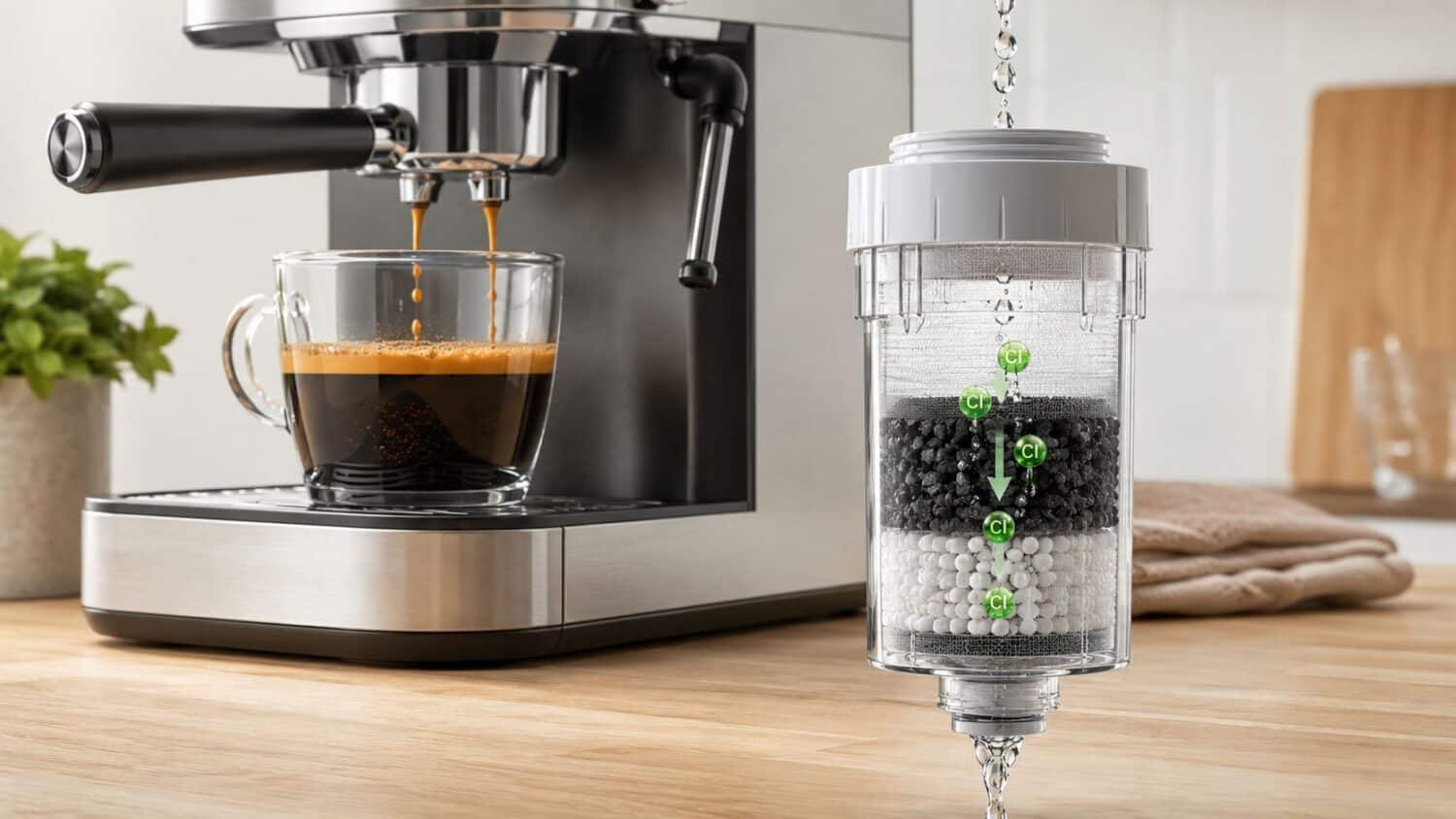
A certified chlorine filter is tested against water containing 2.0 mg/L of chlorine, and NSF/ANSI 42 requires at least 50% reduction to support a chlorine-reduction claim. Well-performing carbon systems can exceed 97% reduction in laboratory testing, but only when water moves through the cartridge at its rated flow and the filter hasn't reached its capacity. That difference matters when the same water fills your Keurig, Ninja, or Breville every morning. (NSF/ANSI 42 testing guidance)
Your brewer may be working perfectly while your coffee tastes flat, medicinal, or faintly like a swimming pool. The practical fix usually isn't a new pod or a more expensive roast. It starts with identifying whether your tap contains free chlorine or chloramine, then choosing a carbon cartridge that fits the machine's actual filter slot and replacing it before the media becomes exhausted.
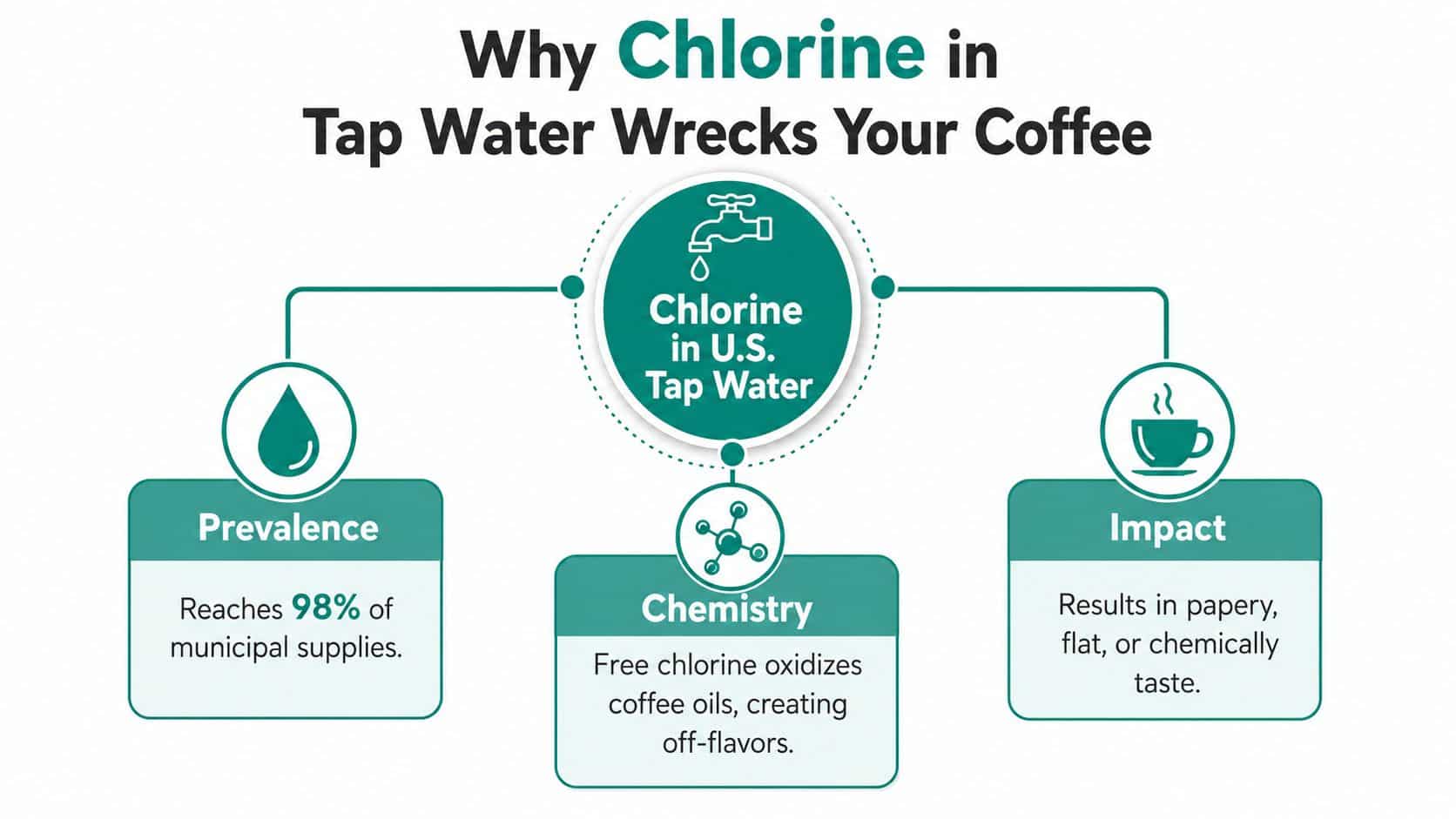
Why Chlorine in Tap Water Wrecks Your Coffee
Municipalities add chlorine or related disinfectants to keep drinking water safe as it travels through distribution pipes. At the kitchen tap, however, that residual disinfectant can become part of your brew water's flavor profile. Free chlorine reacts with organic compounds, and coffee contains plenty of aromatic oils and compounds that create fruit, floral, caramel, and chocolate notes.
That doesn't mean chlorinated tap water makes coffee dangerous. It means the water can interfere with the sensory result you paid for in the beans. A cup that should taste bright may seem dull, papery, or chemically sharp, while a dark roast can develop a harsher finish. The National Center for Biotechnology Information overview of activated carbon explains why carbon became useful for reducing chlorine in water treatment, while also placing that use in the broader history of municipal disinfection.
Flavor changes show up before obvious machine problems
Coffee brewers extract soluble compounds from ground coffee. Chlorine does not sit harmlessly beside those compounds. It can alter the water's smell and taste, which makes delicate flavors harder to notice even when the brewer's temperature and brew time remain unchanged.
Espresso users often describe the result as muted crema or a less defined shot. Pod brewers can produce a similar problem in a different way. Because the coffee is already portioned and the brew path is compact, an off-flavor in the reservoir water can dominate the finished cup.
The machine itself also benefits from sensible filtration, but a chlorine filter isn't a complete scale treatment. Activated carbon targets aesthetic concerns such as chlorine, taste, and odor. It doesn't reliably remove metals, nitrate, or every other inorganic contaminant, as explained in this University of Nebraska extension guide to activated carbon.
Coffee rule: If your coffee tastes wrong immediately after a utility treatment change, test or filter the water before changing the grinder, pod, or roast.
The filter has to match the chemistry and the brewer
A pitcher can reduce chlorine, but it may not provide the right flow path, contact time, or fit for a coffee machine. A cartridge inside the reservoir keeps treated water close to the point of use and lets you follow the appliance's replacement reminder or tank-refill routine.
The rest of the decision is specific: choose free-chlorine carbon when your utility uses free chlorine, choose catalytic carbon when the report lists chloramine, and confirm that the cartridge locks into your Keurig, Ninja, or Breville reservoir rather than merely fitting the opening.
How Chlorine-Removing Filter Technologies Actually Work
Different filter media remove chlorine through different chemical and physical processes. For a coffee machine, activated carbon usually provides the simplest answer because it works without electricity and can sit inside a small reservoir cartridge. Its performance still depends on the carbon bed, flow rate, and remaining capacity.
Granular activated carbon, or GAC, gives water contact with a large internal surface. The carbon reduces free chlorine through reaction and contact in the bed. Water-treatment guidance commonly places the needed empty-bed contact time for free chlorine around one to two minutes, while some technical designs report that shorter contact can work under particular conditions. (Carbon EBCT guidance)
The main media choices
- Activated carbon: A practical choice for free chlorine, taste, and odor. It doesn't provide thorough purification, and ordinary GAC may perform poorly against chloramine.
- Catalytic carbon: A more reactive carbon surface designed for harder-to-remove disinfectants. Look for an explicit chloramine-reduction claim and supporting test information, not just the word “carbon.”
- KDF media: Copper-zinc media uses an oxidation-reduction reaction to convert free chlorine to chloride. It may appear as one stage in a larger filter, especially when the design also targets other water-treatment needs.
- Reverse osmosis: RO systems use pressure and a semipermeable membrane for broad dissolved-contaminant reduction. Carbon normally protects the membrane from chlorine, so an RO system is more than a simple inline cartridge for a pod brewer.
An RO system can make sense when you also need broader dissolved-solids reduction, but its storage and flow design may be excessive for filling a small coffee reservoir. For chlorine taste alone, a properly matched carbon cartridge is usually easier to maintain.
| Technology | How It Removes Chlorine | Free Chlorine % | Chloramine % | Best For |
|---|---|---|---|---|
| GAC | Reacts with free chlorine as water contacts the carbon bed | Commonly tested under NSF/ANSI 42 conditions | Limited unless specifically designed and tested | Coffee reservoirs using free-chlorine water |
| Catalytic carbon | Uses a more reactive carbon surface for difficult disinfectants | High performance is possible when certified and operated within limits | Better suited when the cartridge carries a chloramine claim | Utilities using chloramine or mixed concerns |
| KDF | Uses a copper-zinc redox reaction | Effective for free chlorine in suitable designs | Limited alone, so check the product claim | Multi-stage systems and specialty applications |
| Reverse osmosis | Uses a membrane after carbon prefiltration | Very thorough when properly maintained | Carbon pretreatment addresses the disinfectant before the membrane | Users seeking broader dissolved-contaminant reduction |
The percentages in the table are not universal promises. NSF/ANSI 42 classifies chlorine performance into Class III at 25% to 49%, Class II at 50% to 74%, and Class I at 75% or greater. (NSF/ANSI 42 comparison document)
NSF and ANSI Standards That Prove a Filter Works
A filter labeled NSF/ANSI 42 is aimed at chlorine taste and odor. That label covers aesthetic treatment claims, not every contaminant that may be present in tap water. NSF's overview of NSF/ANSI standards for water treatment systems explains how these standards separate taste-related performance from health-related claims.
NSF/ANSI 53 covers specific health contaminants, including lead, only when the exact product has been tested and certified for that contaminant. A cartridge carrying a 42 claim can improve the water feeding a Keurig, Ninja, or Breville without being a lead, nitrate, or metal filter. For a clearer comparison, see this guide to water filter pitchers and lead removal.
Read the claim, not just the marketing panel
Under NSF/ANSI 42 testing, the chlorine challenge uses 2.0 mg/L influent chlorine, and a certified chlorine claim requires at least 50% reduction across the rated capacity. Some products test far beyond that baseline. Published test sheets report outlet levels around 0.03 to 0.04 mg/L from influent near 1.85 to 2.02 mg/L, equal to roughly 98% reduction in those tests. The Detailed NSF/ANSI 42 document provides the testing details.
Check four items before buying a replacement cartridge:
- Certification scope: Confirm that the exact model claims chlorine reduction, rather than only materials safety or general product certification.
- Rated capacity: Find the listed gallons or liters. That rating describes tested capacity, not a guaranteed service life for every home, machine, or water supply.
- Flow conditions: Carbon needs contact time. Water moving too quickly can cause chlorine breakthrough sooner, as this carbon dechlorination guidance from WaterProfessionals explains.
- Replacement instruction: Follow the manufacturer's interval, then replace sooner if chlorine taste returns or flow slows.
Buying check: Search the exact cartridge model in the NSF product database before checkout. “Removes chlorine” is a performance statement, not automatically an NSF/ANSI 42 certification.
That distinction matters when choosing the small cartridge for a coffee-machine reservoir. The correct filter must match both the certified claim and the machine's replacement schedule.
Matching Filters to Keurig, Ninja, and Breville Machines
The right cartridge must perform two jobs. It must reduce the disinfectant in your water, and it must stay seated in the machine's reservoir without obstructing the float, outlet, or lid. A filter that works chemically but wobbles in the well can create bypass, slow filling, or a frustrating “filter not detected” message.
Keurig machines typically use a small handle-and-cartridge assembly in the reservoir. The Keurig Water Filter Starter Kit is the OEM reference point for compatible models, including several K-Classic and Keurig 2.0 configurations. K-Supreme and K-Express models can use different holder shapes, so match the part to the model number rather than assuming every Keurig slot is identical.
Ninja DualBrew machines use a dedicated reservoir well, commonly paired with the Ninja CL04041 cartridge designation. The cylindrical cartridge must drop fully into that well and allow the cap or cover to close. Breville machines use their own reservoir filter arrangement. Breville Claro Swiss is the commonly identified OEM filter family for compatible espresso machines, but the Barista Express and Bambino Plus still require a model-specific fit check.
| Machine | OEM Filter | Certified Third-Party Option | Capacity | Replacement Interval | Price Range |
|---|---|---|---|---|---|
| Keurig 2.0 and compatible reservoir systems | Keurig Water Filter Starter Kit | PUR or another exact-fit cartridge with an NSF/ANSI 42 chlorine claim | Use the capacity printed for the exact cartridge | Follow the machine or cartridge schedule | Varies by pack and retailer |
| Keurig K-Supreme and K-Express | Keurig-compatible starter assembly | Waterdrop or another model-listed NSF/ANSI 42 option | Verify on the product sheet | Replace by rated capacity and taste | Varies by model and pack |
| Ninja DualBrew | Ninja CL04041 | Exact-fit Waterdrop or another certified option | Confirm the cartridge listing | Follow the cartridge instructions | Varies by pack |
| Breville Barista Express and compatible reservoir designs | Breville Claro Swiss | Breville-compatible certified carbon cartridge | Confirm the machine-specific listing | Replace according to the cartridge rating | Varies by model |
| Universal rental setup | A reservoir-compatible cartridge system | Choose the machine-specific adapter, not a loose pitcher cartridge | Depends on the selected cartridge | Follow the shorter applicable schedule | Varies by setup |
The table avoids invented retail figures because cartridge prices and capacities change by model, pack size, and seller. Treat the part number and slot shape as more important than a generic “universal” label. During installation, press the cartridge down until it seats firmly. Don't torque a plastic holder. If the design uses a click or snap, close it until the confirmation point, then check that the lid and reservoir float move freely.
Installing and Replacing Water Filters the Right Way
A carbon cartridge needs wetting and flushing before it supplies brewing water. The first flush carries away loose carbon dust and conditions the bed, while correct seating prevents untreated water from bypassing the media.
Keurig routine
- Soak the carbon disc for five minutes before placing it in the handle.
- Push the disc fully into the holder and reinstall the assembly in the reservoir.
- Run two 12-ounce cleansing brews without coffee before making your first cup.
The holder should sit flat. If the brewer still shows a filter warning, remove the assembly, reseat the disc, and check that the handle's tabs haven't shifted.
Ninja DualBrew routine
Open the rear reservoir flap and place the cylindrical cartridge in the dedicated well. Snap the cap closed, then run a full-tank flush before brewing. If flow slows, remove the cartridge and inspect the inlet for carbon dust or sediment. A cartridge that doesn't sit vertically can restrict the outlet.
Breville routine
For a Barista Express, soak the in-tank mesh filter for 10 minutes, fit it into the holder, and lock the holder into the reservoir or drip-tray position specified by the manual. For a Bambino, replace the drip-tray filter when the model's design calls for it, and keep the machine's descaling routine separate from carbon replacement.
Use this water filter installation guide when the holder design isn't obvious or the cartridge feels loose.
A simple replacement calendar
| Machine family | Starting replacement reminder |
|---|---|
| Keurig | Every 60 days or 40 tank refills |
| Ninja DualBrew | Every 60 days or 60 tank refills |
| Breville | Every 60 to 90 days |
These intervals are practical starting points, not guarantees for every water supply. Replace earlier when chlorine odor returns, coffee flavor changes, or flow becomes noticeably restricted. If the filter isn't detected, verify the model-specific holder, press the cartridge fully into place, and clean the contact or sensor area without forcing it.
Chloramine, Hard Water, and Other Gotchas Most Guides Skip
A filter labeled for chlorine may not handle chloramine well. Standard GAC works effectively for free chlorine, while chloramine generally needs catalytic carbon and longer contact time. The distinction matters because chloramine remains more stable in water, so a cartridge that fixes free-chlorine odor may leave a medicinal or metallic note untouched.
Start with your utility's annual Consumer Confidence Report. The EPA Consumer Confidence Report resource explains where to find public water-quality information. Look for the disinfectant used by the system, then search the filter's technical sheet for an explicit chloramine-reduction claim.
Chemistry check: Don't buy ordinary carbon for chloramine water simply because both products use the word “chlorine” in the listing.
Hard water creates a separate problem. Calcium and magnesium can coat surfaces and contribute to scale, which carbon alone isn't designed to control. High dissolved-mineral content can also change how coffee tastes, even after chlorine has been reduced. A water softener addresses hardness, not chlorine, so households dealing with both issues may need separate treatment stages. For a broader home-water approach, this resource on water conditioners for homes provides useful context on conditioning equipment.
A neglected cartridge can create its own taste problem. If a brewer sits unused for an extended period, empty the reservoir, rinse it, and follow the machine's cleaning instructions before brewing. A filter can only perform within its rated capacity and operating conditions, so a cartridge that has been left in place too long shouldn't be “saved” for later use.
Choosing the Best Filter and Where to Buy
For daily coffee, an appliance-matched cartridge usually beats a generic pitcher cartridge because the machine receives treated water directly at its reservoir. You avoid pouring water between containers, reduce the chance of bypass from an ill-fitting insert, and can follow a replacement schedule designed around the brewer's tank use.
Begin with the water report, then check the box and technical sheet for NSF/ANSI 42 chlorine certification. If the report lists chloramine, require a catalytic-carbon or other explicitly tested chloramine claim. A fine-particle rating may help with sediment, but it doesn't replace a chlorine claim, and the rating alone doesn't prove broad contaminant removal.
A practical shortlist
- Keurig Water Filter Starter Kit: The straightforward OEM choice for compatible Keurig reservoir holders. Verify whether your model is K-Classic, 2.0, K-Elite, K-Slim, or K-Duo before ordering.
- Breville Claro Swiss: The appropriate starting point for compatible Breville reservoir designs. Confirm the exact espresso-machine model and holder shape.
- PUR Plus: Consider it only when the product listing confirms the needed appliance compatibility and the relevant NSF/ANSI 42 claim.
- EveryDrop by Whirlpool: A third-party option to evaluate by exact model and certification listing, not by brand familiarity alone.
- PureHQ Inc.: PureHQ offers activated-charcoal replacement filters and starter kits for compatible Keurig systems, along with compatible options for Ninja DualBrew models and Breville-compatible charcoal filters.
| Filter | Compatible Machine | Certifications | Chlorine/Chloramine Reduction | Replacement Interval | Approx. Price per Cartridge |
|---|---|---|---|---|---|
| Keurig Water Filter Starter Kit | Listed Keurig reservoir systems | Check the exact model listing | Chlorine claim depends on the listed cartridge | Follow the OEM schedule | Varies by pack |
| Breville Claro Swiss | Listed Breville machines | Check the exact model listing | Chlorine reduction claim depends on the cartridge | Follow the OEM schedule | Varies by pack |
| PUR Plus | Compatible pitcher or adapter setups | Verify NSF/ANSI 42 on the exact product | Chlorine claim, chloramine only if stated | Follow the product rating | Varies by retailer |
| EveryDrop by Whirlpool | Compatible appliance setups | Verify the exact certification listing | Check whether the claim covers your disinfectant | Follow the product rating | Varies by retailer |
| PureHQ compatible carbon filters | Listed Keurig, Ninja, or Breville configurations | Verify the exact product page and model | Activated charcoal targets chlorine; verify chloramine coverage | Follow the product instructions | Varies by pack |
A product page should show the model fit, cartridge capacity, certification scope, and replacement guidance. Manufacturer sites are the safest source for warranty-sensitive parts. Large retailers can offer convenient multipacks, but marketplace listings sometimes combine several model numbers under one title. Before checkout, compare the slot shape, part number, and machine model with the seller's compatibility list. For broader pitcher buying guidance, see these water filter pitcher reviews.
Visit PureHQ Inc. to find compatible chlorine-reducing filters for Keurig, Ninja, and Breville systems, plus descaling and cleaning accessories for routine maintenance. Check your exact coffee-machine model on the product page before ordering, then install and flush the cartridge so your next brew starts with better-tasting water.

