
Coffee Machine Care
Water Filter Pitcher Reviews: The Best for Coffee in 2026
Jun
You buy good beans. You clean the basket. You dial in grind size. Then your coffee still tastes dull, hollow, or faintly chemical.
The brewer often receives the blame. I usually blame the water first.
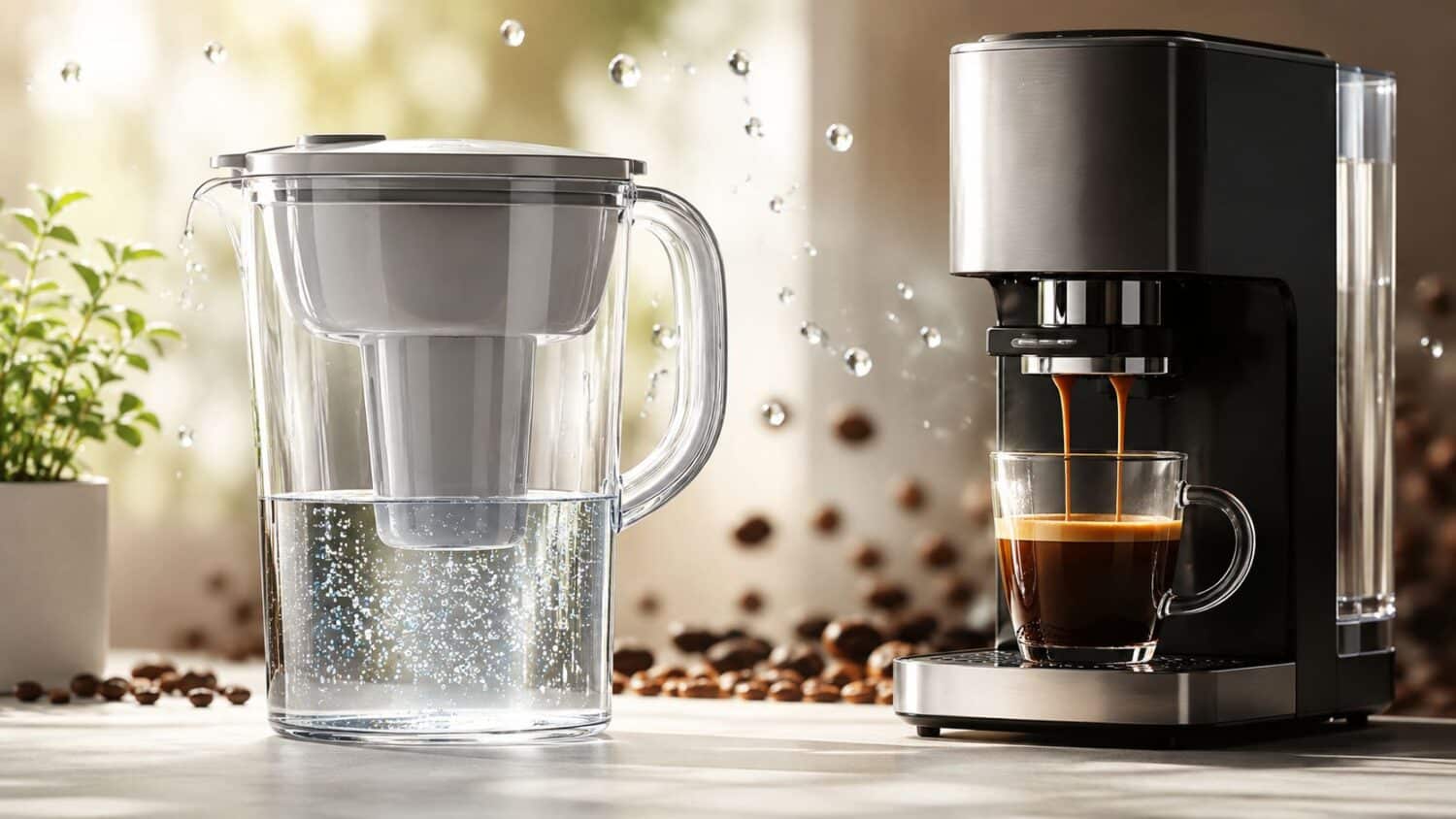
For coffee, a pitcher filter isn't just a kitchen convenience. It's a flavor tool and a machine-protection tool. That matters whether you're filling a Keurig before work, topping off a Ninja DualBrew for a full carafe, or babying a Breville espresso machine that costs far more than the beans sitting next to it.
The tricky part is that many water filter pitcher reviews lump everything together. They treat “better drinking water” and “better coffee water” as the same decision. They aren't. Coffee brewing asks different questions: Does the pitcher remove the chlorine that flattens aroma? Does it help reduce the stuff that leaves deposits behind? Does it filter fast enough that you'll use it every morning? And does the filter itself avoid introducing new material into the water?
Is Your Tap Water Ruining Your Perfect Coffee
You can spend real money on a Keurig, Ninja, or Breville and still brew a disappointing cup if the reservoir starts with bad-tasting water. Coffee pulls aroma, sweetness, bitterness, and body from the water you feed it. If that water smells off, tastes chlorinated, or carries other unwanted compounds, the machine can't rescue the cup.
That's why the best water filter pitcher reviews pay so much attention to taste and odor. In Consumer Reports' 2026 pitcher testing, 8 of the 12 pitchers in its ratings did a very good job of improving flavor and reducing odor. That's a useful signal for coffee drinkers. Reviewers aren't treating taste as a fringe bonus. They're treating it as a core buying factor because people notice it immediately in the glass and in the mug.
Why coffee exposes water problems fast
Hot coffee is unforgiving. It magnifies what cold water can hide.
A little chlorine note in tap water may seem tolerable on its own, but once heat hits the brew chamber and coffee oils dissolve into the cup, that same water can make the result taste thin or oddly sharp. Single-serve brewers make this even more obvious because there's less room to hide defects behind batch dilution.
Practical rule: If your plain tap water smells like pool water or leaves an aftertaste, your coffee will probably advertise that flaw louder, not softer.
There's also the machine side of the problem. The same tap water that hurts flavor can stress internal parts over time. That's one reason local water quality matters so much. If you're trying to understand the broader treatment options behind your tap, this guide to water purification for Northern Colorado homes gives helpful background on how household water treatment approaches differ.
For a coffee-specific angle, a practical next read is this guide on how to improve water quality, especially if you're troubleshooting stale flavor before replacing a brewer that may not be the actual problem.
Early comparison for coffee users
| Pitcher type | Best fit | Main strength | Main trade-off | Coffee use case |
|---|---|---|---|---|
| Mainstream pitcher | Daily convenience | Better taste and odor in an easy routine | Often less specialized than premium models | Keurig and Ninja owners who want a simple everyday upgrade |
| Premium contaminant-focused pitcher | Maximum reduction priorities | Broad contaminant reduction focus | Slower filtration is common | Breville owners and flavor obsessives |
| Budget or generic pitcher | Lowest upfront commitment | Accessible starting point | Performance details are often less transparent | Casual coffee drinkers testing whether filtered water helps |
How Hard Water and Chlorine Harm Your Coffee Maker
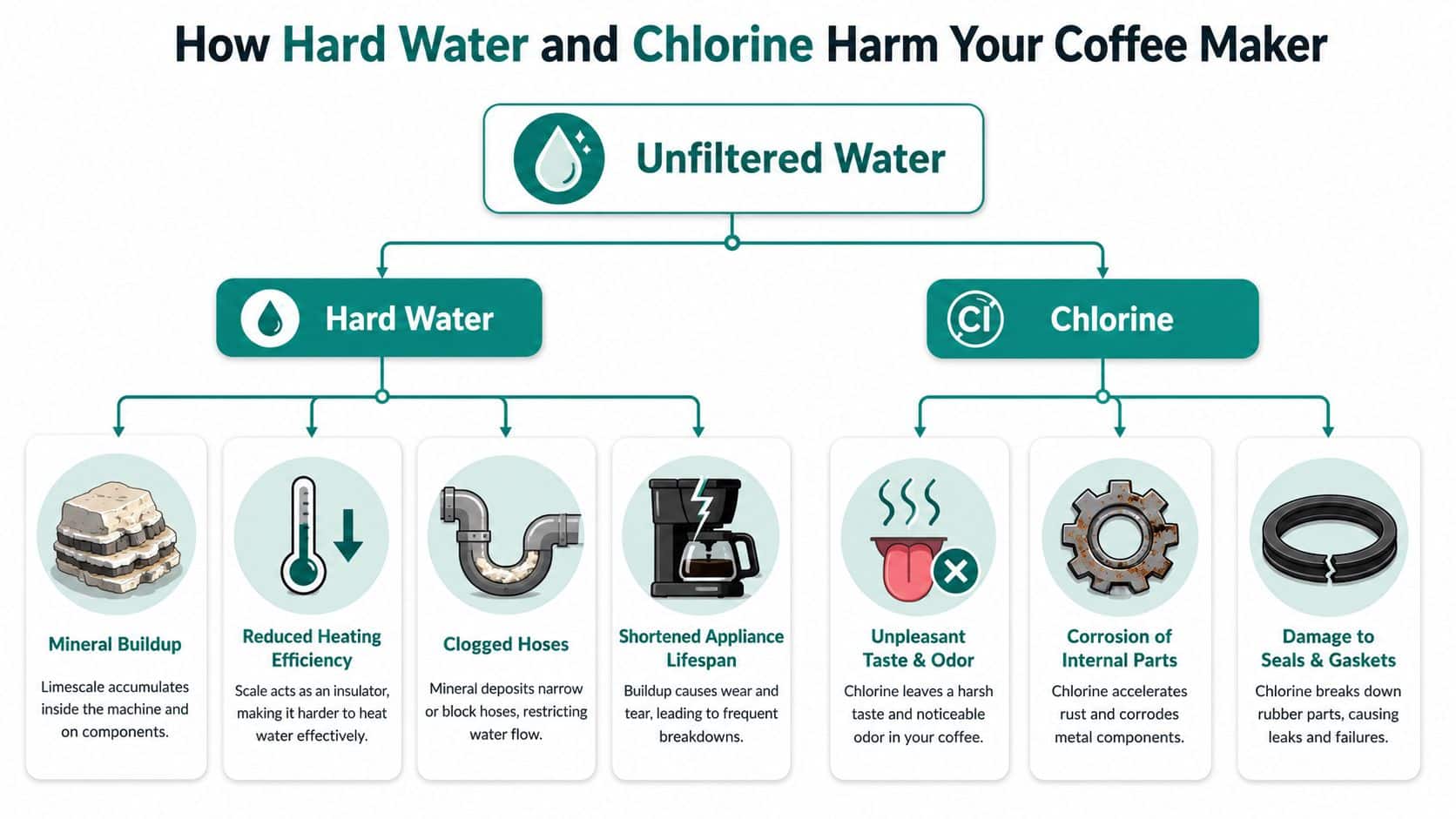
Hard water and chlorine create two different problems. One attacks the machine's internals. The other attacks flavor first, then can wear on parts over time.
What hard water does inside the machine
When a brewer heats water, dissolved minerals can leave deposits behind. Those deposits collect where coffee makers are least tolerant: narrow lines, heating areas, valves, needles, and small flow paths.
In a Keurig, that can show up as slower fills, inconsistent cup size, sputtering, or a machine that sounds strained. In a Ninja brewer, mineral buildup can interfere with predictable water delivery across a larger brew cycle. In a Breville espresso machine, the consequences are more significant because pressure and temperature consistency matter more. If scale builds where water should move freely, shot quality suffers before the machine fully fails.
Here's the practical chain reaction:
- Mineral deposits form first. The machine still works, but water doesn't move as cleanly.
- Heating becomes less efficient. The brewer has to work harder to reach target temperature.
- Flow pathways tighten. Needles, hoses, and internal passages become more vulnerable to partial blockages.
- Performance drops. Coffee tastes less consistent, brew time changes, and maintenance becomes more frequent.
What chlorine does to coffee flavor
Chlorine is brutal on nuance. It can flatten sweetness, mute aromatics, and leave a medicinal edge that reads as “cheap coffee” even when the beans are solid.
That matters for light roasts and espresso most of all. Those styles depend on clean extraction and clear aroma. If your water carries a distinct treatment taste, the cup loses separation between pleasant bitterness and unpleasant harshness.
A brewer can't create clarity from water that already tastes wrong.
Chlorine may also be rough on seals, gaskets, and plastic parts over long use, especially in machines with small internal components and repeated heat cycles. You might not notice it in one month. You notice it when the machine that used to feel reliable starts behaving old before its time.
Cleaning still matters, even with filtered water. If your brewer already has residue, oils, or visible scale, pairing better water with a cleaning routine works far better than doing either one alone. I like practical maintenance references such as Altitude Cleaning Crew's cleaning tips because they focus on the habits that prevent “my machine is broken” moments that are often just buildup.
Decoding Pitcher Certifications and Filter Technology
A pitcher spec sheet matters more than it looks. If you brew with a Keurig, Ninja, or Breville, the wrong filter can leave chlorine in the water, do little for scale-related minerals, or slow your routine enough that you stop using it. The right way to read these products is less about branding and more about three questions: what the filter reduces, which claims were independently certified, and whether the pitcher materials introduce their own quality concerns.
What certifications reveal
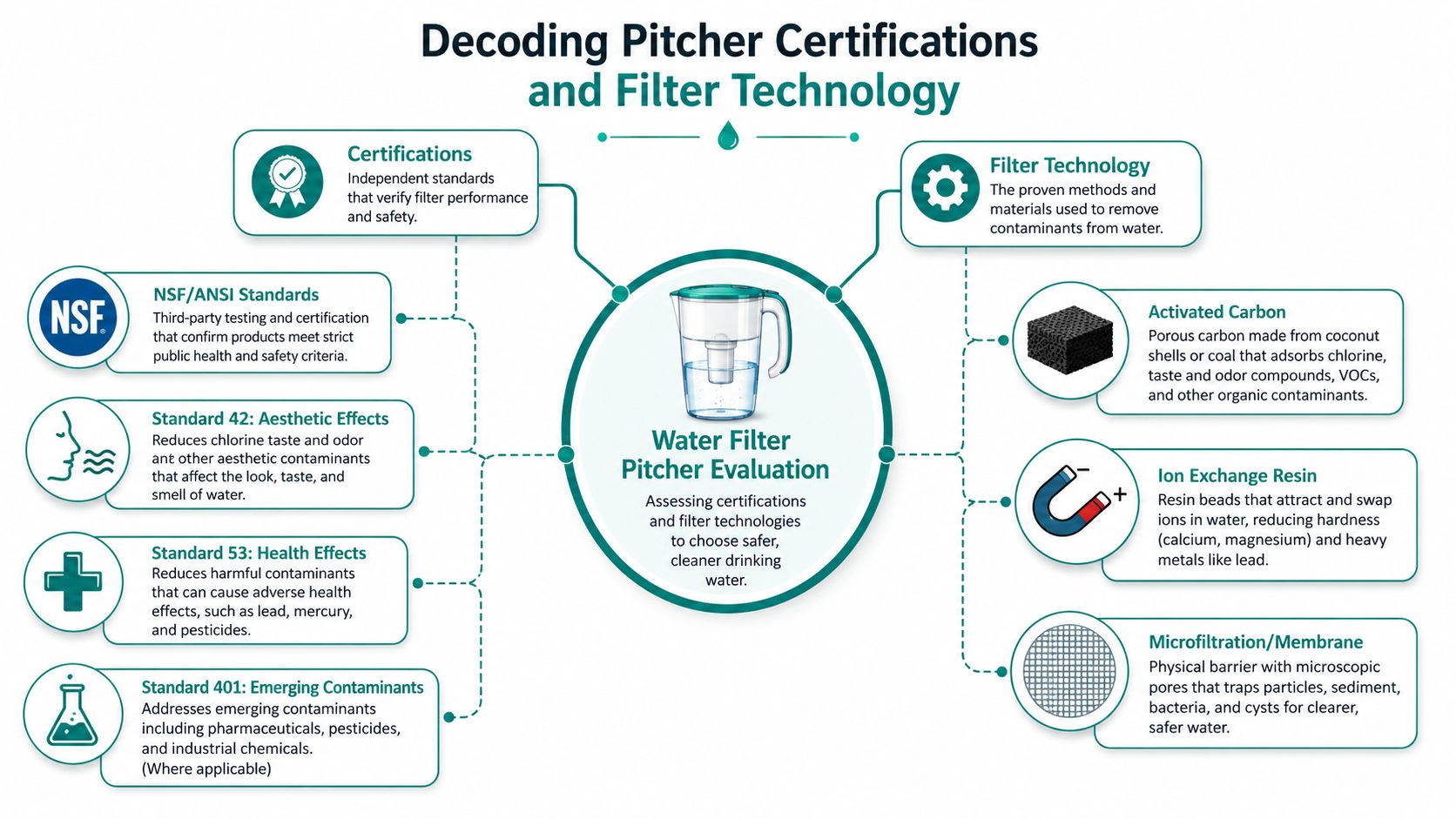
Certification language gives you a minimum verified standard. Marketing copy does not.
For coffee use, that distinction matters because taste improvement and machine protection are related but not identical goals. A pitcher can be strong at reducing chlorine and odor, which helps cup clarity, while doing far less to reduce the mineral load that leaves residue inside heating systems and narrow water lines. That is why NSF or WQA language deserves a close read. You want to know whether the certification covers aesthetic effects such as taste and odor, health-related contaminants such as lead, or scale-linked ions that affect brewer internals over time.
Brand data still has value, but it should be read as a claim layered on top of the certification floor, not a substitute for it. For a Breville owner pulling espresso-style drinks, that difference is practical. A broad contaminant claim may sound impressive, but if the verified reductions do not line up with hardness or chlorine issues in your local water, the pitcher may improve drinking water while leaving coffee performance only modestly better.
The filter media behind the claims
Most pitchers rely on a familiar mix of materials, but the media mix tells you a lot about how the pitcher will behave in daily coffee use.
- Activated carbon targets chlorine, off-odors, and some organic compounds. That is the media most directly tied to cleaner aroma and less chemical edge in brewed coffee.
- Ion exchange resin is used to reduce certain dissolved minerals or metals. This matters more for machine maintenance, especially in brewers with heating elements and tight internal tubing.
- Layered or proprietary blends try to widen the reduction profile, often with slower flow as the tradeoff.
That tradeoff deserves more attention in pitcher reviews. A filter that removes more contaminants on paper can still be a poor fit for a 6 a.m. routine if refill time becomes irritating. Keurig and Ninja owners often do better with a pitcher that is fast enough to stay in rotation every day. Breville owners, especially those making espresso or concentrated drinks, may accept slower filtration if it means better control over taste and scale pressure. If you want a machine-specific framework, this guide to the best water filter for espresso machine connects water treatment choices to espresso performance more directly than a generic pitcher roundup.
A broader perspective helps too. RVupgrades.com's water filtration guide focuses on mobile setups, but the selection logic carries over well: choose the filtration method based on the water problem and the equipment you need to protect.
The overlooked issue of material safety
A good pitcher should not solve one problem while introducing another.
ConsumerLab reports that while most water filters remove chlorine and lead, some can add plastic to the water. That changes how I rate pitcher technology for coffee use. A filter is part of the brewing system, even if it sits in the fridge instead of inside the machine. If the housing, reservoir, or media shed unwanted material, you are no longer judging filtration alone. You are judging the quality of the whole water path.
That is one reason certification-heavy marketing can still leave gaps. A pitcher may show meaningful reduction claims and still leave unanswered questions about long-term material quality, consistency between replacement filters, or whether the design suits your actual brewer. For coffee drinkers, especially those trying to keep a Breville stable or a Keurig from aging early, the best purchase is rarely the one with the longest claim list. It is the one whose certified reductions, media design, and everyday usability line up with your water and your machine.
A short explainer helps if you want a visual walkthrough before you compare models:
Performance Showdown Three Leading Pitcher Models
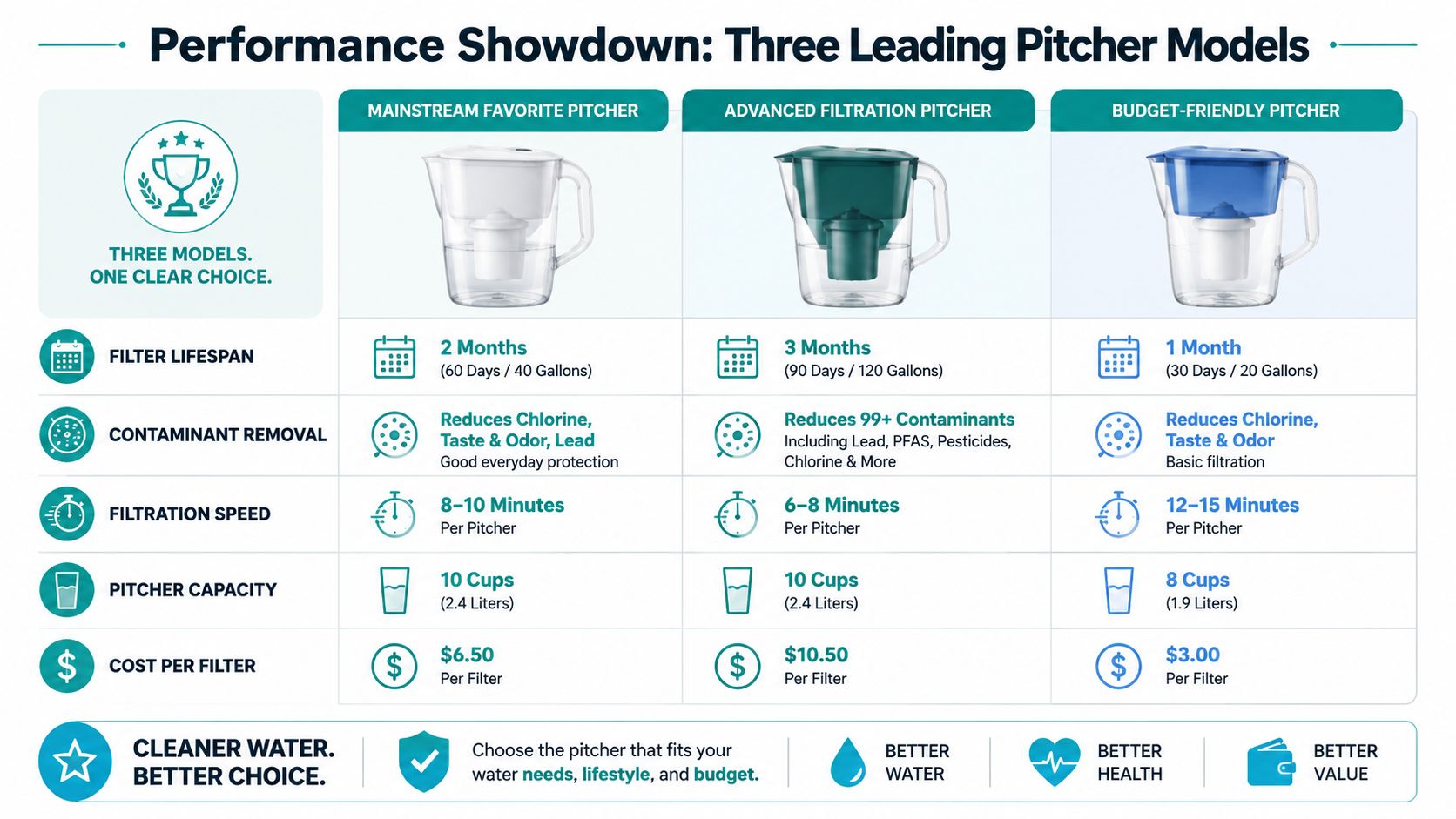
For coffee use, I sort pitcher options into three buckets: the mainstream everyday model, the premium contaminant-focused model, and the lower-cost or generic alternative. That framing is more useful than chasing a giant “top ten” list because most buyers are really choosing between convenience, deeper filtration, and price tolerance.
Mainstream favorite
The mainstream pitcher wins on routine. It's usually easy to fill, easy to stash in the fridge, and simple enough that everyone in the house will use it without instruction.
For coffee, that matters more than enthusiasts sometimes admit. A pitcher with solid taste improvement and low friction often beats a technically superior model that sits empty because nobody wants to wait on it. If your machine is a Keurig or a Ninja and your goal is “better-tasting daily coffee with less fuss,” the mainstream option often lands in the sweet spot.
The weakness is ceiling. Mainstream pitchers can be excellent practical tools, but they often don't become the favorite of people who want the most aggressive reduction profile available in a pitcher format.
Advanced filtration pitcher
The premium contaminant-focused pitcher is where the most interesting data tends to show up. In a data-driven review of the Clearly Filtered pitcher, the filter was reported to reduce 100% of fluoride and uranium in the test sample, and the review states that the product is third-party tested to reduce more than 365 contaminants, including chlorine, lead, and fluoride. The same review measured 0.5 gallons filtered in 13 minutes and 12 seconds, which equals about 2.27 gallons per hour.
That's the core trade-off in one line: broad reduction, slow fill.
For coffee drinkers, that trade-off matters differently by machine:
- Keurig owners may find the wait noticeable if they refill the reservoir right before brewing.
- Ninja users may need to plan ahead for larger batch brewing.
- Breville owners may accept the slower pace because protecting an espresso machine often feels worth the inconvenience.
Bench test mindset: Don't ask whether a slow pitcher is “good” or “bad.” Ask whether its pace fits the way you actually brew on weekday mornings.
Standard or generic alternatives compared
A cheap or generic pitcher can still be useful, but it usually leaves you with less transparency. You may get decent taste improvement. You may not get the same clarity on what the filter targets, how the media works, or whether the company gives meaningful performance detail beyond broad claims.
That doesn't automatically make standard alternatives poor choices. It does make them harder to compare intelligently.
| Category | What you usually get | What coffee users should watch |
|---|---|---|
| Mainstream branded pitcher | Strong ease of use, familiar replacement process, broad availability | Confirm it solves taste issues first, not just branding comfort |
| Premium contaminant-focused pitcher | Deep documentation and stronger reduction positioning | Slow flow can become the daily annoyance that kills adoption |
| Generic or lower-cost pitcher | Lower barrier to entry | Less detail on certifications, media, and long-term consistency |
The objection most buyers have
The most common pushback against premium pitchers isn't “I don't care about filtration.” It's “I don't want to wait around for water.”
That objection is fair. A pitcher that filters slowly can interrupt the whole ritual, especially if your coffee routine depends on speed. My rule is simple: if you brew under time pressure, optimize for consistency and useability first. If you brew for quality and machine protection, especially with espresso, you can justify more patience.
The Right Pitcher for Your Keurig Ninja or Breville
Buying the “best” pitcher in the abstract isn't the goal. Buying the right one for your machine is.
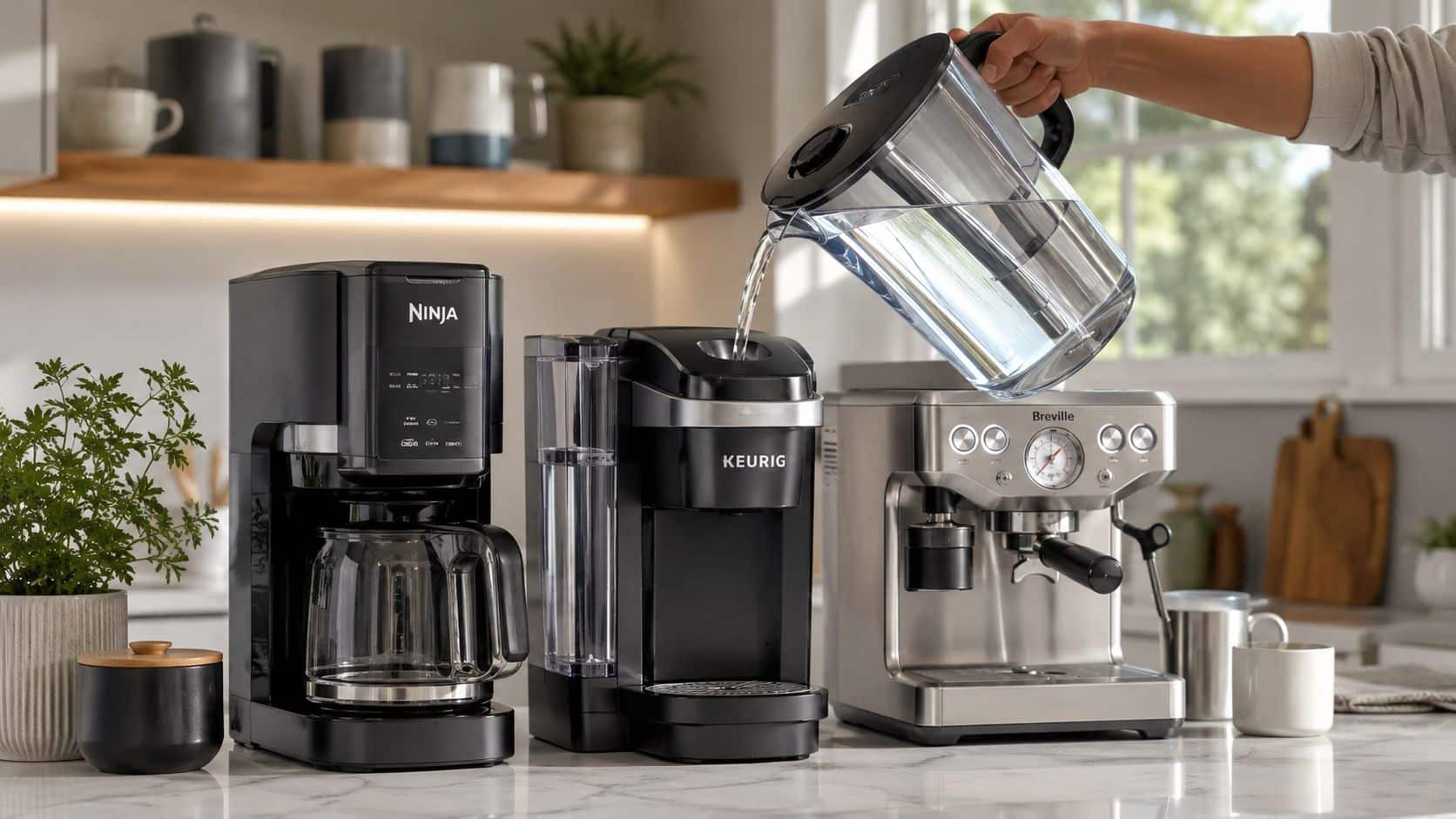
For Keurig owners
Keurig users usually care about speed, routine, and repeatability. You want water ready when you want coffee, not a mini project before the first cup.
That points many people toward a mainstream pitcher or any model with a low-friction refill habit. If you only brew single cups and tend to top off the reservoir casually, a slower premium pitcher may still work. But if your mornings are rushed, convenience matters more than theoretical maximum filtration.
A reusable pod and a dependable filtered-water routine are a strong pairing because both improve control. One lets you choose better coffee. The other stops tap-water off-notes from undoing that effort.
For Ninja users
Ninja brewers often serve households that switch between mugs and larger batches. Capacity and refill rhythm matter more here than with a single-serve-only machine.
A pitcher that feels fine for one Keurig cup can feel annoyingly slow when you're filling for a carafe. That's why Ninja owners should think less about the single best lab profile and more about whether the pitcher supports repeat use without creating friction. You'll stick with a system that feels easy on a busy morning.
For Breville owners
Breville owners should be pickier. Espresso machines are less forgiving than pod brewers because scale and flow issues show up quickly in extraction quality and machine behavior.
A cited review of 14 pitchers ranked the Clearly Filtered model highest overall with a weighted score of 4.22/5 across filtration, usability, and cost, and the same review reported strong 2025 lab results showing nearly every undesirable substance tested was removed, with nitrate reduced but not fully eliminated and low, measurable leaching reported at negligible levels in the tester's summary via this comparative review video. If you own a Breville and care about broad contaminant reduction more than speed, that kind of profile is compelling.
For espresso machines, the best pitcher often isn't the fastest one. It's the one you trust enough to use every day.
A smart maintenance stack for espresso includes more than water alone. Filtered water handles one part of the equation. Regular descaling and timely replacement of machine-specific water components handle the rest. If you use a Breville, these Breville coffee machine water filters are worth reviewing alongside your pitcher choice so the machine-side filtration and your fill-water strategy aren't working at cross-purposes.
Analyzing the Long-Term Cost of Filter Replacements
The cheapest pitcher on the shelf can become the expensive one after six months of coffee use. If replacement filters are frequent, hard to find, or inconsistent in performance, you pay twice. Once at checkout, and again in weaker flavor, slower morning prep, or more scale stress on a brewer that was supposed to be protected.
That is why long-term cost needs a coffee-specific lens.
For Keurig and Ninja owners, ongoing value usually comes down to whether a pitcher removes enough chlorine and off-taste compounds to keep the cup clean without turning refills into a chore. For Breville owners, the math is stricter. Filter cost has to be weighed against how well the pitcher supports cleaner extraction water and reduces the mineral load that can shorten the interval between descaling sessions.
Why the replacement cycle matters more than the sticker price
A filter replacement is not just a consumable. It is the price of maintaining a certain level of water quality over time.
As noted earlier with the Brita Elite example, certifications and brand-reported performance can point to different levels of assurance. That distinction matters in cost analysis. A lower annual filter bill is less impressive if the filter only addresses taste while leaving you with water that still causes machine maintenance problems. A pricier replacement schedule can make sense if it helps preserve flavor consistency and reduces the headaches that come with harder water in coffee equipment.
The hidden cost is inconsistency. If one filter gives you a clean, sweeter cup for a few weeks, then performance drops before the official replacement date, your real cost per good brew is higher than the package suggests.
A better way to judge ongoing value
If exact replacement pricing and lifespan data are not comparable across every model, use a practical framework instead:
- Match the filter to the machine. Keurig and Ninja users can often justify a lower-cost pitcher if chlorine reduction is the main win and hardness is moderate. Breville owners should be more cautious because espresso quality and scale sensitivity raise the cost of mediocre filtration.
- Price the routine, not just the cartridge. A filter that is cheap but annoying to replace or too slow to refill often gets used less consistently.
- Watch for multipacks and broad availability. Easy-to-find replacements reduce the odds that you stretch a filter past its useful life.
- Count maintenance savings indirectly. If better filtered water helps you descale less often or keeps flavor from drifting, that has value even if it does not show up on the pitcher box.
One more point matters here. Coffee drinkers use pitchers differently from plain drinking-water households. A family that fills a kettle, a reservoir, and a carafe every day will burn through filter capacity faster than a buyer who only pours the occasional glass. That usage pattern can make a budget pitcher look less economical than it first appears.
The best value is the filter you will replace on time because the cost feels reasonable, the filters are easy to buy, and the coffee keeps tasting right. For coffee brewing, long-term cost is a performance question disguised as a shopping question.
Our Final Verdict for the Best Tasting Coffee
If your goal is the best everyday balance for coffee, start with a pitcher that reliably improves taste and odor, fits your refill routine, and doesn't make your mornings slower than they need to be. For many Keurig and Ninja users, that practical mainstream choice is the right answer.
If your goal is deeper contaminant reduction and stronger peace of mind for a more demanding machine, the premium category stands out. Based on the evidence in the reviews cited above, the Clearly Filtered pitcher makes the strongest case for coffee enthusiasts who care about broad reduction performance and are willing to accept slower filtration as the price of that capability.
That makes my verdict simple. For the best-tasting coffee with the least hassle, choose the pitcher you'll use consistently. For the most demanding coffee setups, especially Breville espresso machines, choose the pitcher with the strongest documented filtration profile, even if it's slower.
Bad water can make great beans taste average. Better water can make an ordinary machine taste more expensive than it is. That's the hidden advantage most shoppers miss when they skim water filter pitcher reviews.
If you're ready to improve flavor and protect your brewer, shop PureHQ Inc. for compatible coffee machine filters, reusable pods, descaling solutions, and maintenance accessories that help Keurig, Ninja, Breville, and other home brewers perform the way they should.

