
Coffee Machine Care
K Cup Brewing: Your Guide to a Perfect Cup Every Time
You bought good beans. You filled the reservoir. You expected an easy win from your Keurig.
Then the cup came out thin, dull, or oddly bitter.
That problem is common because single-serve brewing is not just about the coffee. It is about a small pressurized system doing several jobs at once. Water has to taste clean. The machine has to heat and flow correctly. The pod has to seal, fill, and drain the right way. When one part slips, the whole cup falls apart.
The Secret to Perfect K Cup Brewing Isn't the Coffee
A lot of people blame the beans first. Sometimes the beans deserve it. Most of the time, the primary issue is the setup.
Keurig machines now sit in just under 40 million households across the U.S., and one-third of all coffeemakers sold in the United States are Keurig or compatible models, according to Food Dive's look at Keurig's growth. That means millions of people are dealing with the same morning annoyance. The machine works, but the coffee does not taste like it should.
The pattern usually looks like this:
- You upgrade the coffee and still get a weak cup.
- You switch pods and end up with leaks or grounds.
- You brew a larger size and the drink gets watery.
- You keep buying disposables because the reusable pod you tried made a mess.
That last one gets expensive and frustrating fast. It also traps you in a system where convenience keeps winning over taste, even when the results are mediocre.
The machine is a system, not a button
K cup brewing works best when you treat the brewer like a compact extraction system. Water enters at a set temperature. Pressure pushes it through a punctured pod. Flow rate, resistance, and cleanliness all affect the final cup.
If your water carries off flavors, the coffee tastes flat. If scale builds inside the brewer, heat and pressure drop. If the pod does not fit or seal well, water takes the easiest path and extraction falls apart.
A disappointing Keurig cup usually means the system is out of balance, not that your coffee is bad.
Waste and frustration usually come from the same mistake
Many people try to solve taste by changing only one thing. They buy darker coffee. They pack more grounds into a reusable pod. They hit the strong button and hope for the best.
That approach rarely fixes the root problem. Better k cup brewing starts with water and maintenance, then moves to pod technique.
If you want a good refresher on how water filtration affects brewer performance over time, this guide on coffee maker water filter replacement is useful. Clean input often matters more than expected.
Why Your Water and Machine Are the First Things to Fix
The fastest way to ruin good coffee is to run it through bad water in a scaled-up machine.
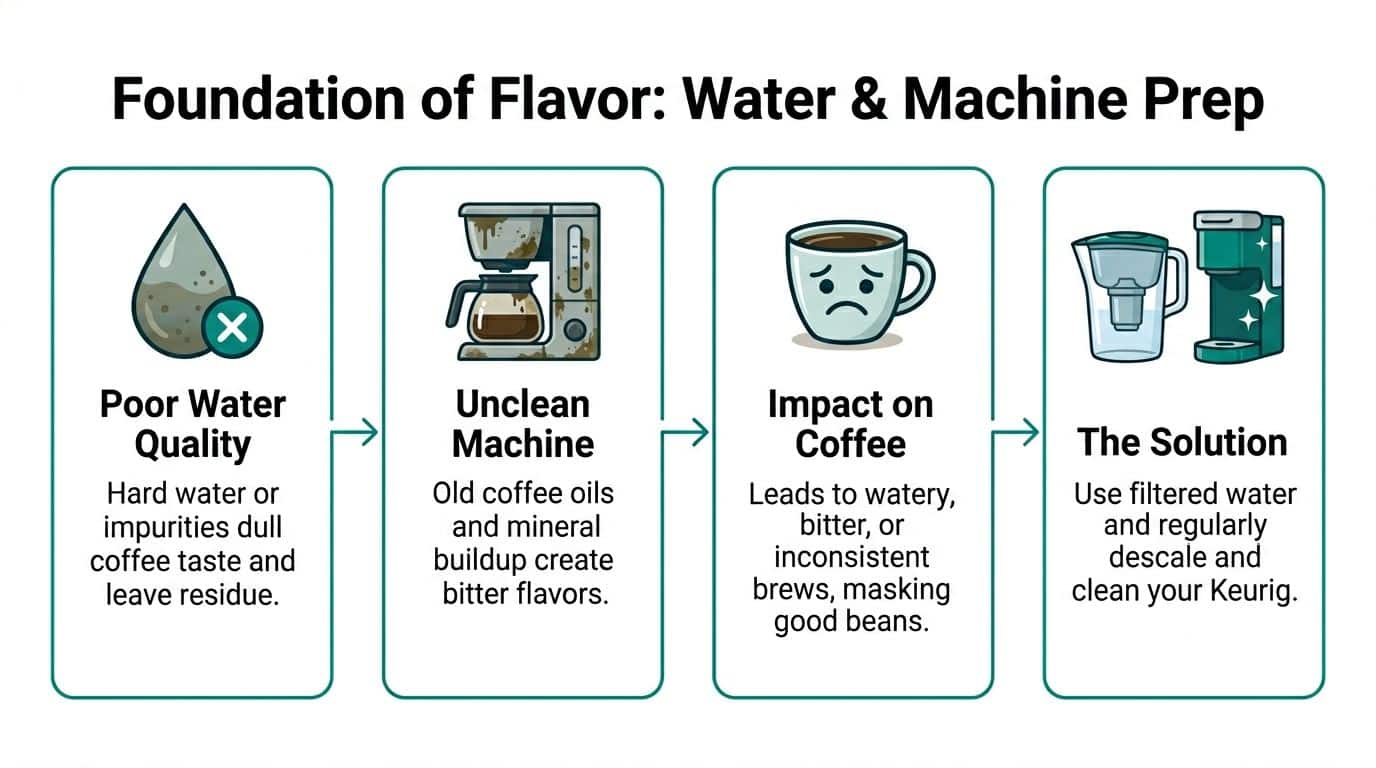
Keurig brewing relies on hot water moving under pressure through a small pod. The machine brews at approximately 192°F, but scale buildup can lower temperature and reduce water pressure, which directly causes weak coffee. In hard water areas, that can lead to a 30% failure rate without monthly descaling, according to this breakdown of how Keurig brewing works and why scale matters.
What bad water does to a small brewer
Hard water leaves mineral deposits behind. Those deposits collect where you do not see them first: internal lines, heating components, and needles.
The result shows up in the cup:
- Lower brew heat means under-extraction.
- Reduced pressure means uneven flow through the pod.
- Mineral-heavy taste can make coffee seem chalky or harsh.
- Old residue inside the machine adds stale bitterness.
If you want a broader primer on best water for coffee, that piece does a good job explaining why filtered water often gives a cleaner-tasting result than untreated tap water.
Descaling fixes more than people expect
When someone says their Keurig suddenly makes weak coffee, I check maintenance before I look at the coffee itself. Scale is one of the biggest hidden causes of bad k cup brewing.
A practical routine looks like this:
- Empty the reservoir and remove any pod.
- Run a descaling cycle using a descaling solution made for coffee machines.
- Let the solution work through the system instead of rushing the process.
- Flush with fresh water until the tank runs clean and odor-free.
- Wipe external parts and needles carefully so old coffee residue does not keep contaminating the cup.
A step-by-step visual guide helps if you have not done this before. This walkthrough on how to descale a Keurig covers the sequence clearly.
If your coffee went weak all at once, descale first. It often fixes the problem faster than changing beans, grind, or brew size.
Filtering is preventive, not optional
Descaling repairs buildup after it forms. Filtration helps slow the problem before it starts.
Charcoal water filters help reduce chlorine and other taste issues that can show up even when your brewer is technically working. They also make it easier to keep flavor consistent from cup to cup.
For people who brew daily, the most useful combination is simple:
- Filtered water for daily use
- Regular descaling
- Quick rinsing of removable parts
- Occasional cleaning of the pod holder and exit needle area
This is also the right place to add maintenance extras that support the system without overcomplicating it. A universal descaling solution and replacement water filters are not glamorous purchases, but they solve the boring problems that sabotage coffee flavor.
What works and what does not
Some fixes sound smart but do very little.
| Approach | What happens in practice |
|---|---|
| Using better beans in a dirty machine | Flavor improves a little, then gets masked by scale and residue |
| Brewing hotter or stronger without cleaning | The machine still struggles with flow and heat loss |
| Switching to filtered water only | Good start, but existing buildup still hurts performance |
| Descaling and filtering together | Restores baseline performance and improves cup consistency |
A clean brewer gives you a fair shot at good extraction. Without that baseline, every other change becomes guesswork.
Unlock Savings and Flavor with Reusable K Cups
Disposable pods are easy. They are also limiting.
Reusable pods give you control over coffee choice, strength, freshness, and waste. They can also save real money. According to Barista Life Co., switching to reusable K-Cups can produce 70-80% cost savings compared with disposables, but technique matters. The same guide says a medium-fine grind and 1.5 to 2 tablespoons of coffee are the key range, and overpacking leads to a 40% failure rate from clogs and overflow in reusable setups: setup guide for reusable K-Cups.
That is the trade-off. Reusables are cheaper and more flexible, but they punish sloppy habits.
Grind is where most cups go wrong
A reusable K-Cup does not forgive the wrong grind.
Too fine, and the mesh clogs. Water struggles to pass through, pressure rises, and the cup can taste bitter, muddy, or incomplete. Too coarse, and water runs through too quickly, leaving the coffee weak.
For most Keurig-style reusable pods, medium-fine is the safe starting point. Not espresso-fine. Not drip-coarse.
If you grind at home, aim for a texture that feels a little finer than standard drip coffee. If you buy pre-ground coffee, look for something in the middle range instead of the finest grind on the shelf.
Dosage matters more than people think
Most bad reusable brews come from overfilling.
A reusable pod needs enough coffee to create resistance, but it also needs headspace so water can spread through the grounds instead of blasting one channel straight through the middle.
Use 1.5 to 2 tablespoons as your working range. If your last cup tasted weak, adjust slightly before you jump to a completely different coffee.
A few practical rules help:
- Fill evenly: Keep the bed level rather than mounded.
- Do not cram extra grounds in: More coffee often creates worse extraction, not stronger coffee.
- Match fill to cup size: Smaller brew sizes usually produce a fuller cup.
Tamp lightly, not aggressively
Tamp lightly, not aggressively. People often borrow espresso habits that do not belong in Keurig brewing.
A reusable pod benefits from an even fill and a gentle settling of the grounds. It does not need a hard press. Heavy tamping restricts flow, especially in smaller mesh pods.
Consider this: You are creating a stable bed, not a compressed puck.
In a reusable K-Cup, a light, even tamp helps water move through the coffee. A hard tamp often creates the exact weak-or-bitter cup people are trying to avoid.
Here is a helpful visual if you want to see refillable pod use in action:
A simple routine that works
When someone wants fewer variables, I suggest this sequence:
- Start with a clean machine and fresh water.
- Fill the reusable pod with 1.5 to 2 tablespoons of medium-fine coffee.
- Level the grounds.
- Press lightly, only enough to settle the bed.
- Brew a smaller cup size first if you want stronger flavor.
- Adjust one variable at a time.
That last point matters. If you change grind, dose, cup size, and coffee origin all at once, you will not know what fixed the problem.
Easy cleanup makes reusables more realistic
Cleanup is one reason people drift back to disposables. Paper liners can help because they make spent grounds easier to dump and can reduce fine sediment in the cup. They also help standardize the fill shape a little, which can improve consistency.
For people comparing pod options and cleanup methods, this article on reusable coffee pods is a useful reference.
What works and what wastes coffee
| Habit | Result |
|---|---|
| Medium-fine grind and moderate fill | Better flow and more even extraction |
| Packing the pod to the top | Clogs, overflow, or weak brewing |
| Brewing huge cup sizes with the same fill | Thinner flavor |
| Making small changes one at a time | Faster troubleshooting |
Reusable pods reward precision. Not perfection. Once your grind, fill, and brew size line up, k cup brewing gets cheaper, cleaner, and much more satisfying.
Not All Reusable Pods Are Created Equal
A lot of people decide reusable pods do not work after one bad experience with a cheap one.
That reaction makes sense. A poor pod leaks, flexes, fits loosely, or lets grounds through. Then the machine gets blamed. In reality, the pod often failed first.
A frequent complaint is the lid popping open or leaking during the brew cycle. The iFixit thread on that issue notes that 70% of searches for "reusable K-cup leaking" go unresolved, which shows how often users hit the same problem without getting a real fix: reusable K-Cup rim opens during brewing.
The biggest objection is leaks
Leaks are not a small annoyance. They ruin extraction.
When the seal fails, pressurized water escapes where it should not. That means less contact with the coffee bed, more mess in the pod holder, and a weaker cup. Generic plastic pods are especially frustrating because they may fit loosely, warp with heat, or use flimsy hinges and lids.
A better pod usually addresses four things:
- Rigid body construction
- A lid that closes securely
- Mesh fine enough to hold back sediment
- Fit that matches the brewer properly
PureHQ Stainless Steel vs. Generic Plastic Reusable K-Cup
| Feature | PureHQ Stainless Steel Pod | Generic Plastic Pod |
|---|---|---|
| Material | Stainless steel body designed for repeated use | Plastic body that may flex or wear faster |
| Lid security | Built for a tighter, more stable closure | Often the weak point in leak complaints |
| Filter performance | Fine mesh intended to balance flow and sediment control | Mesh quality varies widely |
| Cleaning | Easier to rinse thoroughly without holding odors as easily | Can stain, retain oils, or feel rough over time |
| Fit consistency | Made for specific brewer compatibility ranges | Fit can be inconsistent across models |
| Common user frustration | Usually about dialing in grind and fill | Often starts with leaks, grounds, or poor sealing |
Cheap pods can create fake brewing problems
A bad reusable pod creates symptoms that look like machine problems:
- Weak coffee from bypass and poor sealing
- Grounds in the cup from coarse mesh or poor assembly
- Overflow or partial brew from misfit parts
- Mess under the lid from pressure escaping upward
This is why "just buy any reusable pod" is bad advice. The pod is part of the brew chamber. If it does not hold shape under pressure, your technique barely matters.
If your reusable pod leaks, do not keep changing coffee. Fix the hardware first.
When paying more makes sense
This is one of the few coffee accessories where build quality changes the result in the cup. A durable stainless steel pod with a better seal usually costs more than a thin plastic generic, but it is solving a specific failure point.
That matters most if you have already dealt with:
- lids that pop open
- grounds slipping into the mug
- pods that do not sit right in the holder
- inconsistent brews with the same coffee and fill
If your objection is durability or fit, that is a fair objection. Reusable pods are only worth it when they seal reliably and clean up without hassle. A well-made pod removes friction. A generic one adds it.
Fine-Tuning Your Brew and Solving Common Issues
Once the machine is clean and the pod is solid, the remaining work is mostly small corrections.
K cup brewing becomes interesting at this point. Tiny changes in heat, fill, and cup size can shift a cup from flat to balanced.
Preheat before the first real brew
A common issue with reusable pods is the first cup coming out weak even when everything else looks right. One reason is temperature loss. Troubleshooting guidance collected by Francesco's Coffee notes a 10-15°F temperature drop in the first brew cycle with a reusable pod, and that drop can cause under-extraction. The same source also notes that some 2026 Keurig models have strong-brew sensors that react badly to inconsistent reusable pod fills, which can trigger incomplete cycles: Keurig hacks for weak coffee and reusable pod issues.
The simple fix is to run a water-only cycle first.
That warms the internal path, the cup area, and part of the brew chamber before coffee enters the equation. In offices or kitchens where the machine sits idle for a while, this matters even more.
Use cup size strategically
If your coffee tastes thin, the first adjustment should usually be brew size, not more grounds.
Smaller cup settings generally give water less room to dilute the extraction. If your current setup tastes weak, brew the same pod at a smaller size before changing the coffee dose.
The strong button can help too, but it works best when the pod is filled consistently. On newer machines that react to reusable pod inconsistency, a careful fill or paper liner can make the cycle more stable.
Fixing the most common complaints
Grounds in the cup
This usually points to one of three things:
- the grind is too fine and slipping through
- the pod mesh is poor quality
- the pod was overfilled and grounds shifted upward
Try a slightly less fine grind first. If that does not fix it, inspect the pod itself.
Coffee still tastes weak
Check these in order:
- Run a preheat cycle.
- Brew a smaller cup size.
- Make sure the reusable pod is not underfilled.
- Confirm the machine is clean and flowing properly.
If the flavor leans sharp or unpleasantly bright instead of just weak, this guide on why your coffee might taste sour gives a good flavor-based way to think through extraction issues.
Incomplete cycles or odd errors
Machines that use pod recognition or more sensitive brew controls can dislike loosely packed reusables. Keep the fill level even. Do not leave a lopsided mound. Paper liners can help standardize shape and reduce stray grounds near the rim.
When troubleshooting, change one thing per brew. If you change size, fill, and grind at once, you lose the trail.
A practical tuning sequence
| Problem | First fix | Second fix |
|---|---|---|
| Weak first cup | Run a water-only preheat cycle | Brew a smaller size |
| Grounds in mug | Adjust grind slightly coarser | Check pod mesh and fill level |
| Incomplete brew | Level the fill carefully | Try a liner for consistency |
| Bitter cup | Reduce overfilling | Check whether the grind is too fine |
Most Keurig issues are not mysterious. They are small system mismatches. Once you learn the pattern, the fixes become quick.
Your K Cup Brewing Questions Answered
Single-serve coffee stuck because it solved a real need. The K-Cup market grew from 1.8 million machine sales in 2008 to 11.6 million by 2013, and pod sales reached $3.6 billion by 2014, according to Ohio State's summary of the category's rise: how K-Cups transformed coffee consumption. That scale explains why so many people now want better answers for daily brewing, not just more pods.
The good news is that strong k cup brewing is usually a maintenance-and-technique issue, not a mystery.
Can I brew tea or hot cocoa in a reusable K-Cup
You can brew loose tea or powdered mixes in a reusable pod, but results vary.
Tea works better than thick cocoa powder because water can move through leaves more predictably. Cocoa mixes can clump and leave residue behind. If you do this, clean the pod right away so flavors do not carry over into coffee.
How do I clean a stained stainless steel pod
Rinse it as soon as possible after brewing. Letting oils and fines dry onto the mesh makes cleanup harder.
For a deeper clean:
- Rinse immediately: Knock out grounds and wash with warm water.
- Brush the mesh gently: Use a soft brush, not something that can deform the screen.
- Soak when needed: A short soak in a coffee-safe cleaning solution helps loosen oils.
- Dry fully: Moisture left in the hinge or rim can create stale smells.
How often should I replace my water filter
Replace it on a regular schedule based on how often you brew and the quality of your local water. Heavier use and poorer water call for more frequent replacement.
The easiest rule is practical, not obsessive. If coffee starts tasting dull again and the machine is otherwise clean, check the filter before you start changing beans.
Can reusable pods really make better coffee than disposable ones
Yes, they can. Not automatically, but absolutely.
Reusable pods let you choose fresher coffee and adjust the strength around your taste instead of accepting whatever a sealed disposable gives you. The trade-off is that you have to get the grind, dose, and fit right.
Why does the same coffee taste different on different days
Usually because one part of the system changed:
- the machine sat idle and brewed cooler on the first run
- the fill level drifted
- the grind changed slightly
- the brewer needs cleaning
- the water quality shifted
That is why the total-system approach works. It gives you a repeatable routine instead of random trial and error.
Is a reusable pod worth it if I only brew one cup a day
For many people, yes.
If you care about reducing waste, choosing your own coffee, and cutting the cost of daily brewing, a reusable pod still makes sense at one cup a day. It matters even more if you already buy ground coffee you like and want your Keurig to stop forcing a compromise.
What gives the biggest improvement in the cup
If I had to put the fixes in order, I would do this:
- Clean and descale the machine
- Use better water
- Use a well-fitting reusable pod
- Dial in grind and fill
- Adjust cup size and preheat routine
People often start with the coffee because it feels intuitive. Better cups usually start one step earlier.
A Keurig is not a precision café brewer, but it does not have to make bad coffee. When water quality, machine condition, and reusable pod technique line up, the machine becomes much more predictable. That predictability is what saves money, reduces waste, and makes the cup taste good enough that you stop second-guessing every brew.
If you want to improve your whole setup instead of chasing one-off fixes, shop PureHQ Inc. for reusable K-Cups, water filters, descaling supplies, and maintenance accessories that support cleaner, more consistent single-serve brewing.

