
Coffee Machine Care
Water Filter System for Home Types Costs and Smart Choice
Sep
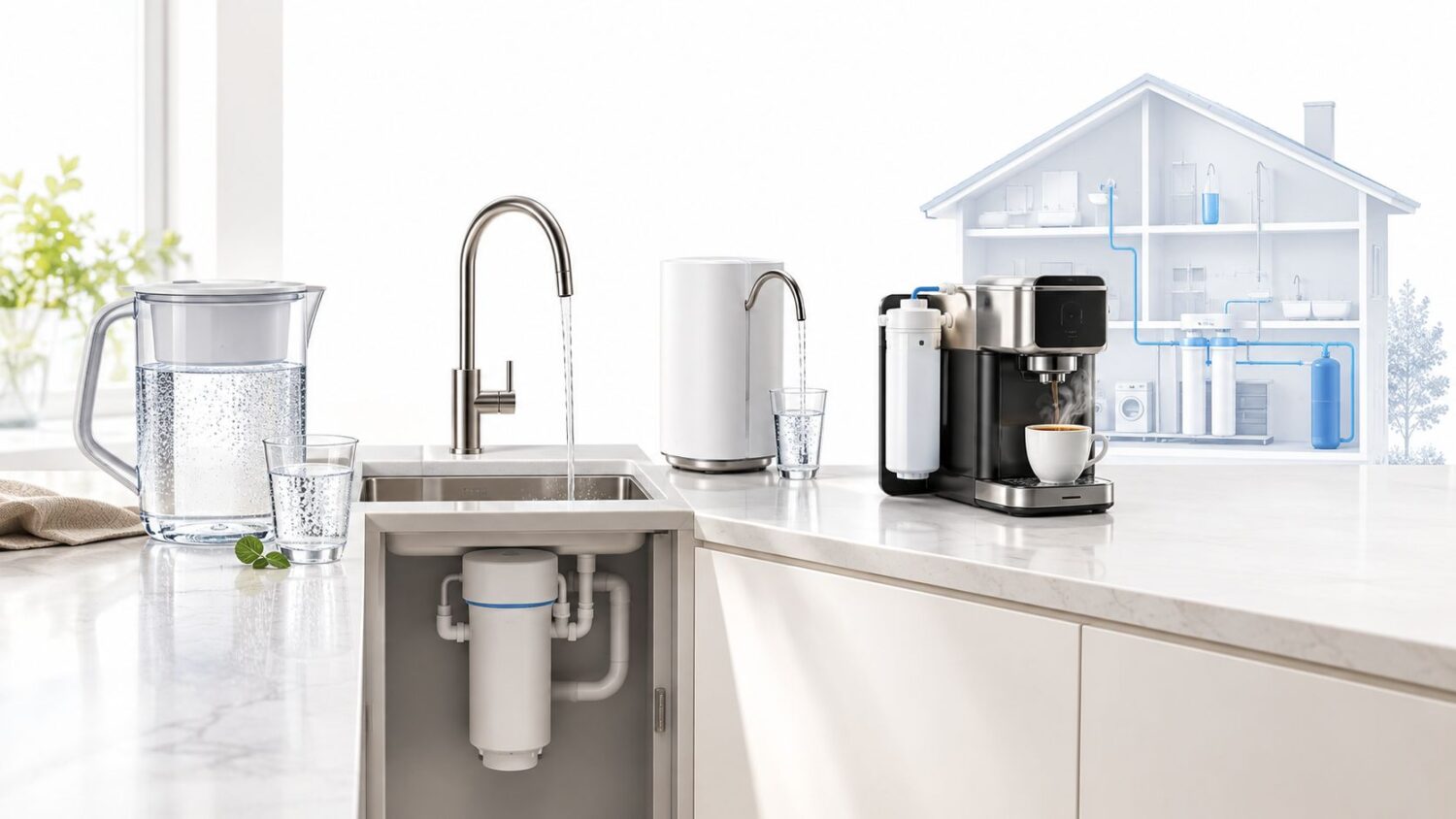
A glass of tap water can taste fine and still leave you guessing about what your water filter system for home removes. That uncertainty explains why filtration has moved from a niche appliance to a normal kitchen habit. A March 2022 survey of 2,246 U.S. adults found that 77% used a water filter at home, compared with 73% in 2020, while 69% considered filtering tap water necessary, according to the U.S. Department of Health and Human Services survey summary.
The problem isn't a lack of options. It's choosing a pitcher, refrigerator cartridge, under-sink unit, or coffee-maker filter without first identifying the contaminant that matters. This guide starts with that question, then connects filter format, certification, maintenance, ownership cost, and coffee-machine compatibility so you can buy with evidence instead of relying on price or vague claims.
Why Home Water Filtration Matters Right Now
A chlorine smell from the kettle, concern about aging plumbing, or the wish to avoid bottled water can all lead households to filtration. Those concerns point to the same buying question: which water filter system for home matches the water problem, daily volume, and appliance setup?
Roughly three in four U.S. adults were already using home filtration by 2022, with refrigerator and pitcher filters among the common choices in the survey summarized by HHS. The pattern reflects more than taste. Filtration gives households a routine way to manage perceived safety, convenience, and control over tap water.
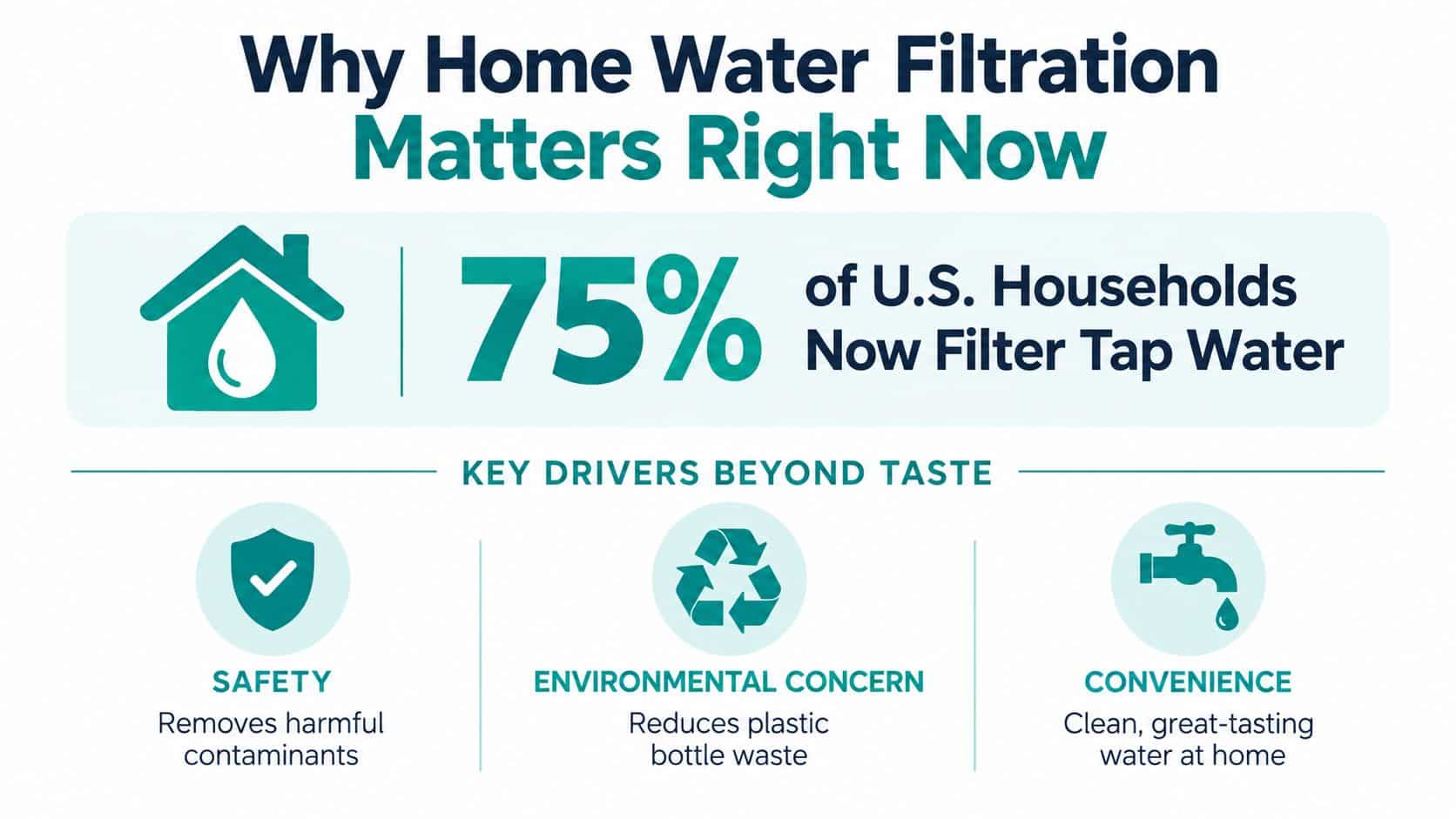
Key idea: Choose the filter that targets your actual contaminant concern and can stay properly maintained.
Filtration is not a single all-purpose solution. A cartridge may improve chlorine taste while leaving another contaminant unchanged, much like a sieve catches pasta but cannot remove dissolved salt. That difference matters for coffee, where brewing makes water chemistry easier to taste, and for safety, where “improves water quality” does not identify a tested contaminant.
Start with the risk, then check the certification for that specific contaminant. After that, compare the filter format with your household's water use and coffee maker. A pitcher may suit occasional brewing, while a plumbed system may better match higher demand, provided its treated water works with the machine. For a brewing-focused explanation, see this guide to pitcher filtration and lead removal for safer, better coffee. Ownership cost also includes replacement cartridges and maintenance across the system's service life.
How Home Water Filtration Evolved Into Modern Systems
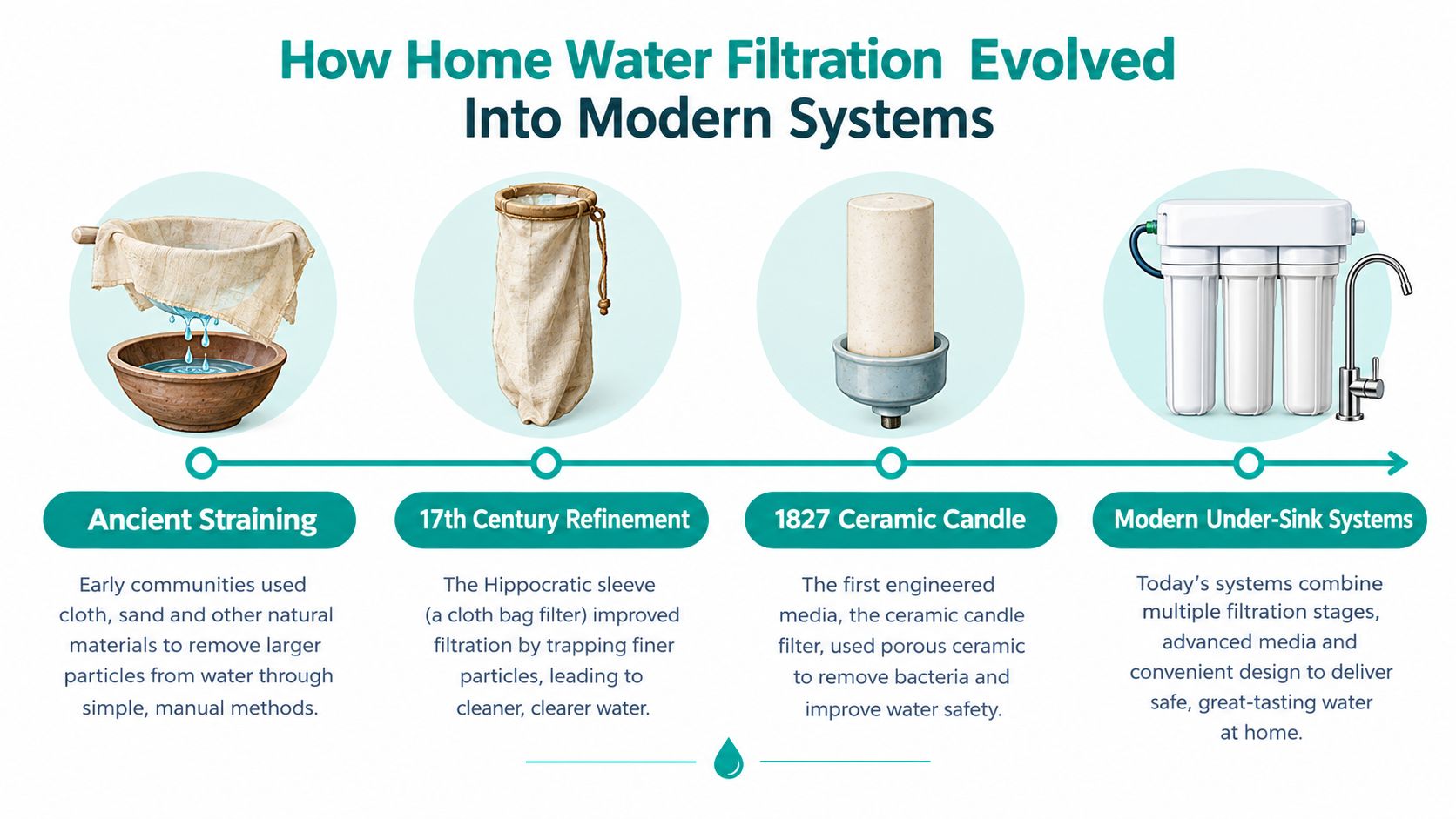
Early filtration addressed a visible problem: separating particles from water. Cloth worked like a kitchen strainer. Hippocrates is commonly credited with using a cloth device around 500 BC, later called the Hippocratic sleeve, to strain water. It could catch suspended material, but it could not handle dissolved substances or perform the jobs assigned to modern filtration media.
A major development followed in 1827, when John Doulton and his son Henry developed a ceramic water filter intended to help remove bacteria. The history and market overview from Grand View Research places these milestones within the longer development of practical household filtration materials.
Three jobs that happen inside a filter
Physical straining works like a kitchen sieve. A porous barrier blocks particles too large to pass through its openings, helping reduce sediment and some particulate matter. Dissolved substances need another mechanism.
Adsorption lets activated carbon capture certain compounds on its surface as water flows through. This can reduce chlorine-related taste and odor, while other contaminant claims depend on the specific cartridge.
Certified reduction connects the filter's design to evidence. An independent standard evaluates the complete system against a defined performance requirement. That certification matters because a material that seems capable of removing something does not automatically support a tested claim.
Modern systems can combine sediment barriers, carbon media, membranes, and other stages. More stages do not automatically make a system suitable for a particular home or coffee maker. Each stage should address a known water concern, and the complete unit should carry certification for the contaminant being targeted.
The market's growth reflects the shift from basic straining to engineered household equipment. One estimate placed the global home water filtration unit market at USD 20.26 billion in 2024, projecting USD 50.89 billion by 2033 and an 11.2% CAGR from 2025 to 2033. Those figures describe commercial scale, not the right choice for an individual kitchen. For homeowners, the practical lesson is simpler: match the treatment method and certification to the actual contaminant risk, then confirm that the treated water suits the coffee maker before comparing ownership costs.
Types of Home Water Filter Systems and What Each Does Best
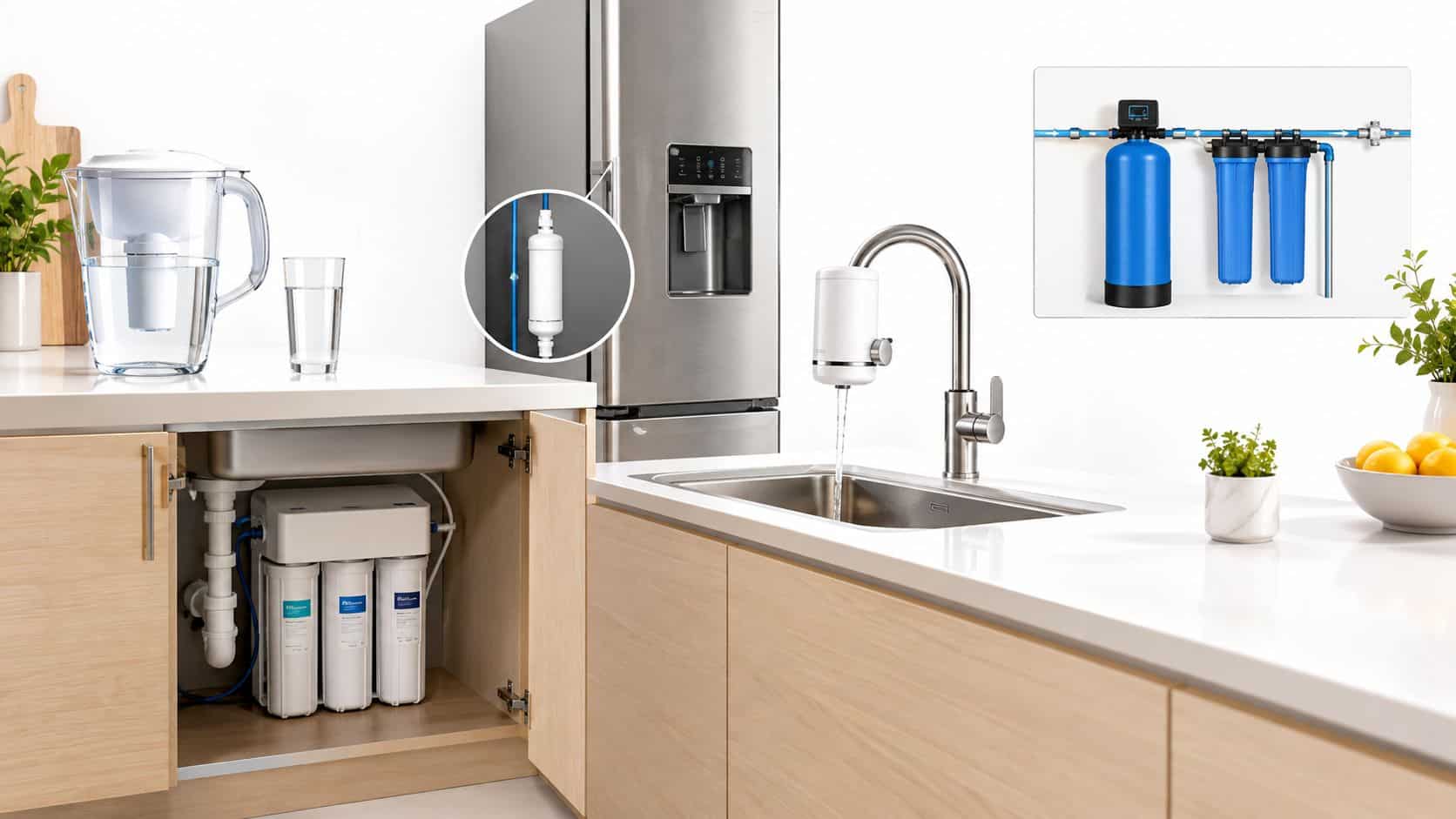
A filter format determines where treatment happens. A point-of-use system treats water at one faucet, pitcher, refrigerator dispenser, or coffee machine. A whole-house system treats incoming water before it reaches multiple fixtures, which is closer to protecting the home's front door than placing a purifier beside one drinking glass.
Pitchers and refrigerator filters
A pitcher uses gravity to move water through a cartridge and into a storage chamber. It suits renters, smaller households, and anyone who wants a no-installation starting point. The trade-off is limited reservoir capacity and the need to remember refills.
A refrigerator filter puts the same basic convenience inside the appliance. It supplies chilled water and can improve taste and odor, but its scope depends entirely on the cartridge's claim. A refrigerator filter that reduces chlorine isn't automatically a lead or PFAS filter.
Faucet-mounted and inline systems
A faucet-mounted filter treats water as it leaves the tap. It offers quick access for drinking, cooking, and filling a coffee reservoir, but the compact design can limit both capacity and contaminant coverage.
An inline filter connects to a dedicated water line, often serving a refrigerator or coffee appliance. It keeps the counter clear and can provide filtered water without a separate pitcher. Before buying, check the connection, cartridge dimensions, flow direction, and the exact appliance compatibility statement.
Countertop and under-sink systems
A countertop unit gives you more capacity without placing equipment inside the cabinet. It can suit renters or kitchens where drilling and plumbing changes aren't practical, although it occupies valuable counter space.
An under-sink system hides the main housing and may feed a dedicated faucet. This arrangement works well for households that use filtered water for drinking, cooking, and brewing throughout the day. A reverse-osmosis design may address a broader contaminant range, but the buyer still needs to verify the system's certification rather than infer performance from the number of stages.
The distinction between softening and filtration often causes confusion. A water softener addresses hardness-related concerns, while an anti-scaling device aims to manage scale behavior. A practical homeowner water softener guide can help if mineral hardness, not drinking-water contamination, is the main issue.
This short video offers another visual explanation of household filtration layouts:
Whole-house systems
A whole-house unit treats water at the point where it enters the property. It makes sense when the concern affects showers, laundry, and multiple fixtures, not only drinking water. Installation, sizing, and maintenance become more involved, so the system should follow a tested water problem rather than a general desire for “more filtration.”
What Filters Actually Remove and How Certification Proves It
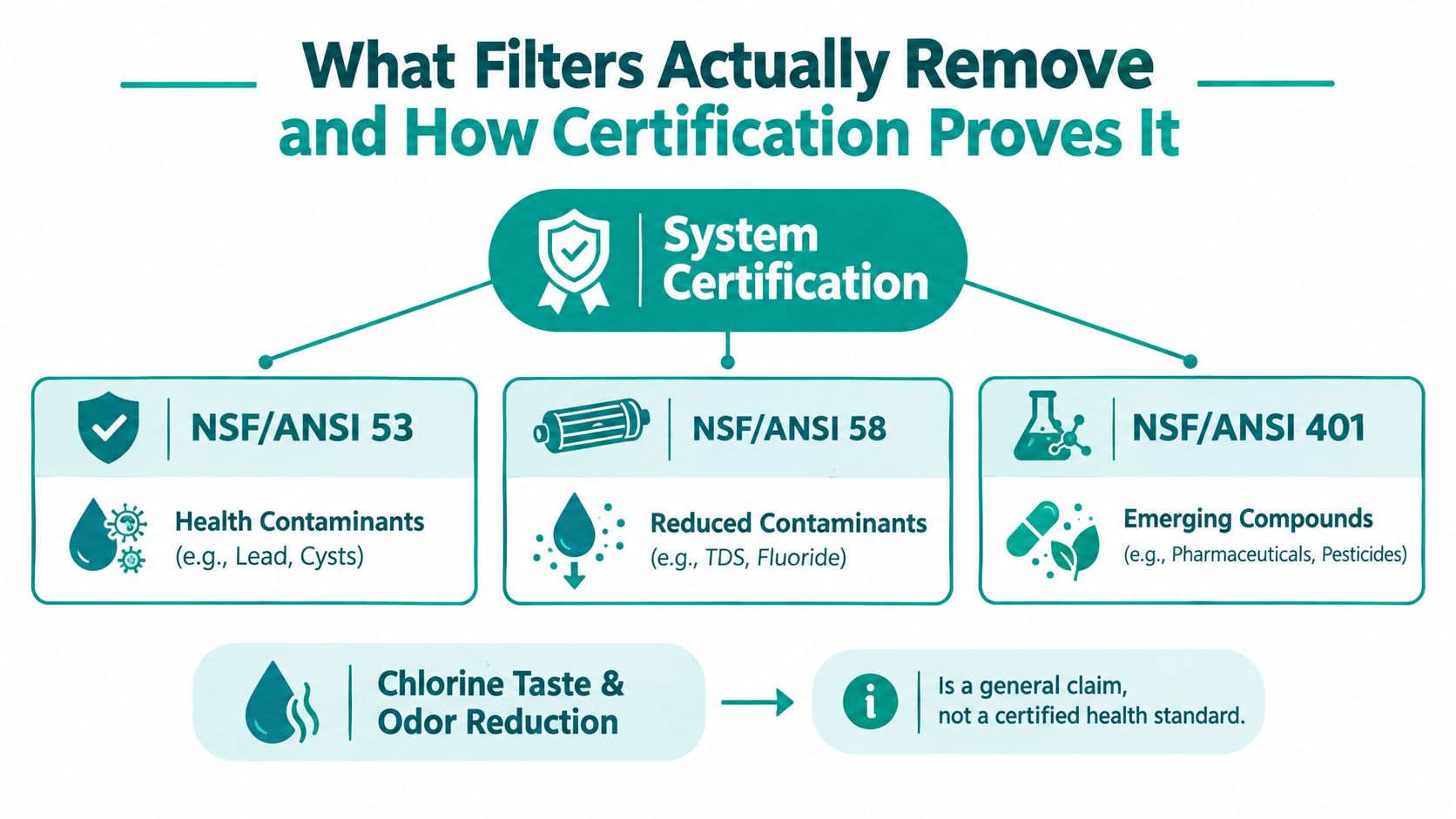
A filter's format shows where it works. Its certification shows what the complete system has demonstrated. The NSF water-treatment FAQ describes certification as a pass-or-fail evaluation at the system level. The assembled unit must reduce every claimed contaminant to the required performance under the applicable standard.
Lead illustrates why the exact claim matters. Under NSF/ANSI 53, the benchmark reduces 150 parts per billion of influent lead to less than 5 parts per billion in filtered water. Post-2019 NSF/ANSI 53 lead testing tightened the benchmark from no more than 10 micrograms per liter to no more than 5 micrograms per liter under specified challenge waters, according to NSF.
Read the standard beside the contaminant
NSF/ANSI 53 commonly covers health-related contaminant claims, including lead when the product carries that specific certification. NSF/ANSI 58 applies to reverse-osmosis systems and the reduced-contaminant claims associated with that technology. NSF/ANSI 401 addresses emerging compounds when the system has the relevant claim.
Activated carbon often improves chlorine-related taste and odor. The NSF's consumer explanation of water-treatment standards explains the practical limit: certification applies to the contaminant or contaminants named in the listing. A pitcher may improve taste without carrying a certified lead or PFAS claim.
PFAS needs careful label reading. The EPA guidance on PFAS-certified filters advises checking for NSF/ANSI 53 or NSF/ANSI 58 certification, then confirming the specific contaminant in the certification body's product directory. The NSF PFAS overview identifies EPA rule limits of 4.0 parts per trillion for PFOA and 4.0 parts per trillion for PFOS, plus 10 parts per trillion for PFHxS, PFNA, and HFPO-DA, also known as GenX.
Buying rule: Match the water concern to the exact certified claim. “Carbon filter” describes a material, not a universal contaminant guarantee.
Use the same method for arsenic, fluoride, and other concerns. Begin with local water-quality information or a properly selected test, then search for the contaminant in the certification listing. A view water treatment help resource can add background before you compare systems. For arsenic-specific research, keep this arsenic filtration guide beside the product certification, not in its place. This certification-first check also helps match filtration to a coffee maker, where the right contaminant claim matters more than a higher stage count.
True Cost and Maintenance Behind Every Filter System
The purchase price is only the first line of the ownership equation. A fair comparison over 12 to 36 months includes the unit, cartridges, installation, replacement reminders, and any appliance-care supplies. The exact dollar total depends on the product and household usage, so a system with a modest entry price can become less convenient if cartridges are hard to find or easy to forget.
| System Type | Upfront Cost Range | Cartridge Replacement Frequency | Key Maintenance Task |
|---|---|---|---|
| Pitcher | Varies by model | Follow the cartridge label and usage guidance | Wash the reservoir and replace the cartridge on schedule |
| Faucet-mounted | Varies by model | Follow the cartridge label and usage guidance | Inspect the mount, connections, and flow |
| Refrigerator or inline | Varies by model | Follow the appliance or cartridge guidance | Use the compatible cartridge and reset or monitor the indicator |
| Countertop | Varies by model | Follow the certified system instructions | Clean the housing and track usage |
| Under-sink | Varies by model | Follow each stage's replacement guidance | Check tubing, fittings, and cartridge seating |
| Whole-house | Varies by model | Follow the system and water-load guidance | Service the housing and prefiltration components |
The EPA maintenance guidance says cartridges wear out and become less effective with use. Replace them on time, use the compatible cartridge, and track the indicator light or the days or gallons used when the system has no built-in reminder.
Why replacement timing changes value
Certification describes tested performance under specified conditions. A cartridge that has exceeded its service guidance may no longer deliver that performance consistently. Delayed replacement can also affect flow and taste, turning a technically suitable system into a frustrating daily appliance.
A useful ownership worksheet should record four items:
- Initial equipment: Include the housing, faucet, adapter, or installation parts.
- Consumables: Count every cartridge required by the system, not only the first filter.
- Care products: Coffee-machine owners may also need descaling solution and cleaning tablets to manage appliance upkeep.
- Reminder method: Record the installation date, meter reading, or indicator status.
For coffee makers, compatible replacement cartridges, descaler, and cleaning tablets belong in the same maintenance plan. The water filter jug price guide can help you compare the recurring side of pitcher ownership, but the same principle applies to every format: predictable replacement habits matter more than an impressive feature list that you don't maintain.
How to Choose the Right System for Your Home and Coffee Maker
A filter should match the contaminant you need to reduce, the amount of water your household uses, and the coffee maker's reservoir. Start with the water problem, not the product category. For lead, look for the exact NSF/ANSI 53 lead claim. For PFAS, consult the certification directory and verify the relevant NSF/ANSI 53 or 58 listing for the specific contaminant. If taste or odor is the concern, a certified chlorine-reduction claim may be sufficient.
Use this decision path:
- Identify the source. Check local water information, then test when available data does not answer your concern.
- Name the contaminant. Separate chlorine taste, hardness, sediment, lead, PFAS, and other concerns instead of grouping them as “bad water.”
- Verify the certification. Search the certification body's directory and read the contaminant-specific claim.
- Choose the delivery point. A pitcher or refrigerator cartridge may suit light kitchen use. An under-sink system handles higher daily demand. Whole-house treatment addresses broader property-wide concerns.
- Calculate upkeep. Compare cartridge access, replacement reminders, installation requirements, and the ownership window you can afford.
Coffee makers require a second compatibility check. A Keurig K-Classic, Keurig 2.0, K-Supreme, K-Slim, or K-Duo needs a cartridge and holder designed for its reservoir and filter assembly. The same rule applies to compatible Ninja DualBrew models and Breville espresso machines that use in-tank charcoal filters.
Fit affects more than whether the cartridge slides into place. A matched filter should seat securely, let the reservoir lid close, and preserve the intended water path. A cartridge made for another holder can cause poor flow, bypass, or leaks, even when its filter media appears suitable.
Coffee-maker check: Confirm the exact model family, holder style, cartridge dimensions, and replacement instructions before ordering.
For the true ownership cost over 12 to 36 months, include the system, cartridges, and any coffee-machine care products. Filtered water can improve brewing, but it does not replace descaling or cleaning removable parts. Replace the cartridge according to its guidance so the machine and filter continue working together.
Premium Versus Standard Filters and Your Next Step to Cleaner Water
A premium cartridge earns its place through clear compatibility, traceable claims, secure fit, and a manageable replacement routine, not through packaging alone. A standard or generic cartridge may cost less initially, but unclear certification, inconsistent dimensions, or weak instructions can create the exact problems buyers want to avoid.
| Buying factor | Premium compatible filter | Standard or generic alternative |
|---|---|---|
| Certification clarity | States the applicable contaminant claim when available | May rely on broad quality language |
| Fit | Designed for named appliance families | May use general compatibility wording |
| Durability | Uses a cartridge and holder intended for repeated handling | Materials and fit can vary |
| Taste consistency | Supports a regular replacement routine | Results may change when replacement is delayed |
| Support | Product guidance and compatibility information | Instructions may be limited |
Leaks usually come from a mismatch, incomplete seating, damaged seals, or an incompatible holder. Before blaming the filter, confirm that the cartridge matches the appliance, the holder is fully engaged, and the reservoir connection is clean. Replacing a cartridge on schedule also protects flow and taste, while descaling solution and cleaning tablets support the machine around the filter.
PureHQ Inc. offers compatible water filters for Keurig families including K-Classic, 2.0, K-Supreme, K-Slim, and K-Duo, along with options for compatible Ninja DualBrew models and Breville in-tank charcoal filtration. Its range also includes maintenance supplies for coffee machines, so you can plan filtration and appliance care together.
Choose the cartridge that matches your exact coffee maker and contaminant goal, then build a replacement routine around it. Visit PureHQ Inc. to shop compatible filters, descaling solutions, cleaning tablets, and other coffee-machine accessories for cleaner-tasting brews and simpler home maintenance.

