
Coffee Machine Care
Water Filters That Remove Arsenic: Technology Guide 2026

Aug
A filter can look convincing on a product page and still leave your water above the modern arsenic limit. That's the problem homeowners run into most often, because arsenic is invisible, and the wrong filter can remove part of it without making the water safer.
The standard changed in a way that matters for every household using a well or a private treatment setup. Since 2001, the U.S. drinking-water limit moved from 50 ppb to 10 ppb, and that shift raised the bar for what counts as real protection (Hanchett 2011). If you're comparing water filters that remove arsenic, the big question isn't just whether a unit “works,” it's whether it works for your arsenic chemistry and keeps working over time.
Why Arsenic Filtration Standards Changed Everything
The biggest change in arsenic filtration was a stricter drinking-water limit. When the United States lowered the acceptable limit from 50 ppb to 10 ppb in 2001, it changed what homeowners should expect from a filter. A unit that once seemed acceptable could still leave water above the modern limit, even if it removed a meaningful share of arsenic (Hanchett 2011).
Partial removal is not the same as protection
A field study of 794 paired samples from household arsenic filters found that 546 samples, or 69%, came from raw water above 50 ppb. The same study reported a median arsenic reduction of 97% overall, but the treated water still varied by device, with median filtrate levels ranging from 0 ppb to 15 ppb. That spread is what homeowners need to notice, because two filters can show similar reduction claims and still leave very different results at the tap.
Practical rule: If a filter leaves the final water above the current limit, it has not solved the problem, even if the reduction percentage looks impressive.
The same study also showed that some filters failing the old 50 ppb threshold were still removing about 70% of the arsenic (Hanchett 2011). That result explains why percentage claims can mislead. A high percentage reduction does not automatically equal safe drinking water, especially when the starting concentration is high.

Why certification matters more now
The lower limit made certification far more important than marketing copy. Homeowners need systems that have been validated against the right standard, not just systems that say “arsenic reduction” on the box. The standard is stricter now, so there is less room for a filter to perform only part of the job and still count as protection.
A practical takeaway is simple. If you are choosing a filter after testing your water, look for documented performance at the modern limit, not just a general promise of cleaner water. The old mindset of “some removal is better than none” still matters for reducing exposure, but it is not enough when you are trying to meet today's safety target.
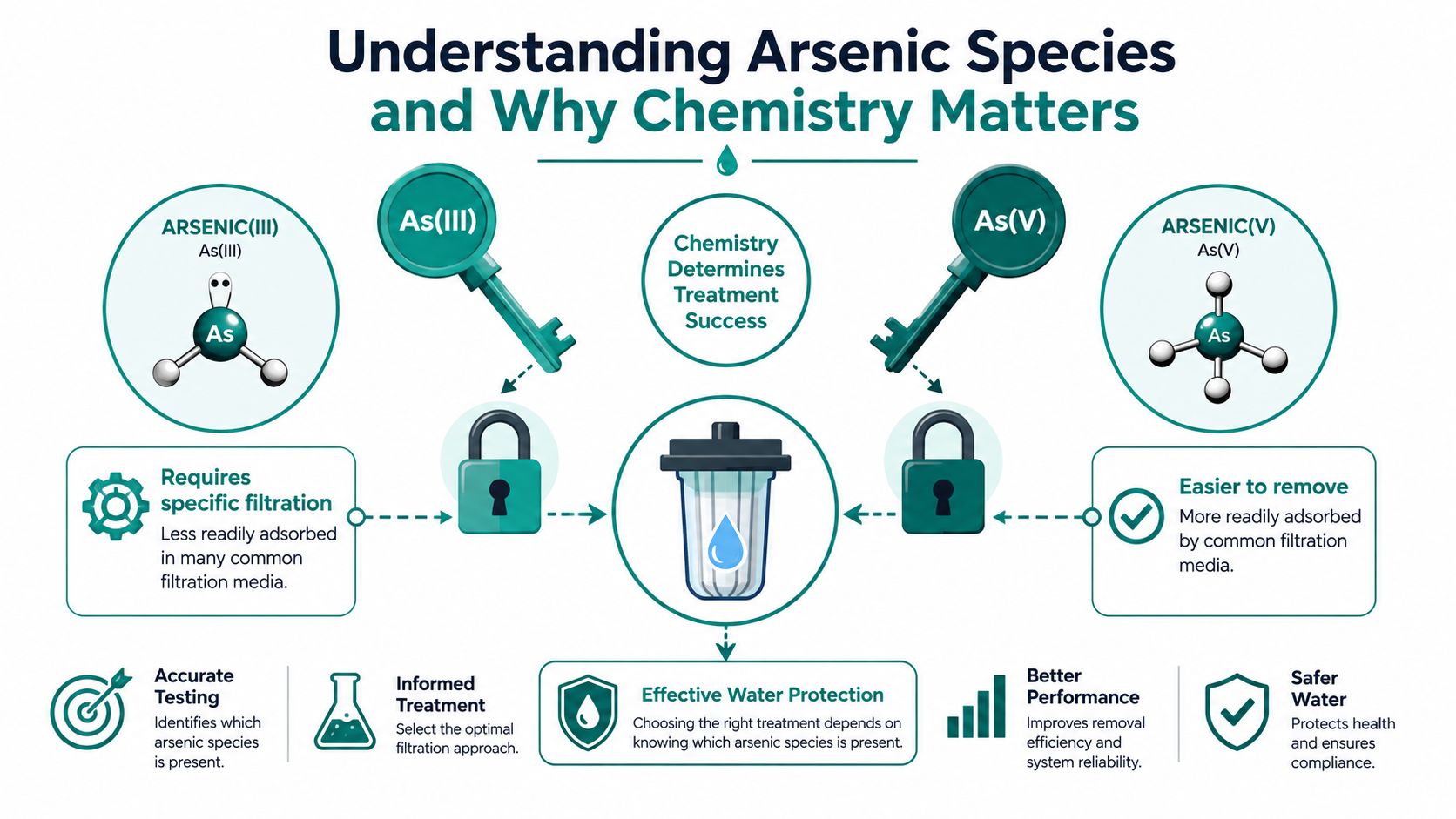
Understanding Arsenic Species and Why Chemistry Matters
Arsenic in water does not exist as one single form, and that matters more than many homeowners realize. The key distinction is between arsenic(III) and arsenic(V), because they interact with filter media differently and do not respond to the same treatment approach. Arsenic(III) and arsenic(V) require different treatment approaches because they interact with filter media differently.
Two forms, two treatment paths
Arsenic(V), also called arsenate, is the form that most treatment systems handle more easily. Arsenic(III), also called arsenite, is harder to remove and often needs a different approach before filtration works reliably (My Tap Score, Clean Water Critic). A filter can still be labeled for “arsenic reduction” and disappoint if it was tested for only one form.
Reverse osmosis is the clearest example of how chemistry changes the result. In practice, RO can be highly effective for arsenic(V), while arsenic(III) usually needs pre-oxidation before removal becomes reliable (My Tap Score). The treatment choice should come from the water report, not from the product name.
Your lab report should tell you whether the sample contains As(III), As(V), or total arsenic only. If it only shows total arsenic, ask the lab whether speciation testing is available before you buy a system.
What to look for in a test report
Start by reading the arsenic line carefully. If the report lists a single arsenic number with no species breakdown, you still have useful information, but you do not yet know which treatment path is safest. If the lab can speciate the sample, that result should guide the filter decision.
A second detail matters too. The right system has to match the chemistry of your water, not just the concentration. A product that performs well on arsenic(V) can underperform on arsenic(III) even if the packaging makes both sound equally covered (My Tap Score, Clean Water Critic).
Watch this short video if you want a plain-language walkthrough of how species and certification affect filter choice.
Comparing Filtration Technologies for Arsenic Removal
A practical choice starts with two questions, do you need one tap protected, or do you need the whole house covered, and how much maintenance will you keep up with. Those answers matter because the best system is the one that fits your daily use, not just the one that sounds strongest on paper.
How the main options differ
Reverse osmosis is still the clearest point-of-use option for many homes, especially when you want a small, dedicated drinking-water setup. Its performance can be very strong when the water chemistry and the membrane setup line up with the arsenic form in the water. In one private-well study, pre- and post-RO arsenic concentrations averaged 443 µg/L and 87 µg/L, which was an average reduction of 79% (PMC review). A separate review of 11 treatment systems found removals ranging from 2% to 90%, with a median of 65%, and about half the systems lowered arsenic below the 10 µg/L maximum contaminant level (PMC review). That range is the reason RO earns respect, but it also explains why it is not a universal answer for every home.
Adsorptive media such as ferric-based or iron-oxide-based systems are often chosen for larger-scale treatment because they can handle higher flows. Their performance is tied closely to media design, pH, flow rate, and the rest of the water chemistry. A ferric-hydroxide arsenic filter listed by Hidro Water specifies a working pressure of 2.5 to 6 bar, a maximum temperature of 40°C, pH adjustment to 6.5, and a capacity of up to 12 g As(III or V) per kg Fe(OH), which shows how tightly these systems depend on staying inside the right operating window. If the water chemistry moves outside that window, performance can drop. The same limitation appears in broader reviews of arsenic treatment, which show that media systems work best when the water is predictable and the system is maintained on schedule (PMC review).
Activated carbon pitchers and faucet filters are a poor default choice for arsenic. Ordinary carbon media is mainly designed to improve taste and reduce chlorine, so it does not give dependable protection for dissolved arsenic (Vetted Clean). A tabletop pitcher study found that only one pitcher filter tested reduced arsenic from 1,000 µg/L to 2.6 µg/L, and from 42 µg/L in well water to below detection, while the others did not show comparable removal (PubMed, ScienceDirect). That is why these products should be treated as convenience filters, not arsenic treatment.
Arsenic filtration technology comparison
| Technology | NSF Certification | Typical Removal Rate | Maintenance Frequency | Best For |
|---|---|---|---|---|
| Reverse osmosis | NSF/ANSI 58 for RO systems | Very high for the right arsenic form, especially As(V) | Regular membrane and prefilter replacement | Drinking water at one sink |
| Adsorptive media | Often NSF/ANSI 53 for non-RO arsenic reduction | Strong at the start, chemistry-dependent | Media replacement and monitoring | Whole-house or point-of-entry use |
| Activated carbon pitcher or faucet filter | Usually not arsenic-specific | Not reliable for arsenic | Cartridge changes only | Taste and chlorine, not arsenic |
| Distillation | Commonly used for dissolved contaminants | Strong, but slow | Ongoing cleaning and care | Small-volume drinking water |
| Tabletop pitcher with arsenic claim | Must be checked carefully | Highly variable by product | Frequent cartridge changes | Short-term bridge, not a long-term plan |
A buyer-oriented guide at best arsenic water filter 2026 is useful if you want to compare product categories against lab results before you spend money.
The practical takeaway is simple. Standard carbon does not solve arsenic problems, while RO and select media systems can. The best choice is the one that matches the species in your water, the flow you need, and the maintenance schedule you will follow.
Testing Your Water Before Choosing a Filter
A filter decision is only as good as the test behind it. If you skip testing, you're guessing about concentration, species, pH, and the other water qualities that change how well a treatment system performs. That's how people end up buying the wrong technology for their own well or municipal supply.
What to test and why it matters
Start with a lab test that measures arsenic concentration and, if possible, arsenic speciation. The species result tells you whether you're dealing with As(III), As(V), or both, and that shapes the whole treatment plan. A report that includes pH is also useful, because the filter media's performance can shift when water chemistry moves out of range.
If you're on a private well, sampling discipline matters. Use a clean sample bottle from the lab, follow their collection instructions closely, and don't treat the sample like a casual taste test. For municipal water, the utility's annual reporting can give a starting point, but a household test is still the cleaner way to understand what reaches your tap.
Good testing prevents bad buying. A result without species data can still help, but a result with species data tells you which systems are credible and which ones are marketing first, treatment second.
Whole-house systems need more than chemistry data. They also need flow rate, pressure, and peak demand information, because a large house can overwhelm a system that looks fine on paper. Point-of-use systems need different sizing, but they still depend on the same water chemistry details.
For homeowners who want a broader checklist around household water issues, this practical overview on how to improve water quality can help you organize the next steps after testing.

When to retest
Test before installation, then retest after the system is in service. That second test confirms the filter is doing what the paperwork promised. After that, keep monitoring on a schedule, especially if you use a private well or if the system handles changing water chemistry over time.
A final mistake to avoid is assuming one clean test means the problem is gone forever. Water sources change, wells shift, and media ages. Retesting is what turns a one-time purchase into ongoing protection.
Decoding NSF Certifications for Arsenic Reduction
Certification language can be confusing because it sounds more complete than it really is. A box may say “arsenic reduction,” but the meaningful question is whether the certification matches the filter type and the arsenic form in your water. Without that match, the claim can be technically true and still practically useless.
What NSF/ANSI 58 and 53 actually mean
NSF/ANSI 58 is the main benchmark for reverse osmosis systems. In the arsenic context, it validates pentavalent arsenic reduction from a 0.30 mg/L challenge down to below the 0.010 mg/L EPA maximum contaminant level (Vetted Clean). That's why RO systems are often the clearest choice for point-of-use protection when the water chemistry is suitable.
NSF/ANSI 53 is commonly used for non-RO systems that claim arsenic reduction. The catch is that the certification is often tied to a specific arsenic form, especially arsenic(V), rather than every form of arsenic in every water sample (My Tap Score). That distinction matters because a system can be certified and still miss the form you have.
Read the certification, not just the headline. If the system is certified for one arsenic species and your lab report shows the other, the label isn't enough.
Red flags in product claims
A vague “arsenic reduction” claim without a certification path is a warning sign. So is any product that doesn't tell you which arsenic species it addresses. If the seller can't point to the exact standard, the exact form, and the exact test basis, you're being asked to trust marketing instead of evidence.
For homeowners comparing treatment options and maintenance gear, the internal guide on water filter pitcher lead removal for safer, better coffee is useful for understanding how certification language shows up in real consumer products.
The best buying habit is simple. Match the certification to the lab report, then match the system to your daily water use. That's how you avoid paying for a filter that sounds right but isn't right for your water.
Maintenance Schedules and Replacement Indicators
Arsenic filters don't fail all at once. They lose margin first, then they lose performance, and the early warning signs are usually visible if you know what to watch. A good maintenance routine keeps a system useful long after the installation date.
What tells you a system is aging
The first warning sign is often flow change. If water pressure drops or the faucet takes longer to fill a glass, the media or cartridge may be loading up. A second sign is a calendar change, because time-based replacement still matters even when the water seems fine.
For whole-house adsorptive systems, capacity is a real limit, not a theory. One ferric-hydroxide example lists capacity up to 12 g As(III or V) per kg Fe(OH), which shows why usage, flow, and feedwater chemistry all affect service life (Hidro Water). If the incoming water chemistry is harsher than expected, the media can exhaust sooner.
Build a maintenance routine that you'll actually follow
Keep a simple log with installation date, cartridge changes, media changes, and test results. Put reminders on your calendar before the filter reaches its expected service window, not after. If the system uses prefilters, treat those as part of the arsenic setup, because clogged prefilters can reduce contact time and shorten the life of the main media.
A few habits make a difference:
- Check pressure and flow: A slower faucet or weaker shower can signal loading, scaling, or a plugged prefilter.
- Replace on schedule: Don't stretch cartridges because “the water still tastes fine.”
- Retest after changes: A post-maintenance water test confirms the system still protects you.
- Keep the whole train working: Sediment, iron control, pH correction, and arsenic media all affect each other.
The whole-house systems that rely on controlled backwash also need correct sizing and installation. As noted in the earlier comparison, undersized flow handling or out-of-range chemistry can shorten useful life faster than most buyers expect.
Using Arsenic-Safe Water with Coffee Makers
Clean water isn't just about drinking. It also matters for espresso, drip coffee, and the machines that heat water every day. If you've already solved arsenic at the tap, the next question is how that water behaves in a coffee maker, because machine compatibility and taste both matter.

What filtered water means for daily brewing
Reverse osmosis water is generally a safe choice for Keurig, Ninja, Breville, and similar brewers because it removes the contaminant concern at the source and can also reduce mineral buildup compared with hard tap water. Many coffee lovers pair RO with a remineralization stage so the water tastes better and doesn't come out flat. That combination gives you both cleaner brewing water and a more balanced cup.
Flow matters too. If your under-sink system can't keep up with a morning routine, you'll feel that immediately at the kitchen faucet. A system that serves the sink without delay is easier to live with than one that makes you wait for every cup.
Maintenance still protects the machine
Filtered water doesn't eliminate descaling, it usually makes descaling more manageable. You should still use a sensible descaling schedule for your machine, because mineral films and coffee residue can build up even when the water is cleaner than your tap supply. The best setup combines the right filter with regular maintenance so the machine performs consistently.
For readers comparing filter choices specifically for espresso gear, the guide on best water filter for espresso machine is a useful next stop.
If you're using a coffee maker every morning, choose a filter system that fits the machine's water demand, your arsenic results, and your willingness to maintain it. That's the practical sweet spot, safer water, better coffee, and fewer machine headaches.
PureHQ Inc. offers premium water filtration accessories and maintenance products that fit the same daily routines coffee drinkers already have, from reusable brewing setups to descaling support. If you want cleaner brewing water and a simpler maintenance plan for your Keurig or other coffee machine, visit PureHQ Inc. and explore the filtration and care products that match your setup.

